Get Full Government Meeting Transcripts, Videos, & Alerts Forever!
Get email alerts on the Land Use Review topic
No spam. Unsubscribe anytime.
Proposal for Northeast Development Review Board deferred after planning commission concerns; sponsor to work with staff
Summary
Council Member Mike Gay’s proposal to create a Northeast Development Review Board drew debate about duplicating the planning commission’s functions and was deferred for further work; the sponsor agreed to workshop alternatives with planning staff and council colleagues.
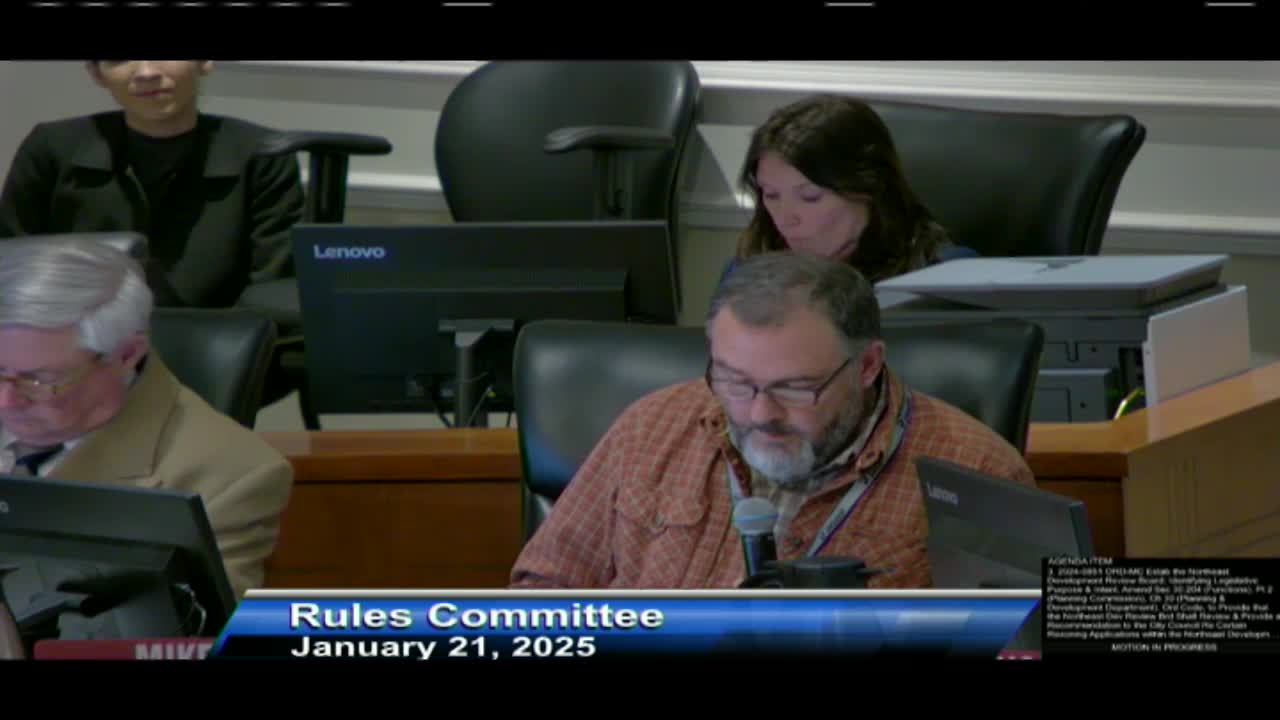
A proposal to create a Northeast Development Review Board that would review land-use and development issues in a large portion of Jacksonville’s north side was deferred by the Rules Committee on Jan. 21 after an extended discussion about overlap with existing planning processes.
Council Member Mike Gay introduced the legislation as a way to give the Northside’s unique mix of wetlands, islands, industrial areas and beaches local review capacity similar to the downtown development review board. Residents and CPAC representatives testified in support, saying they felt their input had not been heard in prior planning decisions.
Planning Department officials and members of the planning commission raised concerns that a new board would duplicate the planning commission’s responsibilities, add administrative costs and risk inconsistent decision-making across the city. Brett James, Planning & Development director, said the planning commission serves as the city’s local planning agency and cautioned against fragmenting land-use review: “I think consistency across the whole city is important,” he said.
Several council members suggested alternatives such as stronger CPAC involvement in land-use review or revisiting the planning commission’s processes; Council Member Mike Gay agreed to workshop the proposal with Planning staff and other council members and the bill was deferred to allow that work. Supporters of the board noted recent neighborhood experiences where residents felt unheard during zoning changes; opponents warned that separate boards across districts could create a patchwork of rules and unpredictability for developers and neighborhoods.
The deferral slows any immediate change but sets a path for staff-led engagement and potential revisions to the proposal.