Get Full Government Meeting Transcripts, Videos, & Alerts Forever!
Get email alerts on the Public Safety topic
No spam. Unsubscribe anytime.
Puget Sound Regional Fire Authority reports heavy 2024 call volume, expansion of wildland capability and thefts from apparatus
Summary
Puget Sound Fire Chief Brian Carlson reviewed 2024 operations for SeaTac, citing nearly record overall call volumes, expanded wildland deployment capabilities, accreditation renewal, a federal SAFER grant enabling four-person ladder crews and a troubling uptick in thefts of rescue tools from apparatus at incident scenes.
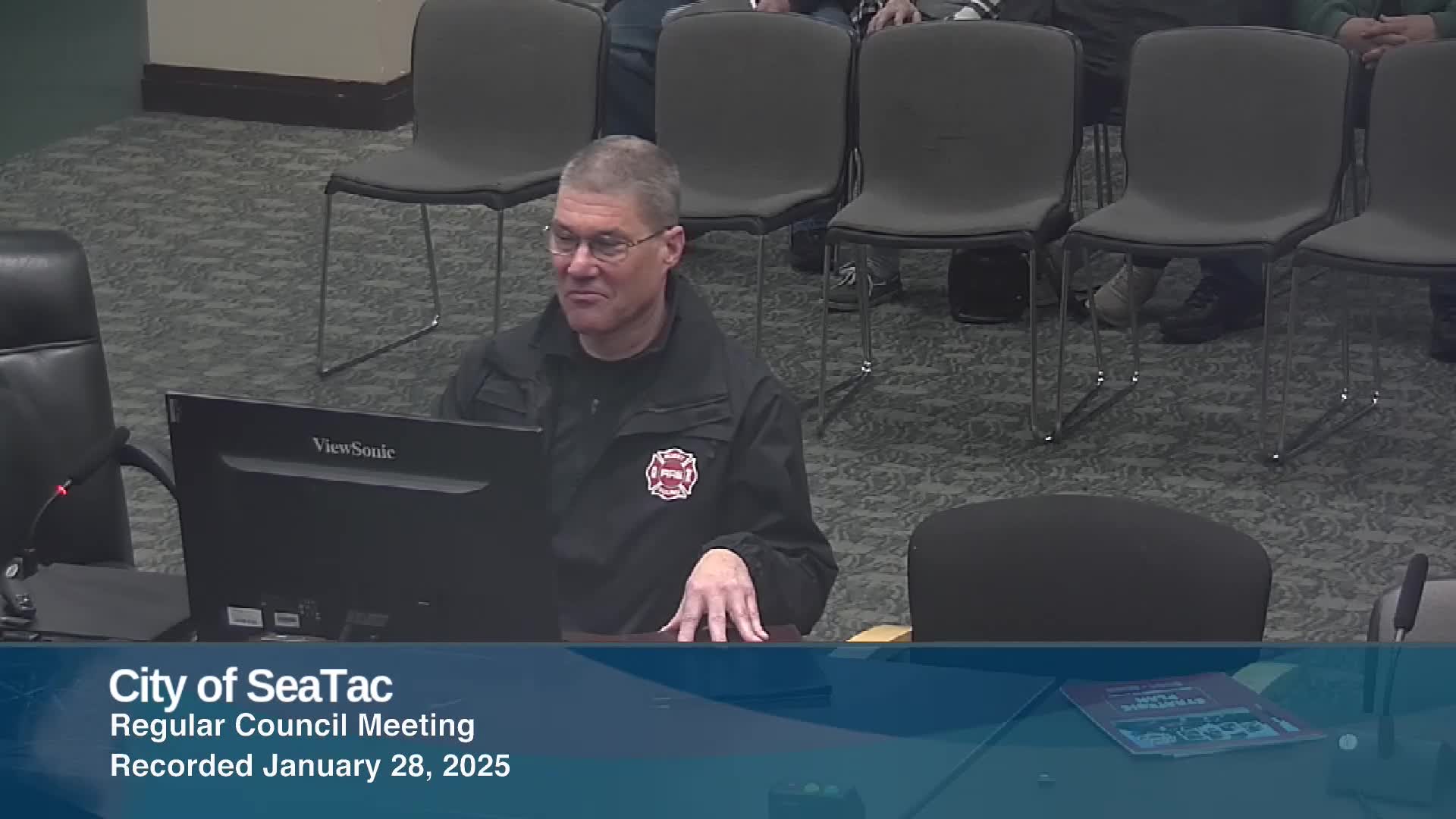
Puget Sound Regional Fire Authority Chief Brian Carlson told the SeaTac City Council that 2024 was a busy year for the regional department and highlighted gains in readiness alongside new operational challenges.
Key takeaways: Carlson said Puget Sound Fire neared 50,000 total calls systemwide in 2024 and that SeaTac units ran more than 6,000 calls. The agency earned re-accreditation from the Commission on Fire Accreditation International, completed a strategic plan and invested in wildland firefighting resources that allowed it to deploy multiple units to recent California fires. "We were the only fire department in the state of Washington that was able to send more than a single unit," he said, noting that the agency sent a type 1 engine and a type 3 wildland engine to Los Angeles.
Staffing, equipment and grants: Carlson said, thanks to a federal SAFER grant, the department put four personnel on ladder companies in 2024 — a first outside Seattle in Washington — which he said improves safety and effectiveness on truck companies. He also noted ordering a ladder truck this year with a five-year wait time for delivery.
New programs and services: The CARES (community response) team continues to focus on chronic medical needs, homelessness and social-services casework, Carlson said, and the agency is expanding carrier units that respond to nonemergent social and medical needs.
Security concerns and thefts: Carlson told the council that in 2024 the agency suffered multiple thefts of rescue tools (commonly called "jaws of life") from apparatus parked at scenes or during errands; some tools were used in criminal activity, he said. Crews have taken interim security steps such as chaining tools in compartments and removing batteries, and the department is considering other measures, including locking exterior cabinetry, which carry cost and response-time tradeoffs.
Local station activity and performance: Carlson said SeaTac stations are among the busiest in the system; Engine 45 at Angle Lake was the third-busiest engine and the fourth-busiest unit overall in the Puget Sound Fire system. He warned that increases in call volume outpace available funding and praised SeaTac staff for completing the 2025 contract but urged continued attention to funding options.
Council questions: Councilmembers asked about the CARES team's typical contacts, coordination with local police mental-health responders, reimbursement for out-of-state deployments and how the department is improving security and tracking for stolen tools. Carlson said out-of-state deployments are reimbursed and that the agency is coordinating with manufacturers and law enforcement to pursue both physical security and tracking options for tools.
Next steps: Carlson suggested the council consider the department's long-term capital needs and acknowledged thefts and staffing pressures as emerging risks that will require attention and potential investment.