Get Full Government Meeting Transcripts, Videos, & Alerts Forever!
Get email alerts on the Airport Hangar Rates topic
No spam. Unsubscribe anytime.
Port hears market-study options to raise Bremerton airport hangar rates; pilots urge honoring 5% cap
Summary
Port of Bremerton commissioners on an information item reviewed a 2024 market study showing regionwide increases in airport hangar rates and discussed three possible rate paths for 2025–2027.
Port of Bremerton commissioners on an information item reviewed a 2024 market study showing regionwide increases in airport hangar rates and discussed three possible rate paths for 2025–2027.
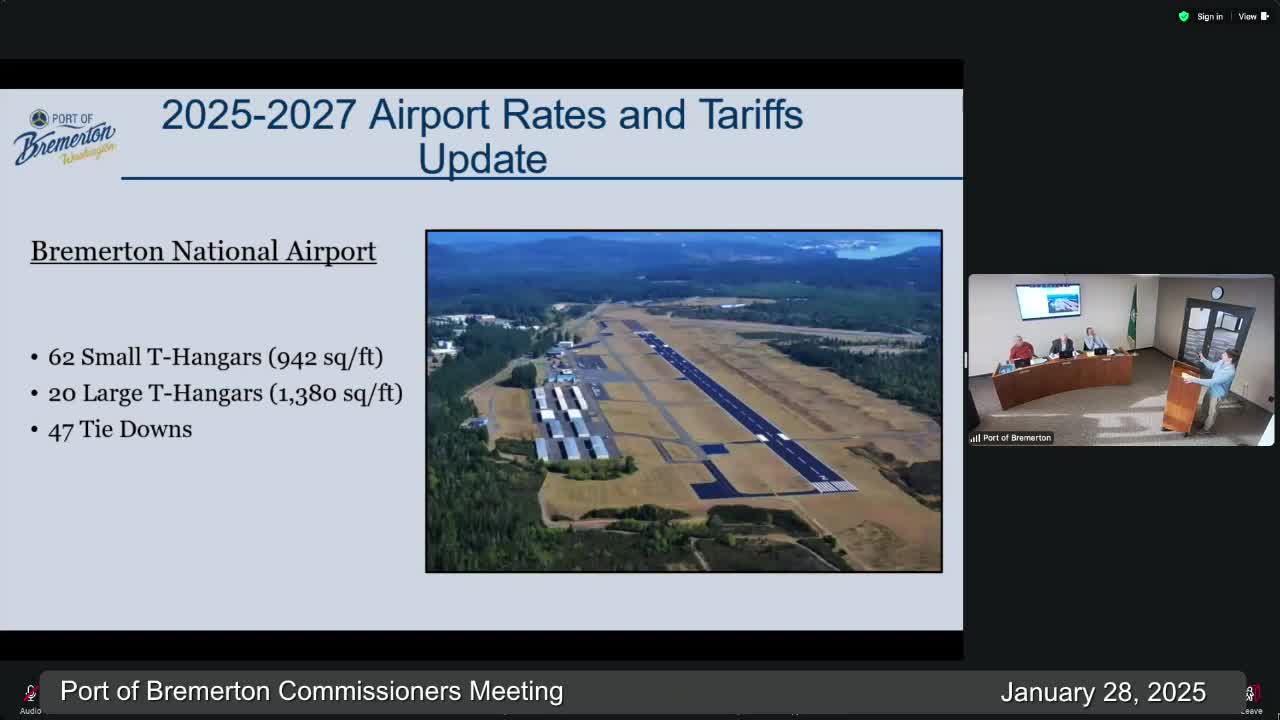
The study, presented by port staff, compared Bremerton’s current hangar and tie‑down rates with other Puget Sound airports using data gathered in November–December 2024. The port’s airport currently manages 82 hangars across eight buildings (two large hangar buildings and six small hangar buildings) and 47 tie‑downs. Staff noted hangars are, in many cases, more than 40 years old and that maintenance and construction costs have risen “upwards of 20 to 30%” in some categories.
Why it matters: airport hangar rents are a large portion of airport revenue and directly affect pilots, many of whom told the commission they live on fixed incomes and depend on predictable, modest increases. The port’s 2024 budgeted airport revenues were $661,000 against $1,388,000 in airport expenses, a gap speakers said partly explains the need to consider higher rates.
Staff presented three options: immediately raise rates to the market‑study recommendation (an 8% increase shown in the study); keep the previously used 5% cap for this year but add the recovered amount in a later year; or apply 5% this year and then add 1 percentage point above CPI in each of the following two years to recover lost ground. Staff emphasized the item was informational and that any formal rate change would be presented for a decision at a subsequent meeting.
Pilots and long‑term tenants urged the commission to respect an earlier written statement that they said capped annual CPI adjustments at 5% and to avoid an unexpected larger increase. Doug, representing the pilots association, told commissioners the association had negotiated an agreement with prior staff and commissioners that “we will cap it at 5%” and that tenants had a reasonable expectation of continued CPI‑based increases: “We champion that. We fought for that because it makes sense.”
Other public commenters said an immediate 8% increase would be difficult for pilots on fixed incomes. Tenant Joel Mace said he is on fixed income and asked commissioners to consider how many local residents could secure an 8% income increase in a year. Another tenant noted the port’s hangar waiting list runs “between 40 to 70 people” and suggested the port consider adding hangars to increase capacity rather than raise rents sharply.
Staff and several commissioners said the 5% cap noted in the letter from a former airport manager does not override commission authority. One commissioner told the room that “not a single staff member present or prior will speak for this commission,” and that the commission would review the letter referenced by tenants before making a final decision.
Staff also provided granular details cited during discussion: the market study used November–December 2024 pricing from comparable airports and included a 12.84% Washington leasehold tax in comparisons; staff reported some comparable airports had announced 2025 increases ranging broadly from roughly 5% to 15% at the time of the review. Staff said an 8% increase in rates would translate to about $9 per month for smaller hangars and about $13 per month for larger hangars in the examples shown.
Next steps: commissioners treated the item as information and directed staff to return with formal recommendations at a future meeting, giving pilots and tenants an opportunity to review the study details and submit follow‑up comments. No formal motion or vote on rates took place at this meeting.
Ending: Commissioners and staff repeatedly framed the discussion as balancing maintenance and capital needs against tenant affordability; several commissioners said they prefer to minimize rate increases but must consider rising operating costs and the airport’s structural budget gap.