Get Full Government Meeting Transcripts, Videos, & Alerts Forever!
Get email alerts on the Elections topic
No spam. Unsubscribe anytime.
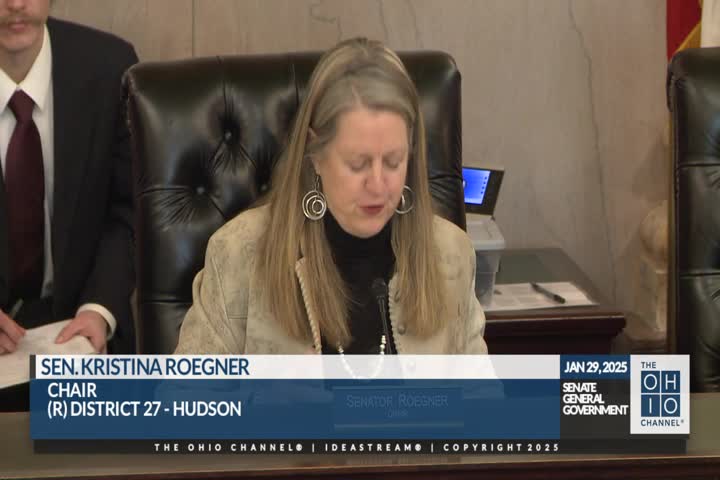
Senate committee holds first hearing on bill to create election integrity unit in Secretary of State’s office
Summary
Senate Bill 4, sponsored by Sen. Theresa Gavarone, had a first hearing before the Senate General Government Committee. The bill would codify an election integrity unit within the Secretary of State’s office to investigate alleged election fraud, accept public complaints, and refer cases to prosecutors or the attorney general.
The Ohio Senate General Government Committee on Oct. 12 held a first hearing on Senate Bill 4, legislation sponsored by Senator Theresa Gavarone to create an election integrity unit within the office of the Secretary of State to investigate allegations of election fraud and voter suppression.
Senator Theresa Gavarone, the bill’s sponsor, told the committee the measure would require the unit to investigate complaints, allow the public to submit allegations, refer matters to county prosecutors, law enforcement or federal agencies, and report to the General Assembly on the number of complaints and referrals. "One case of voter fraud is too much, and I believe the election integrity unit will make it easier to not just prevent it, but prosecute people who try to undermine our election systems and by definition, our republic," Gavarone said.
The bill would codify the election-related portion of a public integrity division the Secretary of State created in 2022, Gavarone said, and would allow the attorney general to prosecute if a referred county prosecutor does not act within 12 months. She described the proposal as continuing prior legislative steps to strengthen Ohio’s election processes, including prior post‑election auditing requirements and a voter ID provision championed in earlier sessions.
Committee members asked procedural and operational questions. Ranking Member Lewis Blackshear and others asked how many employees the unit would have and whether cost estimates have been prepared; Gavarone replied that the legislation codifies a unit that is already in operation and that she would check with Secretary LaRose about staff numbers and past costs. When asked whether the General Assembly would receive data on prosecutions and allegations, Gavarone noted the bill requires a report to the legislature with those counts.
Some senators raised concerns about the risk of overburdening county prosecutors with large numbers of public complaints. A committee member asked, "Are we not worried that, as it's seen in other states... county prosecutors are ... gonna receive hundreds and hundreds of, quote, unquote, allegations of voter fraud when in fact, none of... are prosecuted?" That question, from Senator Demora, prompted discussion of the unit’s investigatory role before referral and the 12‑month period after which the attorney general may proceed.
No vote was taken; the hearing was introductory and the committee did not advance the bill at this session. The sponsor answered member questions and indicated willingness to provide information about staffing and costs to the committee.
The committee will consider further testimony and possible amendments at a later meeting; no formal action or vote occurred at this first hearing.