Get Full Government Meeting Transcripts, Videos, & Alerts Forever!
Get email alerts on the Tobacco Control topic
No spam. Unsubscribe anytime.
Subcommittee weighs cut to tobacco cessation funding as Maryland health officials urge retention
Summary
DLS recommended reducing the fiscal 2026 Prevention and Health Promotion Administration tobacco cessation allowance by $5.7 million to meet a statutory minimum; Maryland Department of Health officials and public-health advocates argued the cut would undercut local cessation and youth-prevention work and urged keeping or restoring funding.
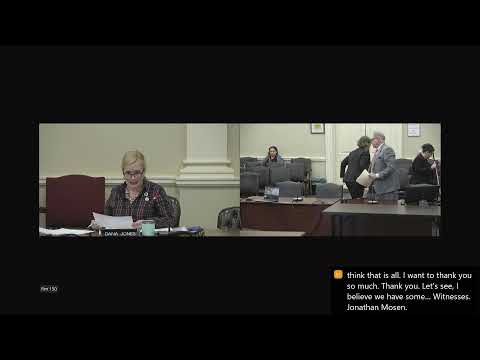
The Appropriations Subcommittee on Health and Social Services on Feb. 5 heard competing recommendations over tobacco-cessation funding in the Maryland Department of Health's Prevention and Health Promotion Administration (FIPA). Naomi Camaro of the Department of Legislative Services said DLS recommends trimming the fiscal 2026 allowance by $5,700,000 in general funds to meet the statutory baseline for mandated tobacco-cessation funding.
Camaro told the subcommittee the governor's fiscal 2026 allowance includes $24,000,000 for tobacco-cessation programs but noted a budget provision requires the governor to include at least $18,250,000 annually. "The governor must include at least $18,250,000 annually in the budget," she said, and DLS recommended reducing the fiscal 26 allowance to that mandated level.
Maryland Department of Health Secretary Laura Herrera Scott and Deputy Secretary Nilesh Kalyanaraman pushed back. "The department respectfully disagrees with this recommendation to reduce the budget for tobacco cessation programs," Herrera Scott said, adding that most of the $5.7 million supports local health department work. Kalyanaraman told the panel some 90 to 95 percent of that amount goes to local health departments to carry out tobacco cessation and youth prevention activities.
Public-health advocates who testified with or after the department repeated concerns that a reduction could reverse gains in youth and adult tobacco use. Laura Hale of the American Heart Association and Alex Casper of the American Lung Association highlighted rising use of new products among youth and national CDC guidance on prevention funding levels. "Maryland even at $23,000,000 is woefully underfunded," Casper said, citing CDC best-practice funding benchmarks.
DLS's written presentation also described performance measures FIPA monitors: adult cigarette use, youth tobacco and electronic smoking device (ESD) use, and unintentional pediatric cannabis exposures. Camaro noted that the proportion of adults and youth using cigarettes has been declining, while some measures of ESD and other product use showed modest increases in 2021—22. She also reported that FIPA had included two new cannabis measures to track youth prevalence in future submissions and that the cannabis public health fund (established by Chapter 26 of 2022) had expended $5.3 million as of January 2025, with a $6.2 million special-fund allowance in fiscal 2026.
Subcommittee members asked how local allocations were determined and whether the proposed cut reflected differential local needs. Kalyanaraman described the distribution as a base amount for each jurisdiction with population-based adjustments on top of that; he said the majority of the contested $5.7 million funds go to local health departments.
The hearing produced no formal vote. DLS left its recommendation on the record and the department recorded its objection, while advocates urged the committee to maintain or restore higher funding to sustain local cessation efforts and youth-prevention campaigns.
Looking ahead, the department and advocates said they will continue to press for sustained state support for tobacco prevention and cessation, and the subcommittee will weigh DLS's fiscal recommendation in its budget deliberations next month.