Get Full Government Meeting Transcripts, Videos, & Alerts Forever!
Get email alerts on the Higher Education Budget topic
No spam. Unsubscribe anytime.
University of Maryland Baltimore warns of staffing cuts, facility backlog after state funding fall
Summary
University of Maryland Baltimore leaders told the Appropriations Education and Economic Development Subcommittee that enrollment declines and a drop in state support will force hiring freezes, elimination of some filled positions and reduced facility renewal funding amid an $840 million backlog.
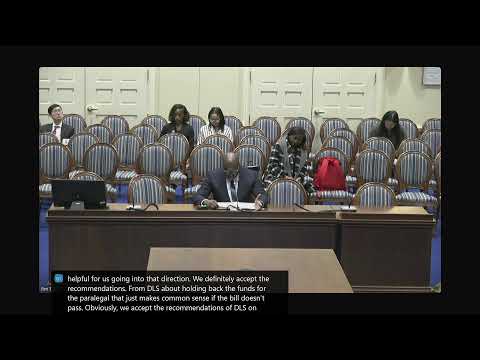
Delegate Stephanie Smith, chair of the Appropriations Education and Economic Development Subcommittee, opened UMB’s budget hearing, where university leaders outlined enrollment declines, program shifts and spending cuts tied to a fall in state support.
UMB President Bruce Jarrell said the university will reduce full‑time and part‑time positions and cut facility renewal spending after the governor’s allowance reduced state funding for the institution.
The university and legislative fiscal staff framed why the adjustments are necessary. Budget analyst Sarah Baker told the committee that enrollment peaked in 2021 and has fallen 8.9% overall, driven largely by a roughly 20% drop in master’s enrollment; the master's declines included a fall in the PharmD and master of social work programs as competing programs and leadership changes affected enrollment. Baker said the rate of decline slowed to 0.5% in fiscal 2024 after a prior 4.3% drop.
Jarrell described UMB’s priorities and consequences of reduced funding. “UMB will reduce full time and part time positions affecting faculty, regular staff, and contingent contractual staff,” Jarrell said, adding that roughly two‑thirds of required savings will come from eliminating vacant positions and the remainder from eliminating about 29 currently filled positions. He also said the institution will lower its usual facility renewal investment from about 2% of income to 1% to meet the reduced appropriation and that UMB has a facilities backlog of about $840 million.
Legislative staff and university presenters highlighted program and budget specifics: Baker said the university provides roughly $180 million in graduate financial aid but that 80% of aid packages are federal loans, and that geographic disparities in salaries affect graduates’ capacity to repay debt. Exhibit figures presented to the committee show average dental graduate debt above $305,000 and that the cost of attendance ranges from about $50,000 for a master of science in nursing to more than $107,000 for dentistry programs.
Jarrell stressed UMB’s research and community role: he told the committee the campus brings in about $638 million in grants and contracts (roughly $1.3 billion combined with strategic partners at College Park), called the Shock Trauma and the Greenbaum Comprehensive Cancer Center “jewels,” and warned that the zeroing out of Cigarette Restitution Fund (CRF) support — about $12.7 million annually used to support clinical programs tied to National Cancer Institute requirements — could weaken the university’s competitive renewal for NCI designation.
Baker and Jarrell walked through the governor’s allowance figures, saying state funds decreased about 5.3% (roughly $18.5 million) when excluding the effect of fiscal 2026 salary increases not included in the 2025 working appropriation. Baker also noted $1 million restored for the Empowering Joint Steering Committee and $750,000 mandated by statute for the University of Maryland Institute for Health Computing.
Committee members had no immediate objections to the presentation; Jarrell said he would work to protect the university’s core mission while implementing the reductions.
UMB did not present any formal motions or votes during this hearing.
Looking ahead, university leaders said they will continue to seek alternative revenue sources and philanthropic support to limit cuts’ impact on research, clinical services and student experience.