Get Full Government Meeting Transcripts, Videos, & Alerts Forever!
Get email alerts on the Long Term Care Regulation topic
No spam. Unsubscribe anytime.
Health Facilities Commission reports spike in nursing‑home complaints and outlines certificate-of-need transition timeline
Summary
The Health Facilities Commission told the Health Subcommittee that nursing‑home complaints rose after CMS changed complaint-reporting guidance, that recertification surveys lag, and that certificate-of-need (CON) items will move to licensure on a multi‑year schedule.
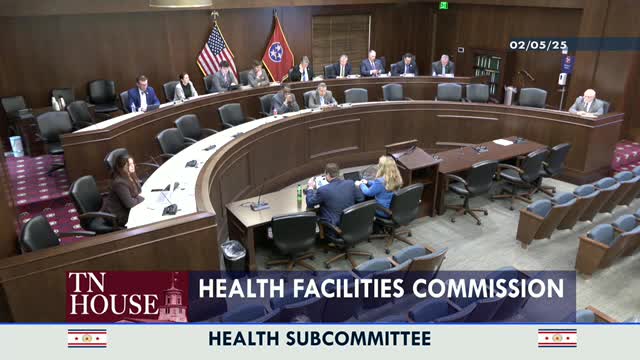
Logan Grant, executive director of the Health Facilities Commission, and Caroline Tippens, director of licensure and regulation, briefed the Health Subcommittee on the commission’s responsibilities, complaint intake trends and the multi-year implementation of Public Chapter 985, which shifts certain services from certificate-of-need regulation to licensure with quality standards.
Grant said the commission now combines licensure and certificate-of-need work, and Tippens described complaint intake and triage performed by registered nurses on a dedicated hotline. Tippens said changes CMS made to the State Operations Manual (chapter 5) in October 2022 produced a 63 percent increase in complaints to Tennessee, creating a backlog that reduced the commission’s recertification throughput because staff must prioritize complaint investigations.
Tippens gave year‑specific figures: 3,703 nursing‑home complaints received in 2024; 2,353 complaints investigated that year; and about 54 percent of investigated allegations substantiated (1,273 substantiations). She said Tennessee has about 309 nursing homes, 294 of which received at least one complaint in the period reviewed, and 128 facilities had more than 10 complaints in a year. The commission has issued 1,320 total federal citations to nursing homes; its top cited health deficiencies included infection prevention and control, quality of care and nursing services. Life‑safety deficiencies top the physical‑plant list, led by sprinkler-system issues and fire-alarm maintenance.
Grant said the commission is addressing the recertification backlog in multiple ways: recruiting to reduce vacancies (from a 28 percent vacancy rate in 2022 to 5.4 percent as of January 2025), converting some positions to mobile workers, and budgeting additional staff to create a statewide high‑priority complaint-investigation unit so normal survey teams can complete scheduled recertifications. He told members the commission completed 94 long‑term‑care recertifications in the previous year while handling an increased complaint workload.
On CON reform and licensure transitions, Grant said technical advisory groups have proposed quality standards for services scheduled to move from CON to licensure. The commission will initiate rulemaking on standards proposed this year for neonatal intensive care units (NICU), burn units, and MRI/PET services. A statutory carve‑out for freestanding emergency departments takes effect July 1, 2025; subsequent phases move ambulatory surgical treatment centers, linear accelerators and long‑term‑care hospitals in 2027, and open‑heart surgery services on Dec. 1, 2029.
Committee members pressed the commission on whether the decline in “immediate jeopardy” findings reflected changed facility behavior or reclassification under new CMS guidance. Tippens said the numbers decline mainly because CMS changed definitions and guidance and the commission retrained staff to apply the revised standard; she said that did not necessarily reflect immediate behavioral change within facilities. Grant and Tippens said they are conducting provider trainings and outreach on top deficiencies and the state operations manual changes.
No votes were taken on the presentation; commissioners said they will continue working with facilities and the General Assembly as they implement staffing changes and the CON-to-licensure transitions.