Get Full Government Meeting Transcripts, Videos, & Alerts Forever!
Get email alerts on the Social Safety Net topic
No spam. Unsubscribe anytime.
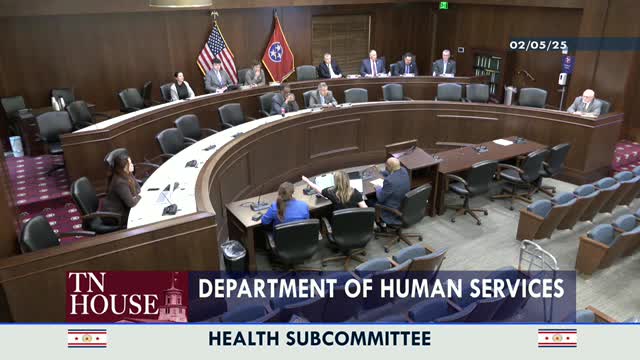
Tennessee Department of Human Services outlines TANF, SNAP and child-care programs to health subcommittee
Summary
Commissioner Clarence H. Carter briefed the Health Subcommittee on SNAP, TANF spending plans, child-care programs and related pilot projects, and said federal program changes are expected under the new U.S. administration.
Clarence H. Carter, commissioner of the Tennessee Department of Human Services, told the Health Subcommittee on Feb. 1 that the department serves more than 2 million Tennesseans annually and administers federal programs including the Supplemental Nutrition Assistance Program (SNAP), Temporary Assistance for Needy Families (TANF) and the Child Care and Development Fund (CCDF).
Carter said Tennessee receives a $191,000,000 annual TANF block grant and that the state budgets roughly $65,000,000 of that each year for direct cash assistance. He described TANF as a time-limited, workforce-oriented program and said recipients may receive up to 60 months of benefits in a lifetime. Carter told members Tennessee had a large unexpended TANF reserve when he arrived and that, under the TANF Opportunity Act passed with the administration’s support, the reserve is now “fully obligated” to contracts and is expected to be drawn down over the next two to three years.
The commissioner and Callan Baggett, assistant commissioner for external affairs, described SNAP as the federally administered nutrition program (USDA) that issues benefits by electronic benefit transfer cards and said eligibility is based on income, household size, residency and work status. Baggett said the Child Care Development Fund is a roughly $300,000,000 federal block grant, approximately 70 percent of which must go to subsidy programs (known in Tennessee as Smart Steps or the childcare certificate program) for low-income working parents. The remainder is used for grants to providers, including enhancement and expansion grants, and for employer-partnership projects such as a multi-party project with Tyson Foods and Gibson County described in testimony.
On the TANF reserve and pilot demonstrations, Commissioner Carter said the TANF Opportunity Act created a spend-down plan and “we obligated a hundred and $40,000,000 of the reserve to fund those 7 pilots.” He also said, in the same exchange, that “there was $25,000,000 from the reserve dedicated to each of the 7 pilots.” (Transcript statements contain inconsistent arithmetic; the department described the obligation amount as $140 million and also referenced $25 million per pilot.) Carter added the department has used reserve dollars for items such as legal services for TANF-eligible families and other non‑cash supports intended to increase self-sufficiency.
Committee members asked about allowable TANF expenditures and federal reporting. Carter and Baggett said eligible TANF expenditures include transportation, child care assistance, educational supports, job training and employment activities, and that TANF operates in practice as a reimbursement grant to contracted service providers. Carter said contracts obligate funds but are expended as providers draw down payments for services rendered.
Members asked whether changes under the new federal administration will affect state programs. Carter said he expects “some very significant proposed changes” in the broader safety-net space and that his team is monitoring executive orders and federal actions, but he said a brief federal hold on administrative draws produced no interruption in direct benefits to Tennesseans.
The department’s presentation also noted other DHS functions: child support enforcement, vocational rehabilitation services (including the Tennessee Rehabilitation Center in Smyrna) and adult protective services, which investigates reports of abuse, neglect or exploitation of vulnerable adults. Carter closed by thanking the subcommittee and offering to work with members during the session.
Members did not take formal action on the presentation.