Get Full Government Meeting Transcripts, Videos, & Alerts Forever!
Get email alerts on the Education Learning Acceleration topic
No spam. Unsubscribe anytime.
Committee hears bill to require free academic intervention services for students scoring at 'limited' on state tests
Summary
Senate Bill 19 would require districts to provide evidence‑based academic intervention services at no cost to any public‑school student who scores at the lowest level on state assessments in English language arts or math; bill would require reporting, math improvement plans for certain third‑grade scores, and periodic state reviews.
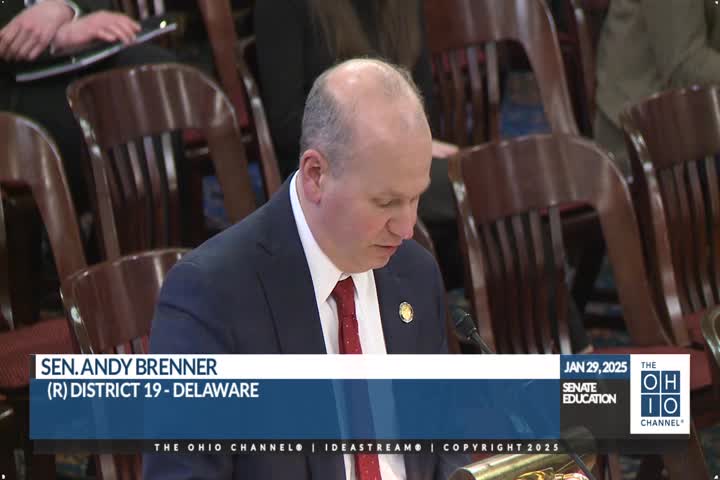
Chair Brenner, sponsor of Senate Bill 19, told the Senate Education Committee the bill responds to statewide assessment data showing significant numbers of students scoring at the lowest proficiency level and seeks mandatory, evidence‑based interventions at no cost to students.
"There are approximately 1,600,000 students in public schools. This means roughly 23 or nearly 1 in 4 of our students demonstrated they need not have even a basic understanding of core concepts," Brenner said, citing 2022–23 assessment results and the National Assessment of Educational Progress (NAEP) 2024 reading declines announced the same day.
Under the bill as presented, any public‑school student who scores at the "limited" level on a state assessment in English language arts or math would be entitled to academic intervention services paid for by the school district at no cost. The services must be evidence‑based, aligned with classroom instruction, and not supplant regular instructional time. Examples listed in testimony include tutoring, additional instructional time, extended school calendar, and other supports chosen by the school or district.
For students who score limited on third‑grade math assessments, schools would be required to develop a math improvement and monitoring plan within 60 days that identifies deficiencies, describes instructional services to remediate, and specifies monitoring and high‑dosage tutoring aligned with classroom instruction. The Department of Education and Workforce would be required to set guidelines for the content and deadlines of those plans and to randomly review 5% of districts, community schools and STEM schools each year to evaluate service provision and quality.
Brenner said districts must notify parents when services are provided and give periodic progress updates and resources for parental support. The bill would end a student's mandated intervention once the student demonstrates proficiency, although schools could continue services voluntarily.
Committee members asked whether limited‑scoring students are concentrated in particular districts and whether existing local supports already provide similar services; Brenner said the bill is designed to identify and scale what works, citing the "science of reading" initiative as an example and saying the department should collect and share successful strategies so schools with similar demographics can adopt them. The committee held a first hearing and did not vote on the bill.