Get Full Government Meeting Transcripts, Videos, & Alerts Forever!
Get email alerts on the Public Safety Oversight topic
No spam. Unsubscribe anytime.
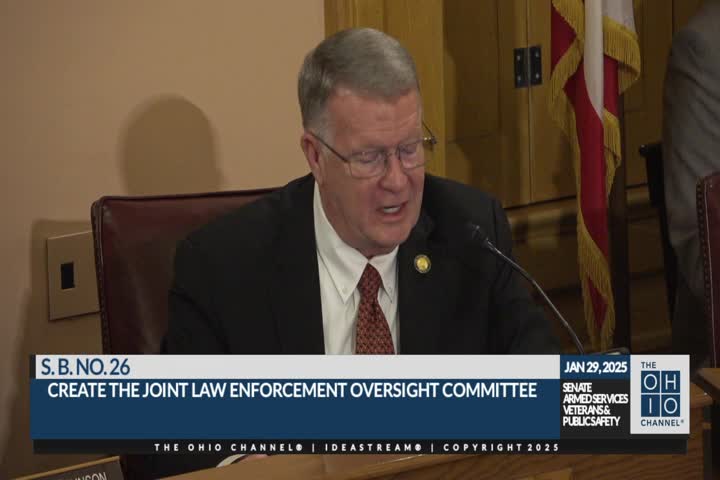
Senator Johnson seeks creation of Joint Law Enforcement Oversight Committee to study modern threats
Summary
Sponsor testimony for Senate Bill 26 proposed a Joint Law Enforcement Oversight Committee (JLEOC) to review law enforcement preparedness for emerging technologies such as aerial and underwater drones and remote-controlled vehicles; bill would fund a one-year investigative task force and requires a General Revenue Fund appropriation.
Senator Johnson presented sponsor testimony on Senate Bill 26, which would create a Joint Law Enforcement Oversight Committee (JLEOC) to assess Ohio law enforcement training, readiness, and preparedness in light of emerging technologies. The committee heard testimony on the bill as a first hearing; no committee vote was taken.
Johnson argued technological advances are creating new security challenges and said, “This is the greatest danger faced by our law enforcement in our time.” He listed threats including unmanned aerial vehicles (UAVs), remote-controlled or autonomous vehicles and underwater drones, and told the panel that training standards must be updated to respond to those challenges. “This legislation seeks to resolve this disparity with the creation of a new agency, the Joint Law Enforcement Oversight Committee,” he said.
Under Johnson’s proposal, the JLEOC would be composed of three members from each chamber (two majority and one minority member from each), appointed by the relevant Senate and House leaders. The bill would include an appropriation from the General Revenue Fund to fund an investigative task force for one year; the task force would prepare a report assessing the effectiveness and resilience of existing training standards and recommend actionable legislation.
The nut graf: The bill is a fact‑finding and oversight measure, not an immediate operational change for law enforcement agencies. It would fund a one-year investigative effort intended to inform later legislation addressing training and equipment gaps exposed by cheaper and more accessible technologies.
Committee members asked no substantive questions; the item concluded as a first hearing with no recorded committee action. Johnson said he is “totally open to suggestions” on membership and acronyming but emphasized the urgency of beginning the study to protect Ohioans.
Ending: The bill remains at first hearing status; sponsors requested committee consideration and potential appropriation from the GRF for a one-year task force.