Get Full Government Meeting Transcripts, Videos, & Alerts Forever!
Get email alerts on the Corrections topic
No spam. Unsubscribe anytime.
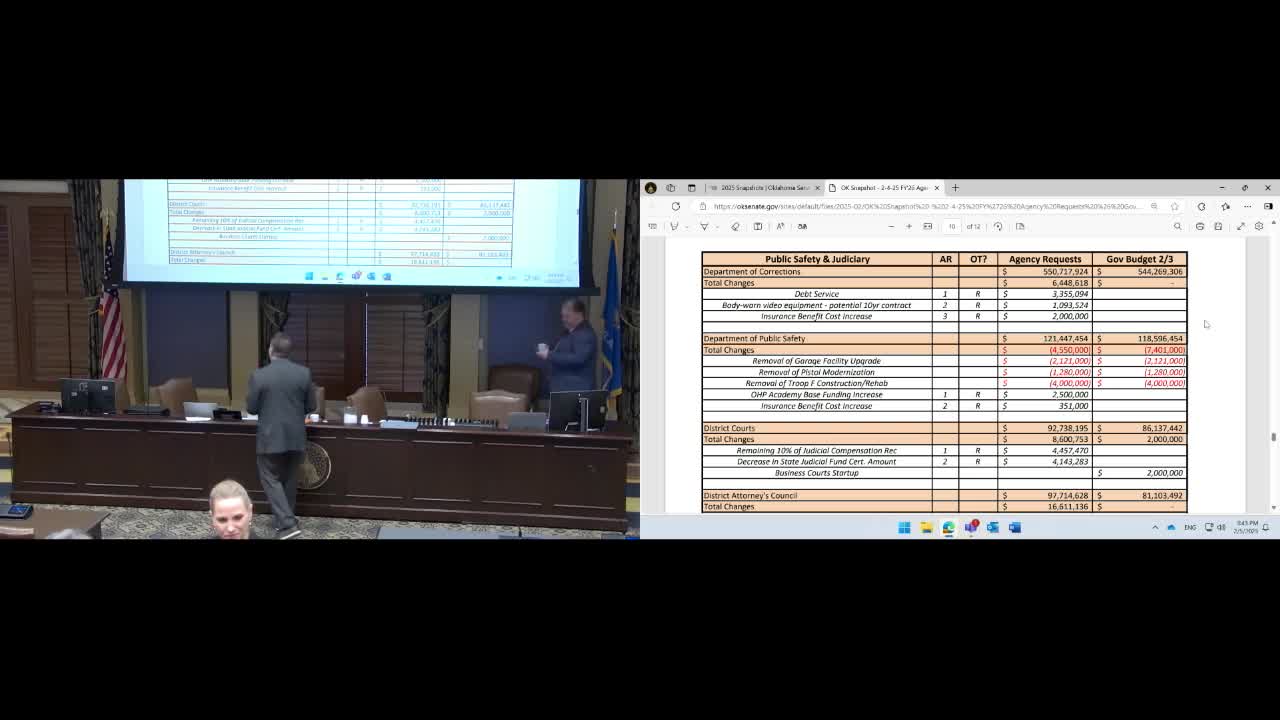
Department of Corrections seeks $6.5M for equipment, insurance and staffing; highlights body‑worn video and automation plans
Summary
The Department of Corrections requested about $6.5 million for debt service, body‑worn-video equipment and insurance/benefit cost increases and described plans to use technology to reduce time‑consuming manual processes such as inmate counts.
The Department of Corrections asked the Appropriations and Budget Committee for roughly $6.5 million in additional recurring funding to cover debt service, body‑worn-video equipment and rising insurance and benefit costs.
Director Steve Hart (presented in the hearing as the department director) told lawmakers the agency is also pursuing technology investments to reduce labor‑intensive tasks. “The issue with the body cams is … the number 1 thing that we do in prisons … is doing count. We do 11 counts a day. It takes an hour at each count,” Hart said, arguing automation could free officers from repetitive tasks and redeploy labor to other duties. He said the department stores body‑worn camera footage currently and that Axon is the primary vendor for body cameras.
Hart told the committee the department has worked to fill correctional-officer vacancies: since May 2023 the agency graduated nearly 400 officers from academies and had improved retention (reported retention rising to roughly 80% in the last year). He said the department’s pay rates are competitive with some neighboring states, and that overtime and staffing shortages remain important budget drivers. He said overtime accounts for a substantial portion of the department’s personnel spending.
Lawmakers pressed on how changes in inmate population would affect operating budgets. Hart said reductions or increases in the incarcerated population have to be large (on the order of thousands) to allow closing or opening facilities in a way that materially changes the department’s $551 million enterprise budget; he offered to run scenarios for the committee.
On medical and sanitation issues, the director said the department provides vaccines and participates in 340B purchasing; he also recognized the need to verify specific facility sanitation concerns raised by lawmakers.
Ending: The corrections director framed technology investments (body cameras, decision‑support/AI and automation of counts) as a way to reduce labor on routine tasks and free officers for direct security duties, while noting that large population shifts—not small caseload changes—are required to change overall operating costs materially.