Get Full Government Meeting Transcripts, Videos, & Alerts Forever!
Get email alerts on the Opioid Crisis Policy topic
No spam. Unsubscribe anytime.
Sponsor urges resolution asking Congress to designate illicit fentanyl a weapon of mass destruction
Summary
Senator Johnson presented sponsor testimony on Senate Concurrent Resolution 1, arguing illicit fentanyl’s potency and international supply chains justify urging Congress to designate it a weapon of mass destruction; committee held a first hearing and took no vote.
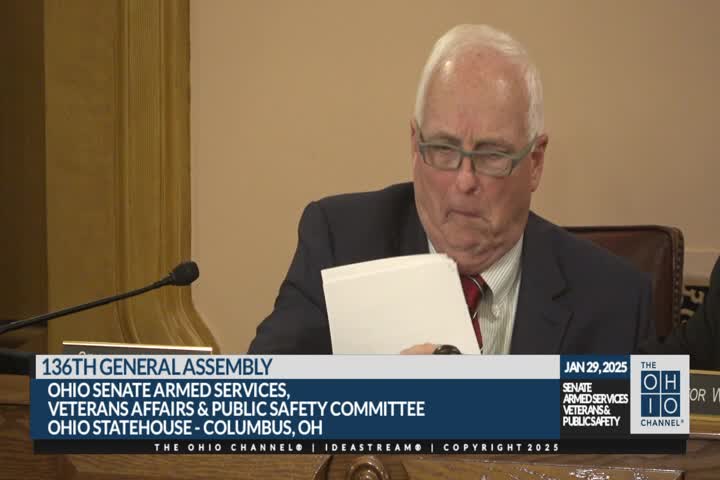
Senator Johnson presented sponsor testimony during a first hearing on Senate Concurrent Resolution 1, which urges the U.S. Congress to designate illicit fentanyl as a weapon of mass destruction. The resolution received sponsor testimony only; the committee took no vote.
Johnson described the public-health consequences and international supply issues of illicit fentanyl during his remarks. “It is 50 times more potent than heroin,” he said, and added that fentanyl is “a hundred times more potent than morphine” and “frequently laced into other counterfeit or illicit substances.” He attributed high overdose counts and manufacturing incentives abroad to transnational actors and urged federal action through measures such as the Stop Our Scourge Act, which he said the U.S. Congress had considered.
The nut graf: The resolution is an urging measure directed at Congress rather than a binding state directive; sponsor testimony framed illicit fentanyl as an international security threat and argued the designation would raise the federal government’s policy and enforcement posture.
Johnson provided several numerical claims during testimony. He said one kilogram of fentanyl “has the potential to kill 500,000 people,” stated that “only 2 milligrams of fentanyl can be a fatal dose,” and asserted that “in 02/2021, over 70,000 Americans lost their lives to fentanyl” while noting fatalities may be underreported. He also referenced past uses of fentanyl-related agents in international incidents and cited a former acting CIA director’s remarks about carfentanyl as a national-security threat.
Committee members did not ask questions during the hearing. The item concluded as a first hearing with no committee vote or formal action. The resolution, if advanced, would be a formal request from the Ohio legislature asking Congress to pursue the federal designation and related legislation.
Ending: The committee took no action at the hearing; sponsors asked for the committee’s consideration of the resolution and to urge federal lawmakers to act.