Get Full Government Meeting Transcripts, Videos, & Alerts Forever!
Get email alerts on the Higher Education Funding topic
No spam. Unsubscribe anytime.
OSU Veterinary Medicine seeks tens of millions for faculty, mobile clinics and new teaching hospital plan
Summary
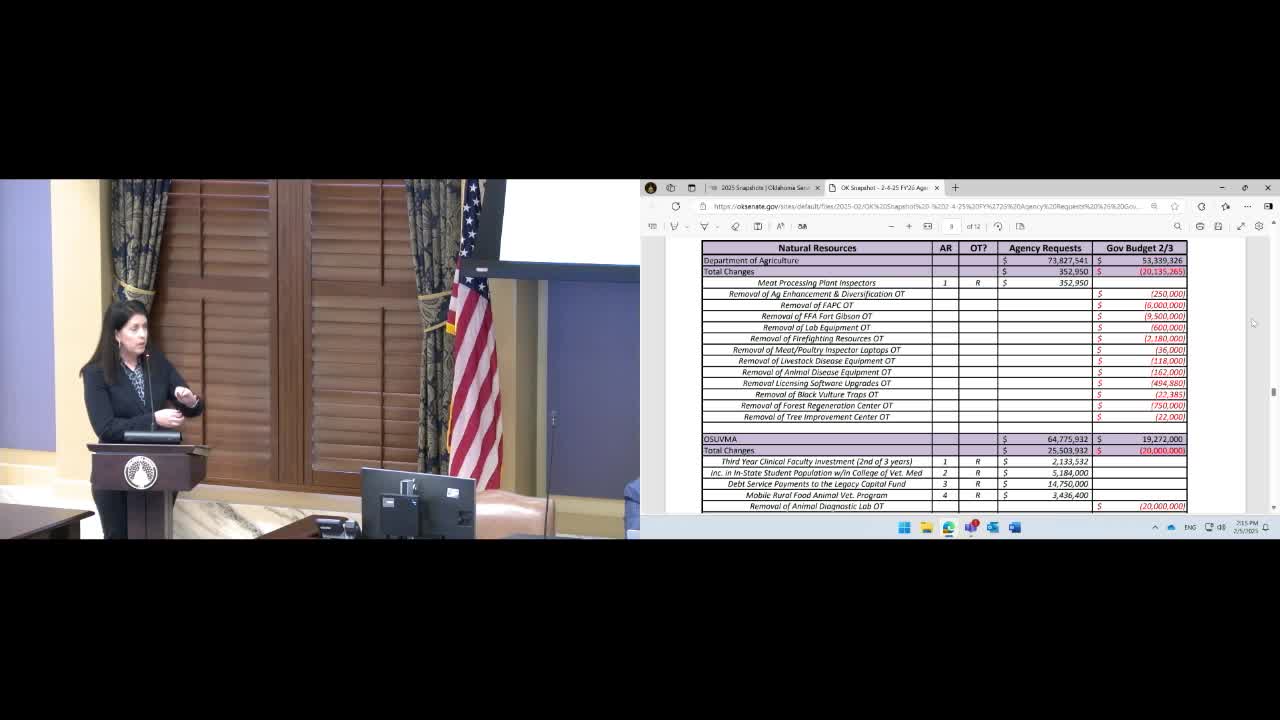
Oklahoma State University’s College of Veterinary Medicine told the committee it seeks roughly $25.5 million for ongoing program support, $3.4 million per mobile large-animal clinic in a proposed fleet, and long-term bond financing for a new teaching hospital; officials said the college is rebuilding faculty and accreditation capacity.
Oklahoma State University’s College of Veterinary Medicine asked the Appropriations and Budget Committee for roughly $25.5 million in recurring funding and additional one-time capital support to address faculty, clinical and facility shortfalls.
Steve Thompson, director of public policy for OSU and the board of regents, told the committee that the request covers debt-service payments tied to prior capital projects, continued funding for a multi‑year faculty hiring plan and a proposal for mobile large-animal veterinary clinics. “We have some debt service payments off of things that we have funded prior through our legacy capital fund,” Thompson said, and added the college is requesting a “mobile … food animal vet program” to address rural shortages.
Committee members asked about the mobile clinics and the college explained the proposal includes equipping vehicles with medical equipment and staffing to deploy to livestock‑heavy areas. Thompson said an individual mobile unit cost is substantial; “there are 8 in the proposal that would have all the equipment,” and the request included $3.4 million per unit in the presentation. He characterized the mobile units as temporary, field‑deployed help “until some of these other investments catch up.”
Thompson described a three‑year faculty funding plan: previous years’ appropriations hired roughly eight to 10 clinical specialists per year; year three would complete that hiring. He said the college now graduates classes of about 106 students, with roughly 58 in‑state and 48 out‑of‑state students, and that recruiting and retaining large‑animal veterinarians has been difficult.
Lawmakers also discussed a long-term bond or legacy capital request: Thompson said an annual debt-service payment estimate of about $14.75 million would support a new teaching hospital to replace an existing facility the college said opened about 1980. He characterized the existing hospital as “outlived its life” and said renovation estimates exceeded earlier projections; the college is weighing a new build versus extensive renovation.
Thompson said the college’s ranking among U.S. veterinary schools has declined over decades and that recent investments aim to restore accreditation strength and competitiveness for faculty and students. He said a one‑time legacy capital request of $295 million had been presented as part of broader funding proposals for a new facility.
Ending: OSU framed the requests as investments to expand rural veterinary capacity, retain graduates in state and replace aging teaching-hospital infrastructure. Committee members pressed for data on workforce retention and implementation plans for the mobile clinics.