Get Full Government Meeting Transcripts, Videos, & Alerts Forever!
Get email alerts on the Appropriations And Budget topic
No spam. Unsubscribe anytime.
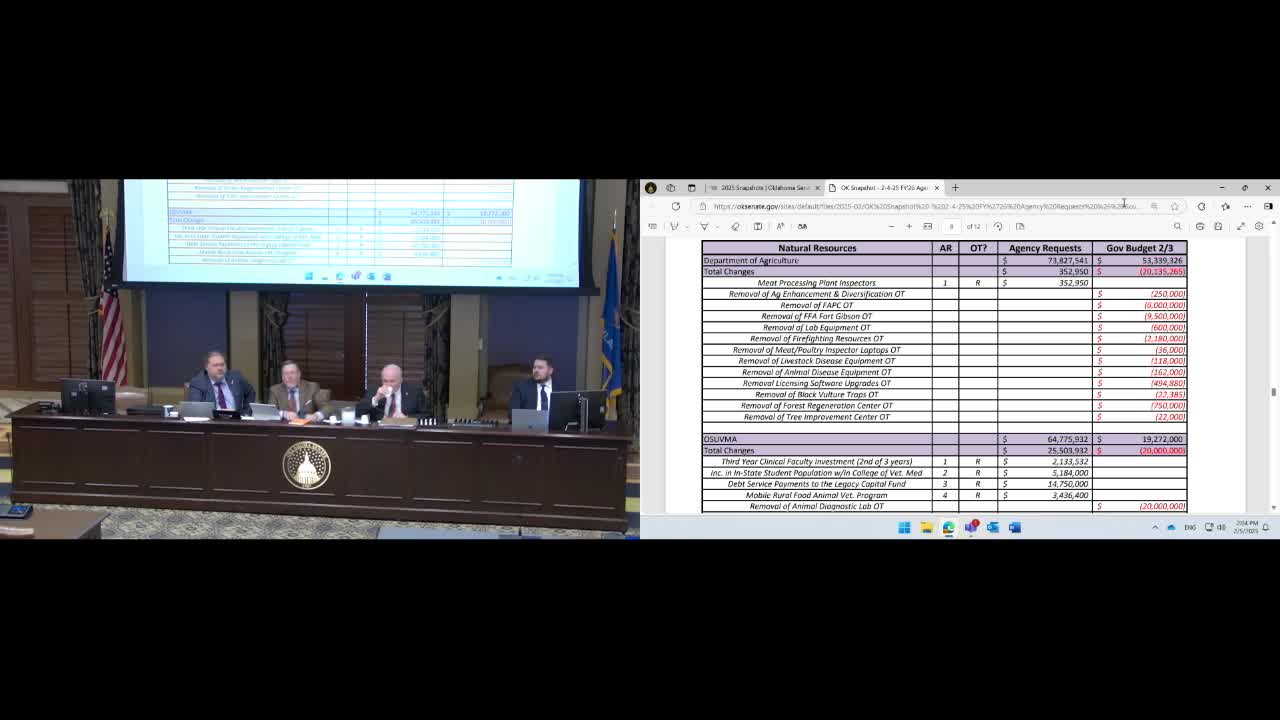
Department of Agriculture asks for $352,950 to add three meat inspectors
Summary
The Department of Agriculture, Food and Forestry requested $352,950 to fund three additional meat plant inspectors as small and medium meat processing facilities in Oklahoma expand; the department said staffing and training capacity remain constraints.
The Department of Agriculture, Food and Forestry requested $352,950 to add three meat plant inspectors, the department told the Appropriations and Budget Committee.
Secretary Arthur, who answered committee questions on the request, said the need predates California’s Proposition 12 and is tied to growth in Oklahoma’s animal protein processing sector. “Since 2020, we’ve had 41 new small and medium sized protein processing facilities come online in the state,” Arthur said, adding that “we have 13 additional facilities that right now are asking us for an inspector.”
The department explained why the inspectors matter for commerce: inspectors make product eligible for retail sale and, in some cases, for interstate or international shipment. Arthur said Oklahoma participates in Talmadge-Aiken (T-A) inspection agreements that allow state inspectors to act on behalf of the U.S. Department of Agriculture; when a T-A stamp is applied by a state inspector, the product can move in interstate and export markets.
Committee members asked whether demand could rise or fall with changes in federal or out-of-state regulation. Arthur noted the state’s growth in processing capacity is the primary driver of the request and added that rules like California’s Prop 12 may change market conditions but are not the underlying cause of the staffing need. “There will be ongoing conversations about how Prop 12 continues to impact … the way we do business,” she said.
Members also probed the supply of qualified inspectors. Arthur and other department staff said there is interest among potential hires but that the work requires specialized training and a willingness to work on processing (kill) floors. The department said it collaborates with regional universities and CareerTech institutions that have “revitalized” meat science curricula to train new inspectors.
The department said converting one-time legislative appropriations into recurring base funding would carry administrative workload for staff, because many prior appropriations have been pass-throughs to partner organizations; those pass-throughs do not come with additional administrative fees to the department.
The department offered to provide additional training and workforce data to the committee if members wanted more detail.
Ending: The department’s request centers on a narrow, recurring staffing need tied to expansion in local processing capacity. Committee members pressed on training pipelines and geographic staffing challenges, especially for rural facilities that want inspectors multiple days per week.