Get Full Government Meeting Transcripts, Videos, & Alerts Forever!
Get email alerts on the Public Safety topic
No spam. Unsubscribe anytime.
Public Safety Committee advances multiple bills on group homes, transportation, corrections and nonprofit transit
Summary
The Public Safety Committee advanced several bills in a short session that covered group-home siting rules for people with intellectual disabilities, a reciprocal driver’s-license agreement with Ireland, UTV highway use, a nonprofit ride service, child‑abuse reporting authority, emergency‑lighting language and prison oversight.
The Public Safety Committee advanced several bills in a short session that covered group-home siting rules for people with intellectual disabilities, a reciprocal driver’s-license agreement with Ireland, new rules for utility terrain vehicles on higher-speed roads, funding/recognition for a nonprofit ride service, expansion of child-abuse reporting authority, clarifications to police emergency-lighting statutes and changes to prison-access and inspector-general oversight.
The committee’s actions move each measure to the next stage; none were defeated in the meeting. Committee members and witnesses emphasized community access, local control and the need for clearer agency language in state statutes.
Why it matters: The items affect multiple public-safety and social-service systems — from how group homes are sited to how elected officials and oversight offices can inspect correctional facilities — and change who can enter facilities, how emergency vehicles are identified and how vulnerable Oklahomans get to medical care.
Most important actions
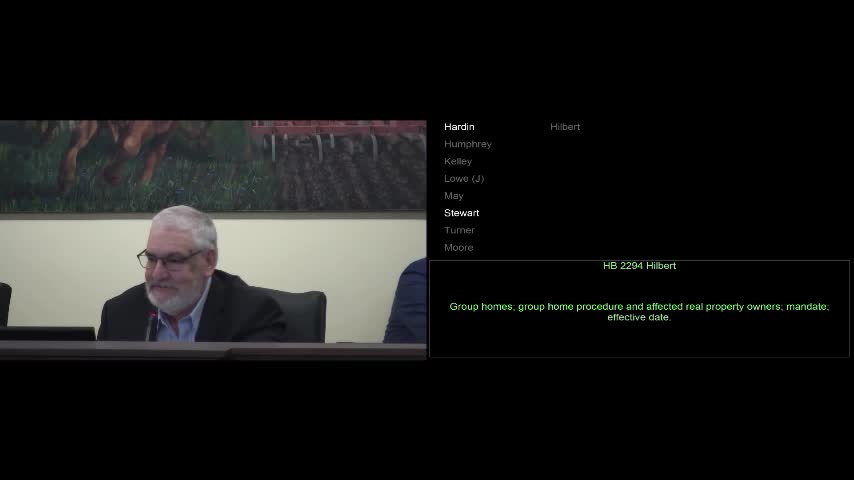
- Group-home siting (change from mandatory 1,200-foot setback to discretionary allowance). A bill presented to loosen a 1,200-foot spacing requirement between group homes — changing statutory language from “shall” to “may” so municipalities and the Department of Human Services retain oversight — was presented and moved forward. The presenter said the 1,200-foot rule dates from the state’s shift away from institutional care and that the change is intended to avoid de facto re‑institutionalization. The presenter also asked that statutory references to the now‑disestablished Commission for Human Services be updated to the Department of Human Services in subsequent edits. The committee voted to advance the bill; the committee reported the bill as passing by voice vote with a recorded tally of 7 yes, 0 no.
- Reciprocal driver’s licenses with Ireland. Members discussed a proposal to authorize a reciprocal agreement under which Irish license holders could drive in Oklahoma and Oklahomans could use Oklahoma licenses in Ireland. The presenter said the opportunity arose after discussions with the National Conference of State Legislatures and examples in Canada; no enforcement or implementation details were specified in the hearing. The committee moved the measure forward (reported passed; tally as recorded in the session: 7 yes, 0 no).
- UTV on highways: speed and county-population threshold. A bill would raise the required safe operating speed for UTVs on state/county highways from 45 mph to 50 mph and allow UTV travel on U.S. highways in counties whose population meets a 75,000‑person threshold per the U.S. Census. The presenter framed the change as a response to local recreation and tourism needs; members confirmed some municipalities (for example, Grove and Jay) already allow local operation. The committee reported the bill passed, 6 yes, 0 no.
- “A Ride For You” nonprofit: recognition/authorization. A bill to recognize and support the Ride For You nonprofit — described in committee as a door‑to‑door service serving people with disabilities, seniors, veterans and low‑income residents across several counties — was introduced with testimony from Colleen Kilby, the organization’s founder. Kilby told the committee the service operates in three counties and provides medical transportation and other supports; “None of this cost taxpayers a dime,” she said, and described the service as aimed at preventing missed care in rural areas. The measure was reported passed by the committee, 6 yes, 0 no.
- Oklahoma Commission for Children and Youth: reporting authority. A bill would add the executive director of the Oklahoma Commission for Children and Youth as an authorized designee to report suspected physical abuse to agencies such as the Oklahoma State Bureau of Investigation (OSBI) or Department of Human Services (DHS), citing authority in section 601.4 as referenced in the hearing. The committee advanced the bill by recorded voice tally, reported as 7 yes, 0 no.
- Emergency lighting and pursuit statute language. Committee members considered a bill to align the pursuit statute’s language about required emergency‑light color(s) with the state’s emergency‑vehicle statute, changing a requirement that an activated law‑enforcement vehicle show “at least one red light” at the front to allow red, blue or white lights (or combinations). The sponsor said the change would help distinguish law enforcement vehicles from other red‑light uses (for example, wreckers or state workers). The committee reported the measure to pass, 7 yes, 0 no.
- Prison access and Office of Inspector General oversight. A bill to allow elected officials to enter correctional facilities without advance notice was introduced and debated with suggested amendments. Representative Turner urged that legislators not serve as the Department of Corrections’ inspection agency and proposed moving the Office of Inspector General (OIG) to report directly to the Board of Corrections rather than to the corrections director; Turner said the change would free the OIG to conduct investigations without reporting to the director. The bill was advanced with committee members agreeing to craft a post‑committee substitute (PCS) to incorporate the inspector‑general language; the committee reported the bill moving forward, 6 yes, 0 no.
Votes at a glance
- Group‑home siting (change setback requirement from mandatory to discretionary): reported passed, 7–0. - Reciprocal driver’s‑license agreement with Ireland: reported passed, 7–0. - UTV speed/population access (raise 45→50 mph; allow US highways in counties ≥75,000): reported passed, 6–0. - A Ride For You nonprofit recognition/authorization: reported passed, 6–0. - Add executive director of the Oklahoma Commission for Children and Youth as designee for abuse reporting (section 601.4 referenced): reported passed, 7–0. - Update pursuit/emergency‑lighting language to allow red/blue/white combinations: reported passed, 7–0. - Prison access / OIG oversight (move OIG reporting to Board of Corrections via later amendment): advanced to next committee with agreement to amend; reported 6–0.
Committee process and next steps
Committee leaders said technical edits remain — for example, replacing references to the disestablished Commission for Human Services with the Department of Human Services — and that sponsors will file post‑committee substitute language or amendments before the next hearing. On the prison‑oversight bill, members agreed to hold the bill for amendment and to draft language that would transfer OIG reporting to the board before further floor action.
Who spoke
Chairman Lawson presided over the session. Several named lawmakers asked questions or offered amendments, including Representative Lowe, Representative Blow, Representative Sterling, Representative Townley, Representative Turner and Vice Chair Humphrey. Witness Colleen Kilby, founder of Ride For You, gave direct testimony about the nonprofit’s operations.
The committee adjourned after reporting the bills out of committee.