Get Full Government Meeting Transcripts, Videos, & Alerts Forever!
Get email alerts on the Tax Conformity topic
No spam. Unsubscribe anytime.
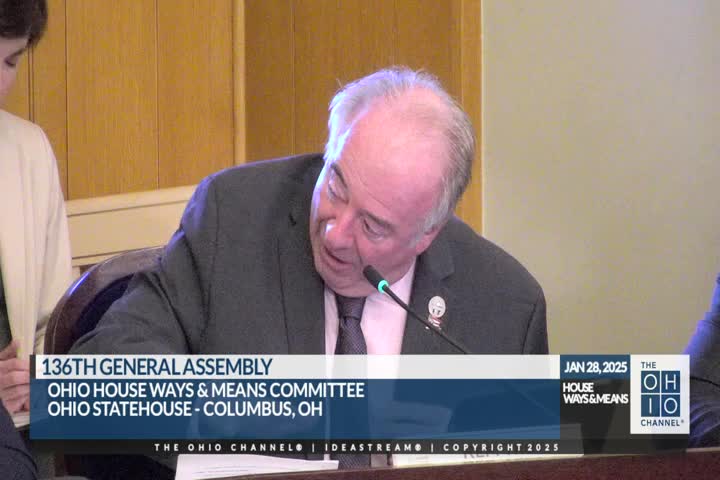
House Ways and Means holds first hearing on bill to align Ohio tax law with federal disaster-relief changes
Summary
The Ohio House Ways and Means Committee held a first hearing on House Bill 14 to incorporate recent Internal Revenue Code changes enacted by the Federal Disaster Tax Relief Act of 2023 into Ohio law.
The Ohio House Ways and Means Committee held a first hearing on House Bill 14 to incorporate recent Internal Revenue Code changes enacted by the Federal Disaster Tax Relief Act of 2023 into Ohio law.
Committee sponsors described the measure as a housekeeping, tax-conformity bill intended to make state income tax filings consistent with the federal changes that took effect after March 15, 2023. The federal act allows taxpayers affected by federally declared disasters to deduct certain personal casualty losses without itemizing, and it altered the federal adjusted gross income (FAGI) base used by some local school-district income taxes.
Committee members and sponsors said the Ohio Department of Taxation reviewed the federal changes and recommended the limited codification. Sponsors noted the change would ease filing for people who received settlements tied to disasters, specifically citing the East Palestine train derailment settlements as an example of why conformity matters. The bill also includes an emergency clause, according to testimony presented to the committee.
Members pressed sponsors on potential local impacts. Representative Richardson asked whether the bill’s change to the FAGI base could affect school funding because FAGI factors into some school-funding formulas; she asked that affected districts be notified. Sponsors said the impact would be de minimis and limited to districts that levy a school district income tax and that had residents who received disaster settlements. Representative Lear asked about fiscal-note materials and was told the Legislative Service Unit had not flagged any substantial local fiscal effect. Representative Troy and other members described routine yearly tax conformity as standard practice when the federal tax code changes.
A sponsor told the committee that prior action in the previous General Assembly (cited as House Bill 33) had already exempted certain payments from Ohio tax and that this measure formalizes remaining conformity items so taxpayers do not have to add and then subtract federally excluded disaster payments.
No roll-call vote occurred during the hearing. The committee concluded the first hearing on House Bill 14 and adjourned; sponsors and members indicated follow-up and routine committee consideration would continue as the bill moves through committee.