Get Full Government Meeting Transcripts, Videos, & Alerts Forever!
Get email alerts on the Energy And Natural Resources topic
No spam. Unsubscribe anytime.
House Energy Committee hears sponsor testimony on House Bill 15 to restrict utility generation ownership and shift tax treatment
Summary
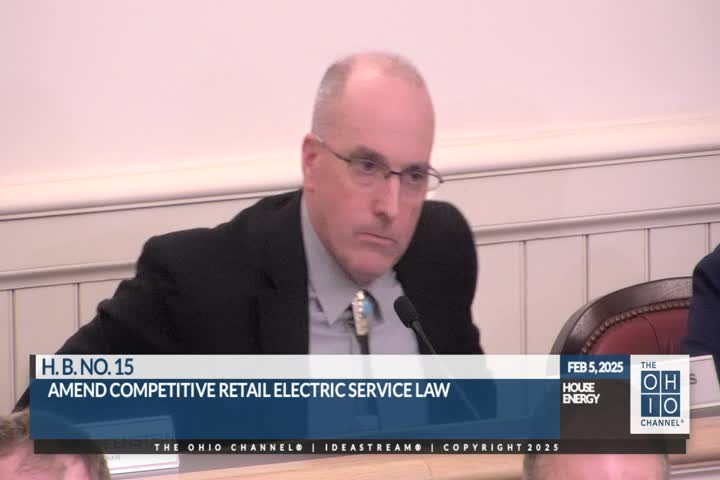
Vice Chair Representative Klopfenstein presented sponsor testimony on House Bill 15, which would bar electric distribution companies from owning generation, move tangible personal property tax collection away from generation facilities, and repeal the Electric Security Plan statute.
Vice Chair Representative Klopfenstein presented sponsor testimony on House Bill 15 to the House Energy Committee, describing the measure as an effort to modernize Ohio’s regulatory structure and encourage dispatchable baseload generation.
Klopfenstein said the bill would prohibit electric distribution companies from owning generation, bar distribution companies from bidding ratepayer-funded assets into wholesale markets, move tangible personal property tax collection away from generation facilities to transmission and distribution, repeal the Electric Security Plan (ESP) statute, and require standard service offers to be market-based. He said the legislation would also increase bonding requirements for competitive retail electric and gas suppliers, mandate customer notification for contract changes, and enable features such as consolidated billing and on-bill financing.
Klopfenstein framed the bill as a response to rapid load growth driven by large customers such as data centers. “We have witnessed an unprecedented surge in energy demand, with data centers alone consuming 600 megawatts of electricity. Forecast that this will increase to 5,000 megawatts by 02/1930,” he said. He also called for removing what he described as subsidies and market distortions, citing OVEC and the Ohio solar generation fund; Klopfenstein said OVEC subsidies had “already cost Ohioans” money since 2017 and said the solar fund “has collected somewhere around $60,000,000.”
Committee members asked detailed questions. Representative Brennan asked why repeal of OVEC-related payments was tied to the ESP repeal; Klopfenstein said refunding past payments sets a precedent and that the bill’s goal is to create a stable, forward-looking market environment to attract baseload developers. He said the committee could discuss making OVEC subsidies end immediately on enactment but emphasized that the bill’s main purpose is to change the framework that influences future investments.
Representative Isaacson asked about transmission expansion and how the PUCO and Ohio would participate; Klopfenstein and other committee members said the Power Siting Board and PUCO processes would be part of that discussion and that siting should be thorough but streamlined. Representative Hall and others pressed on the tax change: Klopfenstein said the intent is to move the point of collection for the tangible property tax so that the consumer ultimately pays the same amount and local governments continue to receive the same distributions, while making Ohio more competitive for long-lived baseload projects.
Representative Rader asked whether the committee would consider amendments to streamline OPSB permitting timelines; Klopfenstein said he supported efforts to reduce bureaucracy and would welcome that discussion. Multiple members raised concerns about relying on PJM market signals and how market design, interconnection queues and capacity auctions affect price signals and resource adequacy.
The committee approved the minutes from the previous meeting “without objection” and then called forward House Bill 15 for its first hearing; the sponsor’s testimony and the ensuing questions comprised the hearing. The committee scheduled continued consideration and proponent testimony at a subsequent session and asked staff to convene technical experts for future hearings.