Get Full Government Meeting Transcripts, Videos, & Alerts Forever!
Get email alerts on the Medicaid Budget topic
No spam. Unsubscribe anytime.
House Medicaid Committee receives primer; JMOC warns drug costs and retroactive payments drove recent spending spike
Summary
The Ohio House Medicaid Committee heard an overview of the Medicaid program from Legislative Service Commission fiscal staff and a briefing from the Joint Medicaid Oversight Committee (JMOC) on drivers of recent Medicaid spending growth and the JMOC rate that will constrain the next biennial budget.
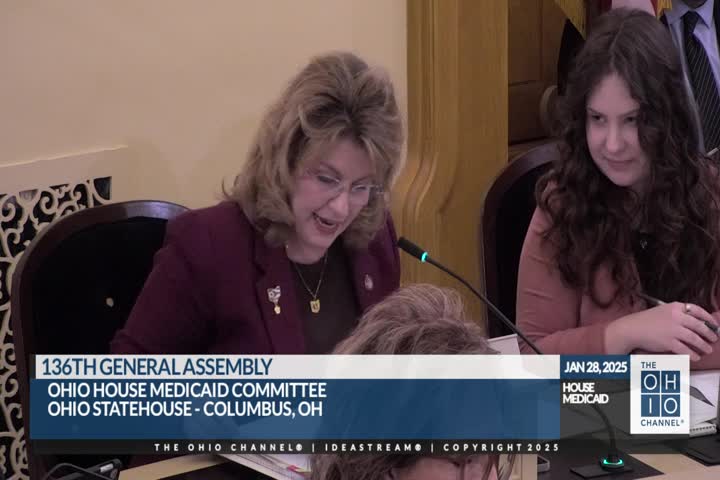
Chair Gross convened the Ohio House Medicaid Committee on Oct. 1, 2025, and said the panel’s work over the next five to seven weeks will be “vital to the success of the main financing in our state budget,” noting Medicaid’s outsized share of state spending and quoting Governor Voynovich’s description of it as the “Pac Man of the state budget.”
Ivy Chin, Medicaid division fiscal staff at the Ohio Legislative Service Commission, gave a history and primer on Medicaid in Ohio, emphasizing the program’s size and structure. “Currently about 3,000,000 people are in enrolled in Medicaid,” Chin said, and she noted Ohio’s estimated Medicaid budget for fiscal 2025 was close to $44,000,000,000. Chin explained that Medicaid is a joint federal–state program, that Ohio’s program is run by the Department of Medicaid and implemented across multiple state agencies, and that the program covers groups including children, pregnant women, adults, and elderly and disabled populations under different eligibility rules.
Jada Brady, executive director of the Joint Medicaid Oversight Committee, presented JMOC’s role and its most recent growth-rate work. Brady summarized that JMOC set a per-member-per-month (PMPM) growth, or JMOC rate, at 3.8% for fiscal 2026 and 3.7% for fiscal 2027 and explained the statutory requirement to limit PMPM growth to the lower of the JMOC rate or the three-year Midwest medical CPI average (1.5% for this biennium). “Every percent of Ohio's growth costs approximately $300,000,000,” Brady said, and JMOC’s analysis finds administrative and payment changes, pharmacy spending, provider rate increases and large retroactive payments as primary drivers of recent spending growth.
JMOC’s presentation highlighted specific drivers: pharmacy cost increases (accounting for over one-third of the total increase in recent years), higher nursing-facility per diems and wages for waiver workers, an elevated administrative spend tied in part to the state PBM transition, and nearly $1,000,000,000 in large retroactive payments identified around late 2023–early 2024. JMOC’s actuary (Optimus/CBIZ) calculated a gap between the Department of Medicaid’s growth estimate (5.3% for FY26 and 5.0% for FY27) and JMOC’s lower-bound numbers equal to roughly $450–$500 million for FY26 and $900–$1,000 million for FY27 (approximately $1.35–$1.5 billion across the biennium).
Committee members pressed on several operational and policy issues. Vice Chair Barhorst asked why federal and state shares differed markedly between 2023 and 2024; Chin attributed the change to increased provider rate increases in the prior budget cycle. Representative Hall and others asked for historical provider-reimbursement data and asked staff to share studies tracking reimbursement changes against the underlying cost of care; Chin and committee members agreed LSC would assemble prior years’ reimbursement information and that Chen would provide materials to the chair’s office for distribution. Representative Baker asked whether recent federal actions (a described “federal pause on spending”) have an immediate impact on Ohio’s Medicaid finances; staff said multiple federal policy changes are in process and that LSC can prepare scenario estimates, but exact effects depend on policy details and varying FMAP and federal rules across service categories.
Members also raised data-sharing concerns for behavioral-health and provider planning. Director Brady acknowledged past data-sharing efforts had paused in the last six months and said restoring a more robust, de-identified data-sharing program would be feasible and useful. Questions about estate-recovery receipts and where recovered dollars are deposited were raised; staff said the program is complex and would require follow-up for precise accounting.
Procedural matters recorded on the record included the committee’s acceptance of operating rules for the session (no objections) and the appointment of Ranking Member Rachel Baker as secretary, which the chair announced after hearing no objections.
The committee concluded after the briefings and directed staff to provide requested data and analyses to members as they prepare recommendations for the finance process.