Get Full Government Meeting Transcripts, Videos, & Alerts Forever!
Get email alerts on the Parking And Housing topic
No spam. Unsubscribe anytime.
Bellingham council adopts interim ordinance eliminating parking minimums, sets one-year study period
Summary
After a lengthy public hearing and more than two hours of public comment, the Bellingham City Council voted 5-2 to adopt an interim ordinance removing citywide automobile parking minimums and establishing consistent bicycle parking standards; the change becomes effective after a 15‑day adoption period and will be studied for one year.
The Bellingham City Council on Jan. 14 adopted an interim zoning ordinance that eliminates minimum automobile parking requirements citywide and establishes consistent long‑term bicycle parking standards, a measure council members and city staff said is intended to accelerate housing production, reduce construction costs and advance climate goals. The ordinance passed on a 5‑2 roll call vote.
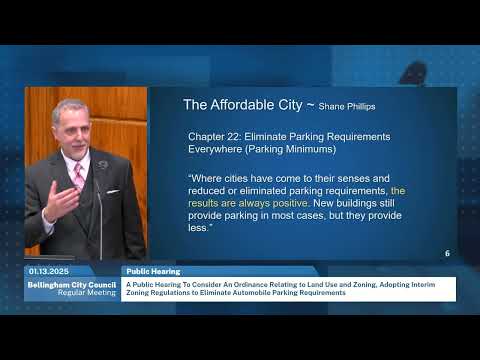
Director Blake Lyon, Planning and Community Development, told the council the measure is one part of a larger package of reforms intended to increase housing supply and improve multimodal streets. Lyon said cities that relax parking requirements often unlock more development and allow more units to be constructed on the same parcels, and he cited construction-cost estimates in the presentation, saying a structured parking stall can add about $20,000 per space and that accessory dwelling unit construction can run roughly $300–$400 per square foot depending on features.
Why it matters: The council and dozens of public commentators framed the proposal as a lever to address a housing shortage, reduce the city’s climate footprint and create more walkable urban places. Opponents and several commenters urged the council to attach affordability requirements or stronger accessibility and sidewalk provisions, and caregivers and disability advocates warned about impacts where sidewalks and on‑street parking are limited.
Most important facts
- The ordinance eliminates minimum automobile parking requirements citywide and adopts consistent long‑term bicycle parking standards for new development.
- Council adopted the ordinance after a public hearing and public comment; the final roll call was 5 in favor, 2 opposed (Lisa Anderson and Michael Lilliquis).
- City staff said, if adopted, the interim ordinance will become effective after a 15‑day adoption period and will remain in effect for one year while staff studies impacts and prepares a permanent code.
Staff presentation and rationale
Director Blake Lyon summarized earlier outreach and analysis, saying staff began discussions in May, followed the mayor’s executive order in November, and focused in December on elimination of parking minimums. Lyon presented five themes: housing production, equity, affordability, climate, and safety/placemaking. He told the council the measure is intended to be one tool among many and that the city would monitor and study outcomes during the one‑year interim period.
Lyon and staff noted technical housekeeping edits to the ordinance during the meeting, including correcting a state citation from a WAC reference to RCW 43.21C.045 to clarify the SEPA exemption for this interim action. He confirmed the ordinance includes a 15‑day adoption period and that the city proposes a one‑year interim effective window for study and refinement.
Public comment: themes and key quotes
About 60 people signed up to speak. Speakers broadly split on tactics but often agreed on goals—more housing and fewer car‑dependent environments—while disputing whether this ordinance should include mandatory affordability conditions or additional accessibility protections.
- Dr. Susan Kane Ronning, a licensed psychologist, urged linking parking reform to affordability, saying, “By lowering rental costs, affordability enables people with low incomes to spend more on other basic needs, such as food and medicine,” and warned of long‑term harms to children from housing instability.
- Carrie Burnside, organizer with the Bellingham Tenants Union and Silver Beach Neighborhood Association president, supported parking reform but urged at minimum a tenant‑protection or affordability element: “I hope you really consider that. Affordability measures can be added in even just a small measure that would help bring us a step closer.”
- Ben Besley, CEO of the Talbot Group and owner/manager of Berkeley Village, said removing parking minimums would unlock underused surface parking at office parks and facilitate conversions to housing: “This is acres and acres of land that could be dedicated to another use, specifically housing.”
- Diane Kitchen, a home caregiver and SEIU 775 union leader, described operational problems when parking is scarce and warned caregivers might have to refuse clients if they cannot park: “Where do I park to now serve this client? That means I have to refuse to take care of them.”
- Kyan (spelled Kyan in the record), a disability advocate, said many people with disabilities rely on cars and that removing parking requirements without additional accessible infrastructure could “ostracize and discriminate against many disabled individuals.”
- Randall Stamm, a parking and transportation professional, cautioned that eliminating requirement could increase pressure on neighborhood streets and said transit frequency and quality are the levers that reduce driving, not removing parking requirements alone.
- Several environmental and active‑transport groups, including Walk and Roll Bellingham and the newly formed Whatcom Environmental Council, urged council to pass the reform and to strengthen bike parking standards.
Council debate and amendments
Council members debated whether to make housekeeping edits immediately, table housekeeping until after public comment, and whether to attach affordability or infrastructure conditions. Council Member Jace Cotton moved to adopt technical edits requested by staff but later moved to table that motion until after the hearing; the council agreed to table housekeeping edits earlier in the meeting to allow public comment.
Later in the evening Council Member Cotton moved a separate amendment to adopt the edits Director Lyon had read into the record (correcting state code citations and cross references in the bicycle parking language). That amendment was approved on voice vote with one abstention; the council then resumed final consideration of the ordinance.
Vote and outcome
The council took final (third and final) action on the ordinance. The roll call on final adoption produced five yes votes and two no votes; the motion carried. Yes: Hannah Stone, Daniel Hamill, Skip Williams, Jace Cotton and Council President Holly Huffman. No: Lisa Anderson and Michael Lilliquis. The ordinance is interim, becomes effective after the 15‑day adoption window and will be studied for one year before staff returns with a recommended permanent code.
What the ordinance does not do
The interim ordinance does not itself: impose mandatory affordability requirements tied to every development that uses the waiver; create new sidewalk‑building obligations beyond existing development‑standards triggers; or set maximum parking limits. City staff and several council members said these topics will be part of the one‑year study and concurrent work such as the mayor’s executive order initiatives and proposed middle‑housing code changes.
Next steps and implementation
City staff will monitor effects during the one‑year interim period and return with recommendations for a permanent ordinance and any associated infrastructure or affordability measures. Staff reiterated that the SEPA exemption cited for the interim ordinance is RCW 43.21C.045, and that the ordinance’s effective date is contingent on the 15‑day adoption period described in the ordinance language.