Get Full Government Meeting Transcripts, Videos, & Alerts Forever!
Get email alerts on the Municipal Workplan topic
No spam. Unsubscribe anytime.
University City manager outlines 2025–27 work plan focused on economic development, public safety and operational reforms
Summary
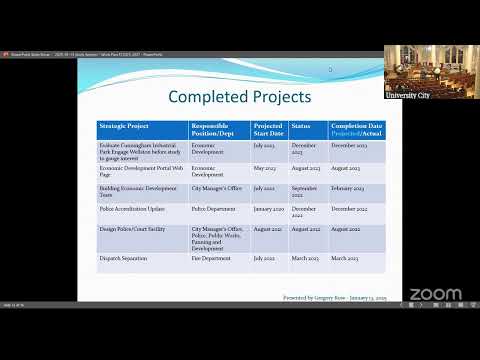
City Manager Rose presented a draft 2025–2027 work plan to the University City City Council at a Jan. 13 study session, laying out initiatives on economic development, public safety, internal operations and several policy studies that staff said will be used to guide budget recommendations this year.
City Manager Rose presented a draft 2025–2027 work plan to the University City City Council at a Jan. 13 study session, laying out initiatives on economic development, public safety, internal operations and several policy studies that staff said will be used to guide budget recommendations this year.
Rose told the council that the schedule for the plan is timed to inform the budget process: "to understand what your priorities are at this time will enable us to incorporate those priorities into the budget," he said. He said the presentation is the first part of the work-plan discussion and that he intends to finish the item at the Jan. 27 meeting.
The work plan groups projects under economic development, public safety, prudent fiscal management and organizational improvements. On economic development, Rose proposed a quarterly economic development report beginning in 2025, a revived business-retention program, a recruitment program for The Loop and a capital-improvement program (CIP) for Olive Boulevard. He said about $5,000,000 from the market-of-Olive development is being set aside for Olive Boulevard improvements and that other economic-development retail sales tax revenue could help fund projects once the city defines a vision for Olive Boulevard.
On The Loop, Rose proposed starting a capital recruitment program in July and asked that the council consider whether The Loop Special Business District’s activities should be supplemented by a dedicated CIP. He said the Loop district currently focuses on smaller, recurring items such as event support and that a broader capital program could prompt a discussion about a future vision for the corridor.
Public-safety items include identifying a West Side site for a joint police–fire satellite facility and continuing construction of the police and court facilities already underway. Rose also proposed evaluating a community paramedic program but said that, before the city advances that program, it "will need to work with the state legislature" to obtain authorizing legislation. Rose floated the possibility of a quarter-cent sales tax for fire services to fund paramedics and other equipment and recommended a staff report on options to supplement officer work, including technologies such as robotics.
The manager presented several operational and policy initiatives: a vacant-building fee concept to encourage reuse, a solid-waste rate study (which will examine whether the transfer station could be a revenue source), consolidation of boards, committees and commissions where appropriate, updates to the zoning code following the recent comprehensive-plan update, a stormwater ordinance review (under evaluation by a planning commission subcommittee), an asset-management program, online licensing payments, a fleet-management program and a resident-satisfaction survey.
Rose also flagged human-resources work including an updated personnel policy review, an employee Gallup survey and a salary survey that will inform a review of the police pension system. He said the citywide pension is about 94% funded but that the police pension still needs work: "the way that it's structured today simply does not work," he said.
Council members asked questions about how the various plans would be coordinated. Mayor Pro Tem Smothersson and other council members pressed whether the Olive Boulevard CIP and The Loop CIP should be separate or combined; Rose said they could be combined but that separate CIPs would highlight the distinct identities and capital needs of each corridor. Several members urged the administration to explain the origin of individual work-plan items—whether they derived from the comprehensive plan, a commission recommendation or council direction—so councilors can track why a project is proposed.
Members also discussed equity-focused business support. One council member expressed strong support for a minority- and women-entrepreneurship program, saying they "could not be more supportive" of the idea. City Attorney John Mulligan cautioned that the city must study the legal framework before designing a program, saying there appear to be opportunities "to promote women and minority entrepreneurship within the confines of the law," but that staff should study the matter before specific recommendations.
Public-safety staff answered questions about a West End satellite facility. City officials said the scale and projected crowding around forthcoming large retailers in the West End — including mentions of Costco and Target during the discussion — argued for planning a long-term dedicated facility or dedicated patrols as the area develops. Chief Hampton and other public-safety officials were asked to prepare operational analysis and reports.
Several council members encouraged attention to parks, consolidation of commissions, and outreach to neighboring jurisdictions for cost savings or revenue opportunities; Rose noted the city already participates in shared programs such as the SLATE insurance trust and joint purchasing and said staff will explore further opportunities.
No formal actions or votes were taken on the work plan at the Jan. 13 study session; Rose said staff will return at the Jan. 27 meeting to conclude discussion and incorporate council priorities into the budget process.