Get Full Government Meeting Transcripts, Videos, & Alerts Forever!
Get email alerts on the Radioactive Waste Energy Development topic
No spam. Unsubscribe anytime.
Committee advances bill authorizing fees tied to expansion of West Desert disposal facility
Summary
Senate Bill 216 was favorably recommended after proponents described a licensing pathway for Energy Solutions’ expansion in Clive and a newly imposed fee estimated at roughly $30 million to fund state energy development.
Senators on the Natural Resources, Agriculture and Environment Standing Committee on Feb. 5 favorably recommended Senate Bill 216, a measure sponsors said would create a streamlined process for an expansion of an existing licensed radioactive waste disposal facility in the West Desert near Clive, Utah.
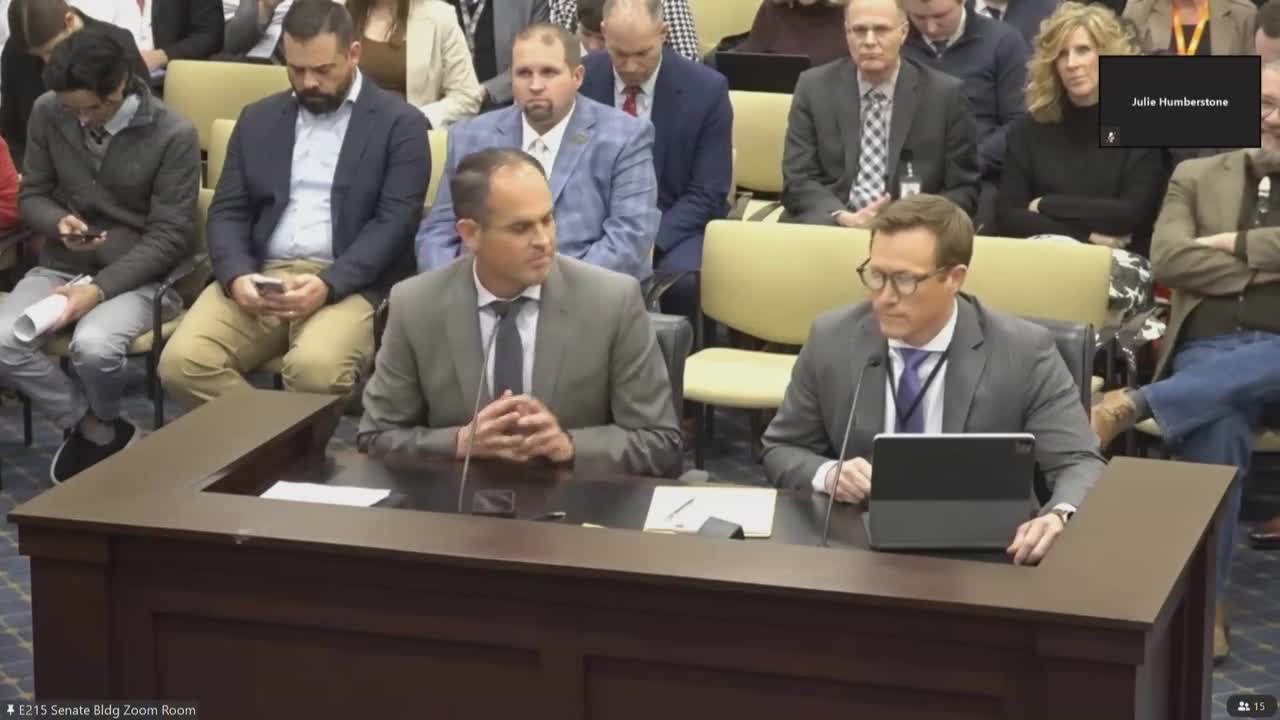
Casey Hill, representing Energy Solutions, told the committee the measure would allow an applicant already licensed to dispose of waste within a designated hazardous-waste corridor (Tooele County) to pursue an expansion without repeating the initial licensing steps. "This bill ... deals with the expansion of our facility in the West Desert out in Clive, Utah. It essentially just lays out a streamlined process for expansion of an existing facility," Hill said.
Hill said the bill includes a tax equal to $3.45 per cubic yard of new licensed disposal volume, capped at 8,700,000 cubic yards — a provision Hill described as creating an obligation that would generate roughly $30,000,000 for the state to allocate to new energy development. He told the committee the fee is part of a public–private partnership approach and called the allocation to energy development a benefit to Utah.
Committee members questioned whether the facility accepts medical-related low-level radioactive waste generated by dental and hospital sources. Hill said those materials are typically required by regional compacts to be disposed of in a facility in Washington state. He described the Clive facility as licensed to accept "Class A" low-level radioactive waste and said that expansion would not change that classification. On historic safety, Hill said the company has operated in the state more than 30 years and that instances requiring regulator intervention have been "very few and very limited," and that the division’s oversight has prevented exposure to the public.
Senators discussed the bill and, after no public testimony in opposition, Senator Hinkins moved that the committee favorably recommend the bill. The transcript records the committee's approval with the comment "That bill passes 3 2 1," recorded by the chair; no roll-call names or a conventional yes/no tally were provided in the hearing transcript.
Why it matters: The bill would create a faster pathway for expanding a licensed radioactive disposal site while imposing a per-volume fee that sponsors said would fund new energy projects. Supporters emphasized that the facility accepts only the lowest class of low-level radioactive waste and that public exposure has not occurred. Critics were not present for the committee hearing; some senators used the discussion to note the state's interest in energy development and the role of nuclear-related infrastructure.
The bill moves to the next stage of the legislative process for further consideration.