Get Full Government Meeting Transcripts, Videos, & Alerts Forever!
Get email alerts on the Sustainable Aviation Fuel topic
No spam. Unsubscribe anytime.
Lawmakers hear broad support for incentives and studies to advance sustainable aviation fuel production; some environmental groups urge caution on Clean Fuel S.
Summary
Senate Bill 5,601 would fund and incentivize in‑state production and distribution of alternative jet fuels, create a Commerce‑run grant program for blending/loading infrastructure, adjust tax deferral and exemption rules for AJF equipment and require Ecology to study local biomethane availability.
Senate Bill 5,601 would advance Washington’s alternative jet fuels (AJF) agenda by authorizing a Commerce Office grant program for fuel production and distribution infrastructure, expanding certain tax deferrals and exemptions to apply to AJF production equipment, and directing the Department of Ecology to study biomethane availability and to explore a programmatic environmental impact statement for AJF pathways.
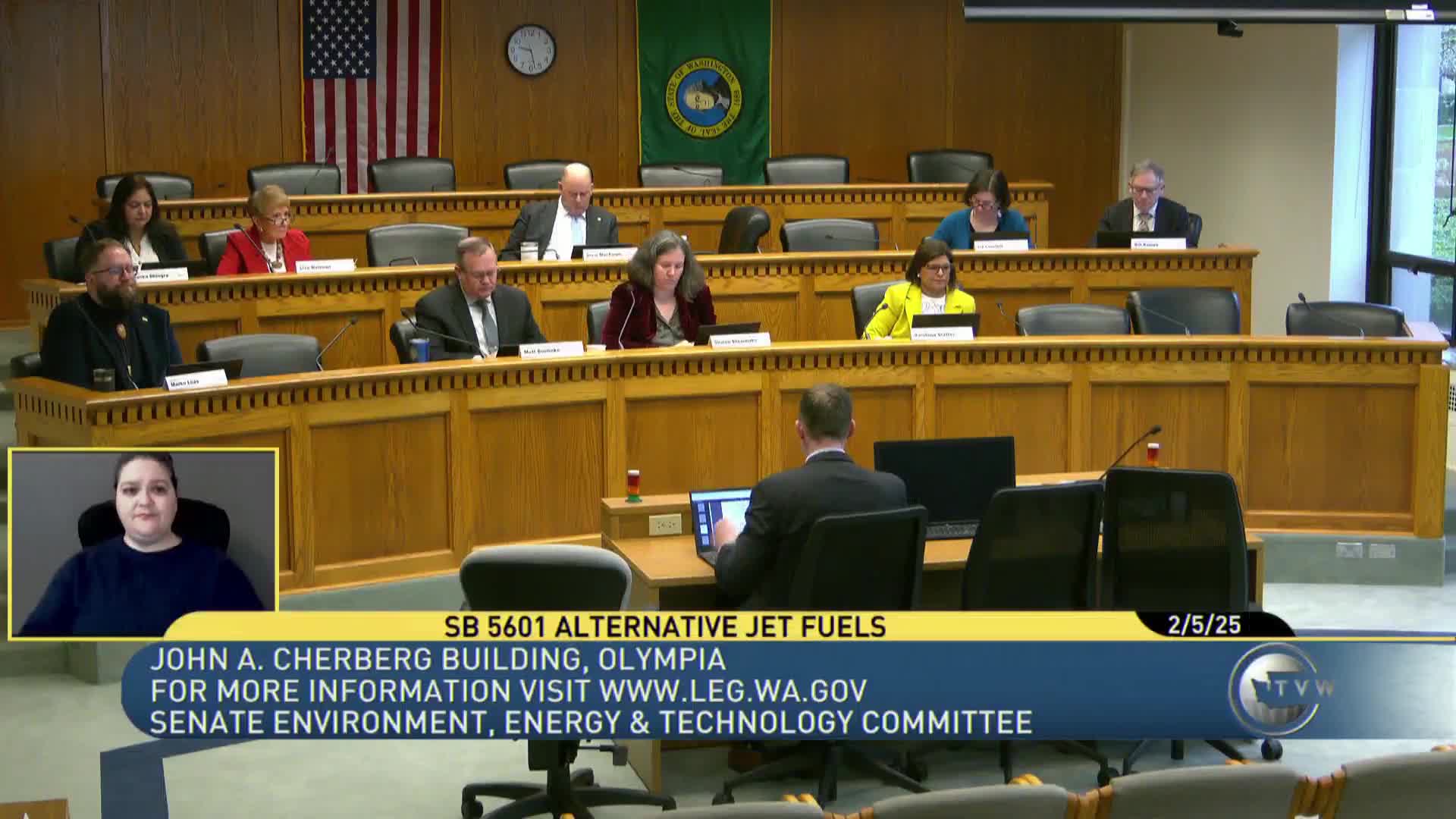
Department of Commerce and committee staff summarized the bill’s components and the AJF work group’s 2024 recommendations. Matt Shevberg, committee staff, described proposed elements including a Commerce‑administered grant program for qualifying infrastructure (rail spurs, barging, loading racks and blending equipment), an Ecology study on biomethane availability with deliverables by January 2026, and extensions of clean energy tax deferral and property/leasehold tax exemptions to certain AJF manufacturing equipment.
Supporters from industry and local government emphasized jobs, economic investment and the need for feedstock access. Darren Morgan of Sky Energy said his company plans a Walla Walla County facility that would produce 50 million gallons of SAF per year and estimated nearly $2 billion in regional investment and more than 100 permanent jobs. Mike Fong (Snohomish County) and Port and airport representatives urged permitting and infrastructure support to convert pilot projects to commercial scale and noted facilities for testing and blending could be enabled by seed grants. Scott Kennedy of Alaska Airlines said SAF is core to aviation decarbonization but currently makes up less than 1% of available jet fuel and is two to three times the cost of conventional jet fuel, limiting commercial uptake without incentives.
Some environmental groups asked for caution about limiting Ecology’s ongoing Clean Fuel Standard rulemaking. Joel Creswell, Climate Pollution Reduction Program Manager at Ecology, told the committee that SB 5601’s Section 3 would prohibit Ecology from finalizing certain Clean Fuel Standard rule changes relating to biomethane until the mandated study is complete and that delaying ecological rule adjustments could postpone the agency’s ability to align market incentives with program goals. Climate advocates and some environmental organizations recommended removing or changing Section 3 so it would not interrupt the department’s existing rulemaking process.
Several stakeholders favored the biomethane availability study as a useful data source; industry and RNG (renewable natural gas) trade groups said an analysis would clarify feedstock supply from landfills and digesters and help site production facilities. Supporters also argued that in‑state production brings local air quality benefits near airports and broader economic development.
No committee votes were recorded in the transcript. The bill includes a tax‑preference performance statement and requests a JLARC review; staff said a fiscal note had been requested but was not yet available at the hearing.