Get Full Government Meeting Transcripts, Videos, & Alerts Forever!
Get email alerts on the Broadband Universal Service topic
No spam. Unsubscribe anytime.
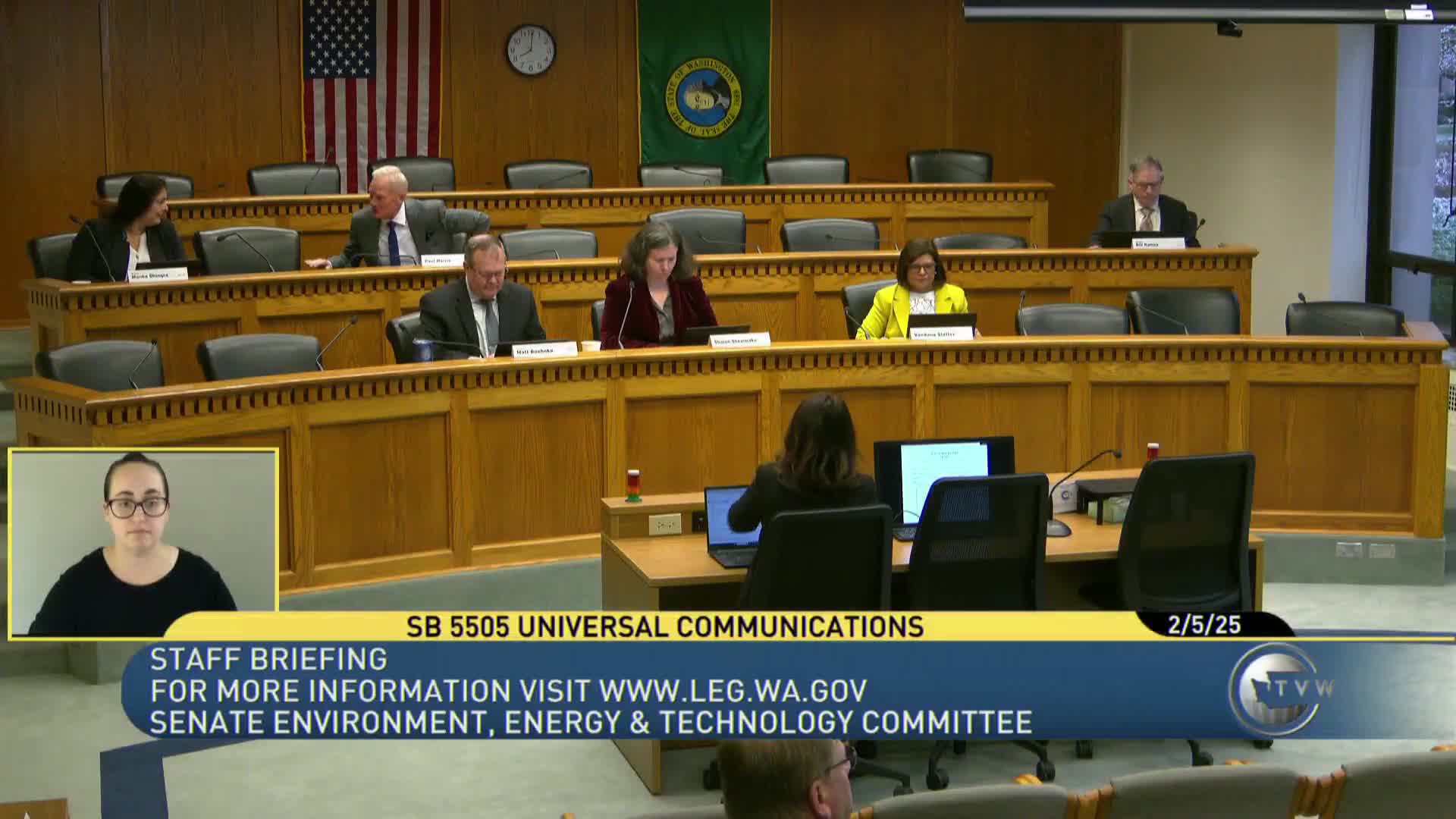
Senate committee hears testimony to renew State Universal Communication Services program to aid rural phone and broadband providers
Summary
Senate Bill 5,055 would renew Washington’s State Universal Communication Services Program and expand the program’s stated purposes and eligible uses to include broadband deployment and reliability for public safety, telemedicine, distance learning and public libraries.
Senate Bill 5,055 would renew Washington’s State Universal Communication Services Program and expand the program’s stated purposes and eligible uses to include broadband deployment and reliability for public safety, telemedicine, distance learning and public libraries.
The committee heard from Alicia Kinney Clawson, staff to the committee, who summarized the bill. "The program expired in 2024," she said, "and the bill before you renews the program through July first of 2027 and modifies the program purposes, allowable fund uses, and eligible telecommunication service providers." The bill also would lower the population threshold used to define eligible incumbent providers from 40,000 access lines to 20,000 access lines and add requirements such as battery backup systems and 911 connectivity.
Why it matters: supporters told the committee the program subsidized costly infrastructure and reliability measures for small, rural carriers that are otherwise unlikely to be profitable. Rick Vitsnam, chief financial officer for Klamath Telephone Company and Tono/ Tenino (as stated in testimony) Telephone Company, described his carriers as "the carrier of last resort" for roughly 4,000 customers across a remote service area and said the program funded generators, backup communications and other measures that keep 911 services functioning during outages. "The cost to do this is extremely high, and the universal state communications program is an important key product to that," Vitsnam said.
Other rural operators reinforced that testimony. Clint Volk, fire chief of Mesa County Fire District 6, said many residents in his district still rely on landlines and that upgrades tied to enhanced e-911 capability were vital to emergency response. Michael Bozzallo, vice president of Hood Canal Communications, said prior state funding allowed his company to buy a $68,000 backup generator that powers a head-end site used by the county 911 dispatch center and co-located servers. He told the committee that without the program, providers would be limited to smaller, incremental projects tied to firm capital rather than comprehensive, cost-effective build-outs.
Committee members asked about overlap with federal broadband programs and whether the program would duplicate, complement or complicate distribution of BEAD or other federal funds. Alicia Kinney Clawson said a fiscal note had been requested and was not yet available and that details about BEAD spending were not yet finalized; she said staff would attempt to collect additional information about overlap.
What was not decided: the hearing was a public bill hearing; no committee votes were recorded in the transcript. The fiscal impacts, including the requested fiscal note, were noted as pending.
Closing: supporters asked the committee to restore the program to address reliability, emergency communications and the high costs of serving remote customers; the bill remains under committee consideration.