Get Full Government Meeting Transcripts, Videos, & Alerts Forever!
Get email alerts on the Children In Crisis topic
No spam. Unsubscribe anytime.
Lawmakers hear extension for rapid care team for children in crisis; bill adds flexible funding
Summary
Senate Bill 5427 would extend the multisystem rapid care team and project director role that helps find community placements and services for children with complex needs who otherwise remain hospitalized.
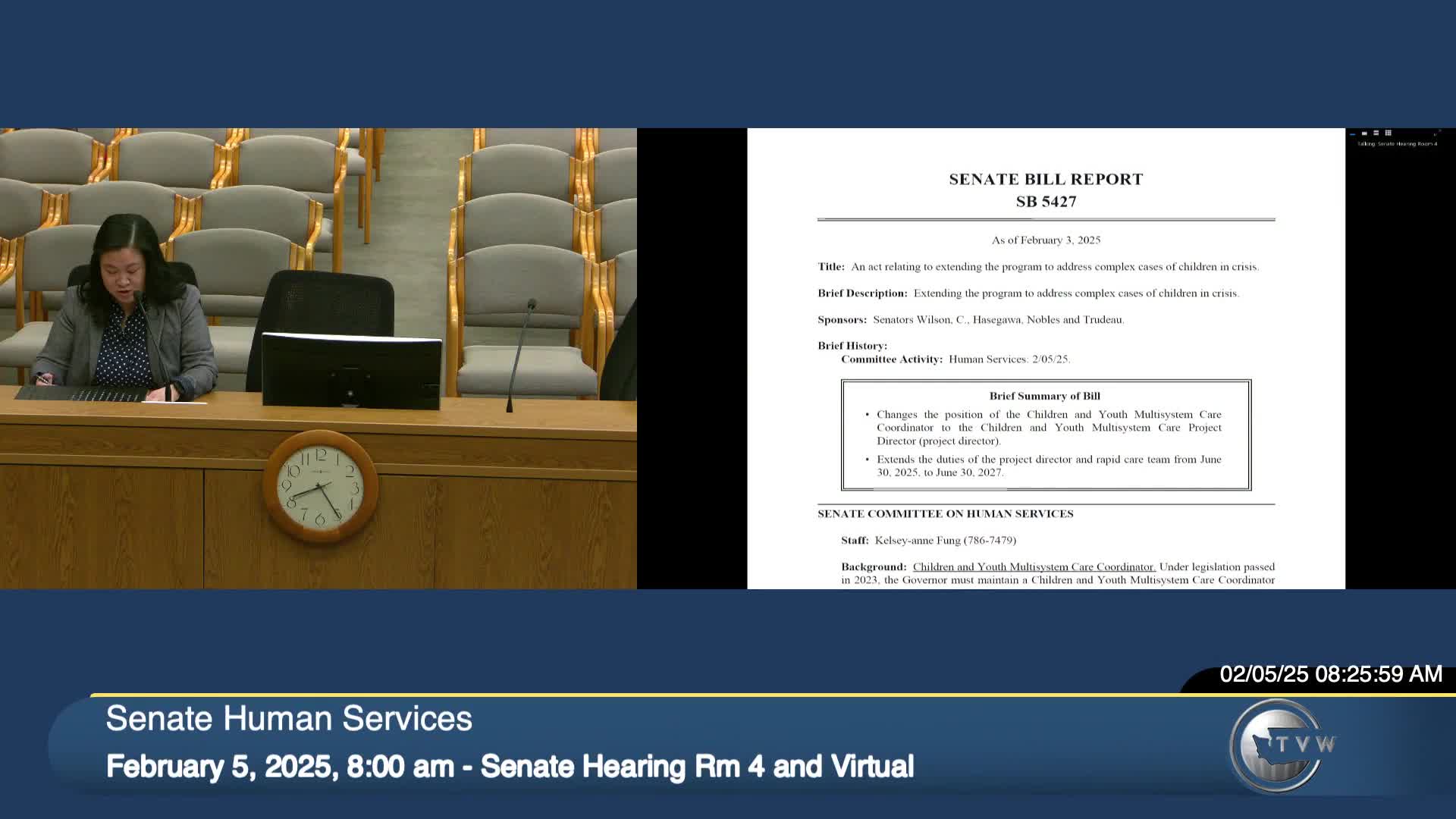
Senate Bill 5427, sponsored in the Senate by Claire Wilson, was the subject of a Feb. 5 hearing before the Washington State Senate Human Services Committee. The bill would extend the children- and youth-multisystem-care project and the rapid care team established under 2023’s House Bill 1580 for two additional years, through June 30, 2027, and rename the care coordinator position as a project director.
Kelsey Ann Fung, committee staff, summarized the bill’s provisions and fiscal implications: the substitute removes outdated initial and final reporting requirements and replaces them with an annual report to the legislature; it includes an emergency clause; and a fiscal note shows $454,000 for the 2025–27 biennium for Health Care Authority participation and $6,000,000 for the governor’s office for staff and flexible funding for housing and wraparound services to support safe discharge and prevent future hospitalization of children in crisis.
Senator Claire Wilson, the bill sponsor, described the program’s origins in a behavioral-health work group that identified children who remained in hospitals “for many reasons,” including lack of an appropriate placement. She told the committee that between January and August 2024 the program served 36 children and that more than two‑thirds of cases staffed by the rapid care team transitioned to closed or monitoring status.
Takumi Minesita, project director in the governor’s office (children and youth multisystem care), said the rapid care team uses a two‑tiered approach—child‑specific case conferencing paired with systems‑level meetings—and that it has directly supported more than 60 children and their families. He described the program as “human centered, data driven, integrated” and said partnerships include hospitals, state agencies, service providers and people with lived experience.
Health systems and family advocates described expected benefits and data from the first year of operation. Kashi Arora of Seattle Children’s said the rapid care team “has made dramatic improvements” in care planning and discharge processes and that Seattle Children’s has referred more than 25 youth in the past year. Stacy Dam of The Arc of Washington State cited report figures showing that three out of four children served had intellectual or developmental disabilities and that 66% had an autism diagnosis; she urged including public education partners and enhancing crisis infrastructure.
Family representatives and parent‑led organizations said flexible funding was essential. Cheryl Landstrom, who serves on the rapid care team as a lead parent support specialist, said the program’s flexible funding and interventions can prevent children from remaining in hospitals for months or years. Rochelle Madigan and Kimberly Runge gave examples—one involving out‑of‑state specialized treatment enabled by rapid-care coordination and flexible funds—and urged extension of the program.
Supporters said the program has reduced hospital stays and improved discharge planning for children with complex behavioral-health, developmental and medical needs. The bill would continue that work and provide flexible funds to support tailored, person‑centered solutions.
No committee vote on SB 5427 is recorded in this transcript; the hearing closed after panel testimony and the committee prepared for executive session.
Why it matters: Witnesses described children with developmental disabilities and co‑occurring mental health conditions as disproportionately represented among youth who remain hospitalized because no appropriate placement or discharge plan exists. Advocates and hospital staff argued that the rapid care team’s cross‑agency coordination and use of flexible funds reduce unnecessary hospital stays and connect children to community supports.