Get Full Government Meeting Transcripts, Videos, & Alerts Forever!
Get email alerts on the Child Welfare Housing topic
No spam. Unsubscribe anytime.
Committee hears bill to expand child-welfare housing assistance, staff: 108 families on wait list
Summary
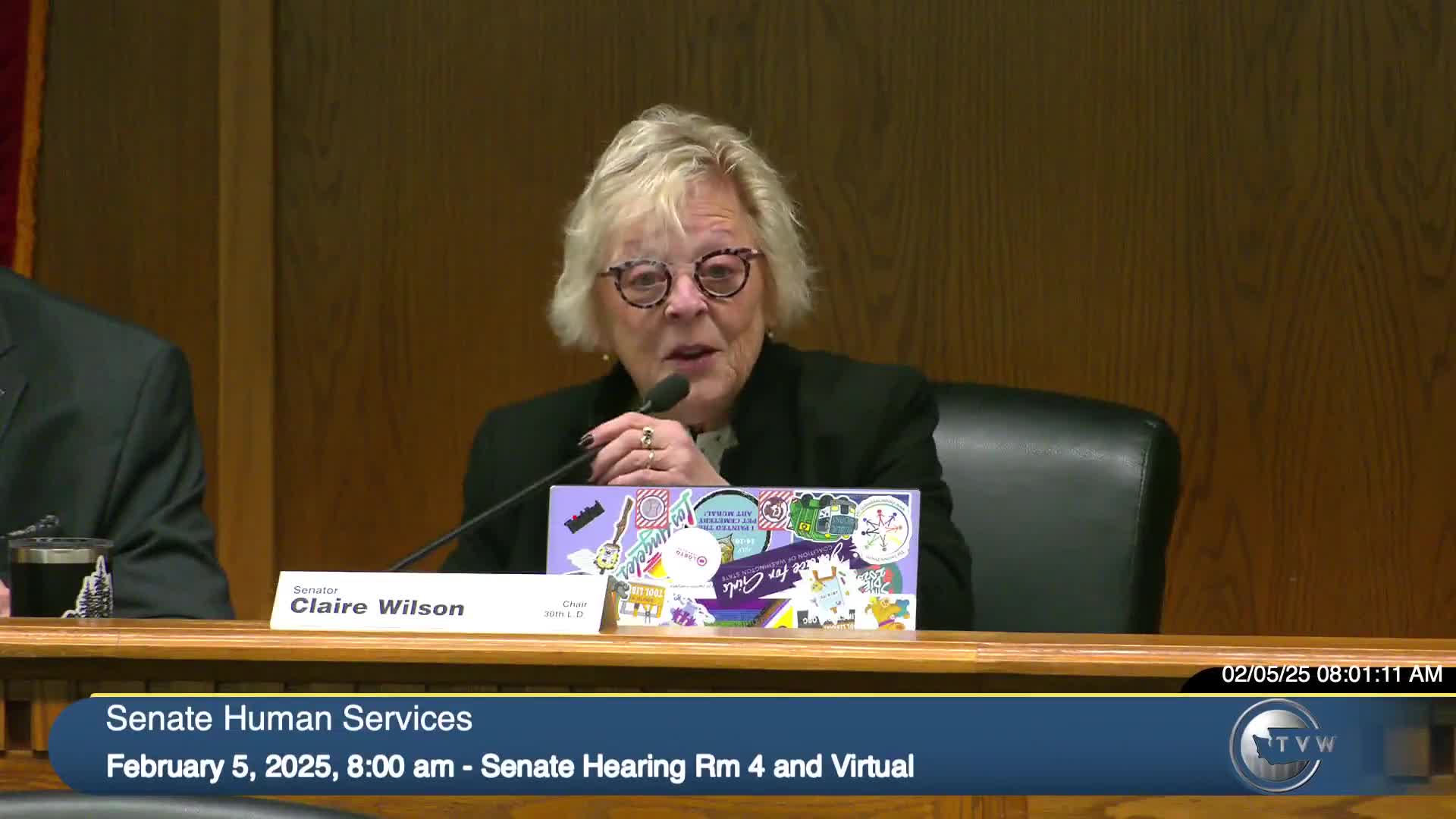
Senate Bill 5508, which would expand and clarify the state’s child welfare housing assistance program, was the focus of testimony during the Washington State Senate Human Services Committee’s Feb. 5 hearing.
Senate Bill 5508, which would expand and clarify the state’s child welfare housing assistance program, was the focus of testimony during the Washington State Senate Human Services Committee’s Feb. 5 hearing.
Alison Mendiola, committee staff, briefed members on the bill and described the program’s goals and requirements. The child welfare housing assistance program, administered by the Department of Children, Youth, and Families (DCYF), was created as a pilot in 2019 and made permanent in 2023. Mendiola said DCYF “is to increase the number of households served by the program by at least 200 above those served during fiscal year 25” during the 2025–27 biennium and to maintain at least that number beginning July 1, 2027. She also said DCYF must adopt rules for program implementation and provide an annual report to the legislature beginning Nov. 1, 2024.
The program provides vouchers, rental assistance, navigation and other supports to families when lack of appropriate housing is the remaining barrier to reunification or when housing instability is a barrier to keeping a child in the home. Mendiola reported that 464 families were served in fiscal year 2024 and that 108 families were on the program wait list.
“Too often children are unnecessarily separated from their families and their parents, not because of neglect or abuse, but simply because their families can't afford housing,” said Senator Krishnadassan, the prime sponsor. “No child should have to grow up away from their family due to financial hardships alone.”
Witnesses from advocacy and service organizations urged committee support and highlighted cost and trauma considerations. Kim Justice of Partners for Children, testifying in support, said the program “is a lifeline” and argued it is more cost-effective than foster care because it leverages federal housing vouchers and reduces foster-care stays. Michael Mirra, who testified on behalf of the Association of Washington Housing Authorities and the Administrative Office of the Courts’ Housing and Child Welfare Committee, described an MOU between DCYF and housing authorities that pledged vouchers and housing resources conditioned on DCYF offering supportive services. Mirra said the legislature provided $7.6 million in 2023 to begin that work and cited an estimate that fully serving all eligible households could cost about $45 million per biennium while creating housing resources worth about $60 million and saving roughly $26 million in averted foster-care costs.
Shranda Selivanoff of the Washington State Office of Public Defense urged passage and highlighted DCYF data she cited: “2 in 5 families involved in the system need housing assistance to be reunified,” and that the average yearly cost per placement is, she said, $41,385. Jason Bragg, who serves as a statewide housing liaison for contracted attorneys, also supported the bill and emphasized the fiscal burden on the state for foster-care placements when families are eligible for federal Title IV-E reimbursement but remain separated because of housing instability. Parent ally Jennifer Justice offered a first-person account of how receiving housing assistance led to reunification and recovery, saying the Section 8 assistance gave her “a chance for stability for me and my children.”
Committee staff noted a fiscal note that characterizes costs as non-zero and indeterminate, with an estimate of just over $4,000,000 for the 2025–27 biennium tied to program expansion language in the bill.
No formal committee action on SB 5508 was recorded in this transcript; the hearing closed after witnesses finished testimony and the committee moved to a separate agenda item.
Why it matters: Committee staff and witnesses said the program targets housing instability as a direct barrier to reunification and that the state may realize net savings when shorter foster-care episodes and reduced placements are taken into account. Advocates emphasized both cost and trauma avoided when children remain with families.
The committee hearing record shows continued stakeholder interest and a mix of policy and fiscal questions that staff said will be addressed in implementing rules and in any future budget deliberations.