Get Full Government Meeting Transcripts, Videos, & Alerts Forever!
Get email alerts on the Step Housing Siting topic
No spam. Unsubscribe anytime.
Committee hears bill to streamline siting and permitting for supportive and emergency housing
Summary
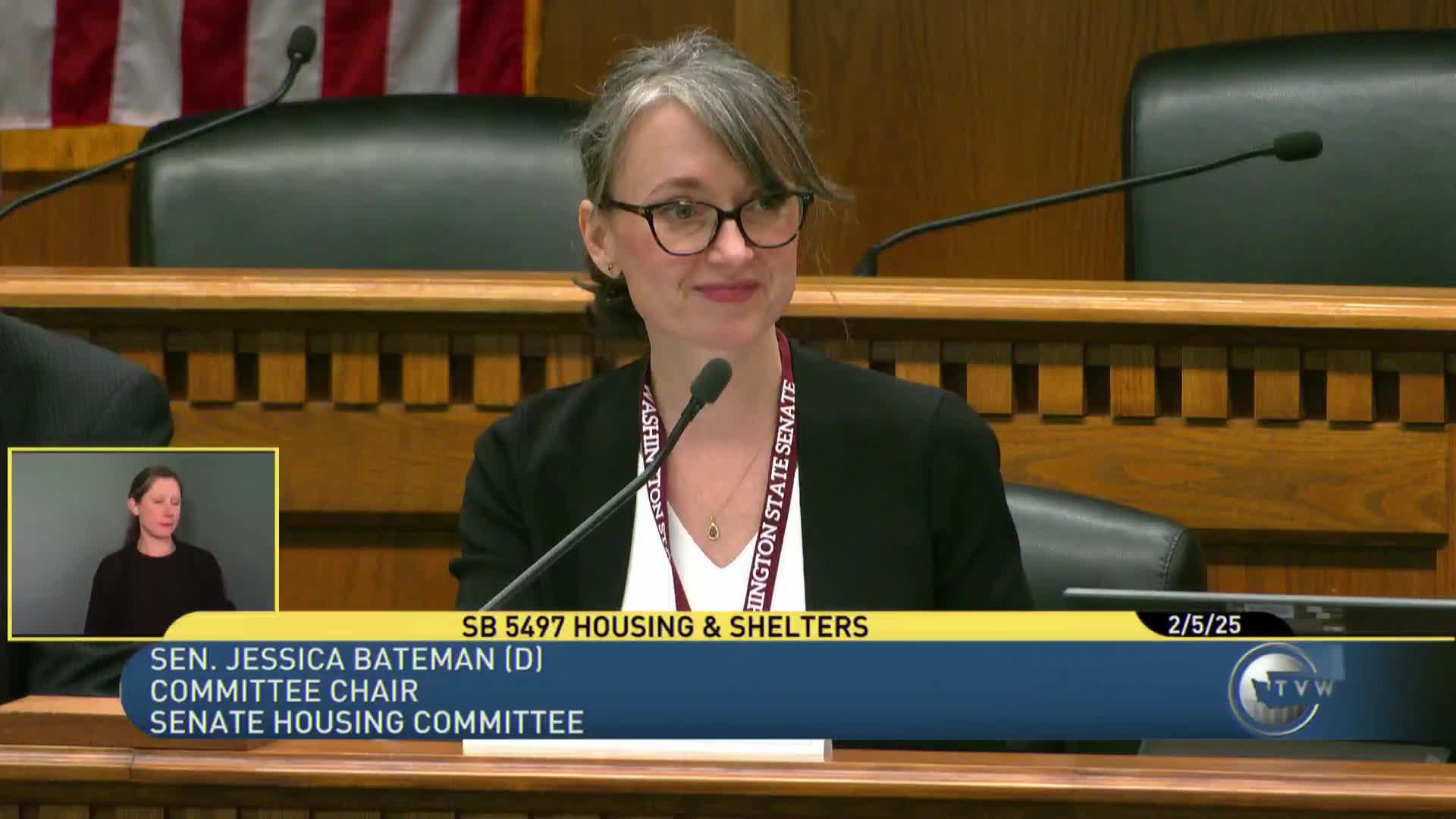
The Washington State Senate Housing Committee took testimony Feb. 5 on Senate Bill 5,497, which would require administrative permitting and a Commerce‑led dispute resolution process for permanent supportive, transitional and indoor emergency housing in fully planning Growth Management Act jurisdictions.
The Washington State Senate Housing Committee took testimony Feb. 5 on Senate Bill 5,497, which would standardize siting and permit procedures for permanent supportive housing, transitional housing, indoor emergency housing and indoor emergency shelters (collectively described in testimony as “step housing”). The bill would require cities and counties that fully plan under the Growth Management Act to approve step‑housing permit applications using an administrative process based on objective standards, allow a waiver process when local regulations preclude siting, and authorize the Department of Commerce to resolve disputes and, if noncompliance persists, withhold certain state revenues from a jurisdiction.
Ben Bridal, committee staff, told the committee that under the bill a city or county "must approve any permit application for step housing using an administrative process only" and that Commerce may reverse local decisions it finds noncompliant and require corrective action within 60 days. Bridal also noted an estimated fiscal impact: approximately $1.6 million in expenditures in the 2025–27 biennium and about $3.0 million in a four‑year outlook, with additional estimated local costs.
Sponsor Senator Liz Alvarado said the measure aims to remove unreasonable local barriers that delay or block facilities designed to shelter and house people experiencing homelessness. "Local government can't in good faith oppose unsheltered homelessness while also blocking every measure to shelter and house people," Alvarado said, and urged the committee to provide dispute‑resolution tools and consequences for obstruction.
Nonprofit and housing‑sector witnesses described repeated permitting delays, public opposition campaigns, and the costs of stalled projects. Dan Wise, agency director at Catholic Community Services of King County, said local opposition often masks stigma and delays projects that serve single adults. Michelle Thomas of the Washington Low Income Housing Alliance described a recent example where misinformation and prolonged public debate nearly jeopardized a shovel‑ready, fully funded project that ultimately relocated and was delayed by a year. "When new housing like this becomes public debate, it wastes valuable resources, time, energy, and funding," Thomas said.
Local government associations were more cautious or neutral. Curtis Steinhauer of the Washington State Association of Counties said the association was neutral but urged changes made in the House companion bill be mirrored in the Senate version; counties' remaining concern centered on the bill's automatic penalty structure, which could restrict revenues that fund local programs. Karl Schrader of the Association of Washington Cities said many cities support shelter siting but object to removing local authorities to regulate occupancy, intensity of use and spacing in all residential neighborhoods and raised concern about Commerce having final decisions with no appeal.
The committee heard favorable testimony from planning professionals and service providers including Bryce Yaden of FutureWise and Joe Tovar of the American Planning Association Washington chapter, who recommended technical amendments to improve the bill's as‑applied enforcement language and the Commerce model ordinance.
No final vote was taken on SB 5,497 during the Feb. 5 hearing. Supporters said the bill is intended to speed development of life‑saving shelter and supportive housing; local governments and associations asked for technical fixes to preserve reasonable local regulatory tools and to address the bill's penalty provisions.