Get Full Government Meeting Transcripts, Videos, & Alerts Forever!
Get email alerts on the Housing Investors Single Family topic
No spam. Unsubscribe anytime.
Committee hears bill to limit institutional purchases of single‑family homes
Summary
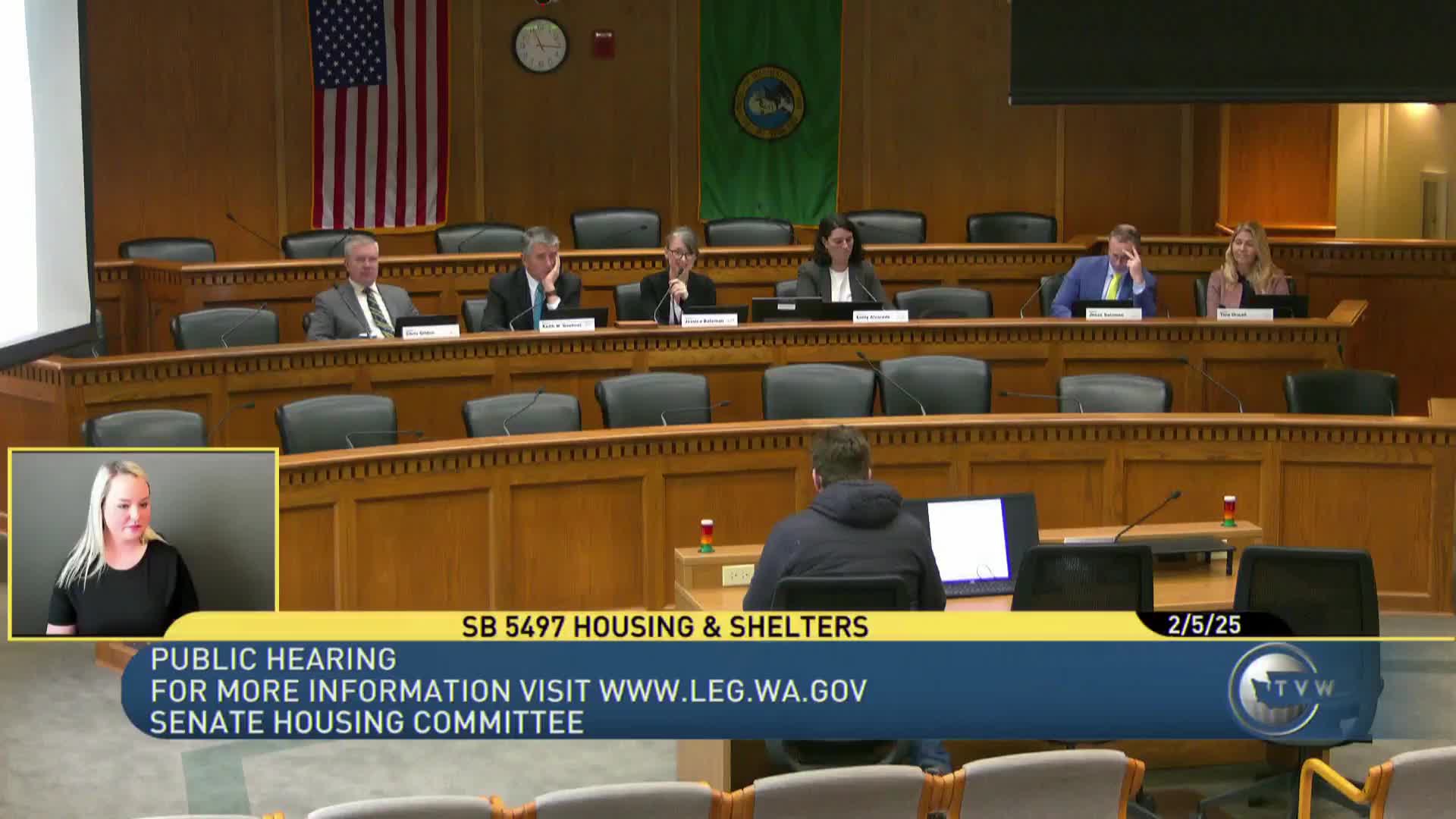
Senators on the Washington State Senate Housing Committee heard public testimony Feb. 5 on Senate Bill 5,496, a measure that would prohibit certain investment entities from buying additional single‑family residential properties in Washington once they hold an interest in more than 25 such homes, with limited exemptions and a civil penalty enforceable by the state Attorney General under the Consumer Protection Act.
Senators on the Washington State Senate Housing Committee heard public testimony Feb. 5 on Senate Bill 5,496, a measure that would prohibit certain investment entities from buying additional single‑family residential properties in Washington once they hold an interest in more than 25 such homes, with limited exemptions and a civil penalty enforceable by the state Attorney General under the Consumer Protection Act.
Bill Fosbury, staff to the committee, summarized the proposal and a proposed substitute that adds a limited exemption for entities that acquire a property through foreclosure when the entity is already servicing a recorded loan on that property. "It prohibits an investment entity like a REIT or a business entity that has an interest in more than 25 single family residential properties from purchasing, acquiring, or otherwise obtaining an interest in another single family residential property with certain exceptions," Fosbury told the committee.
Vice Chair Senator Liz Alvarado, the bill sponsor, framed the measure as a way to preserve homeownership opportunities for Washington families. "We need to do everything possible to increase access to homeownership and that's why this bill takes preventative steps to stop institutional investors from buying single family homes and crowding out Washington home buyers," Senator Alvarado said.
Supporters including Ethan Robinson, advocacy and policy manager at Habitat for Humanity Seattle‑King and Kittitas Counties; Nick Federici of the Northwest Community Land Trust Coalition; and Denise Rodriguez, executive director of Washington Homeownership Resource Center and member of the Black Home Initiative, said institutional purchases—often all‑cash offers—reduce inventory at lower price points and make it harder for first‑time buyers and buyers using VA or FHA loans to compete. "This bill represents an important step toward preserving homeownership opportunities for Washington residents," Robinson said.
Opponents raised concerns about legal and market consequences. Brent Ludeman of the Building Industry Association of Washington and Morgan Irvin of the Association of Washington Business asked how the bill would define "interest," whether minority investors or lenders would be captured, and how the restriction would operate during downturns or when builders need to offload large numbers of homes. "There are far more questions than answers at this point," Ludeman said. Morgan Irvin warned the bill might unintentionally sweep in local housing providers and builders who hold portfolios for practical reasons.
Other witnesses included Riley Benge of Washington Realtors, who urged care to avoid capturing local providers and suggested alternatives such as a waiting period; Kevin Hunter, a community development professional who said the bill could help stabilize neighborhoods; and Tim Eiman, a private-sector testifier who called the proposal an arbitrary interference with market transactions.
The committee did not take a vote on SB 5,496 during the Feb. 5 hearing. Committee staff noted a requested fiscal analysis and identified a House companion, HB 1732, that had not yet been heard. The proposed substitute and the foreclosure servicing exemption were summarized on the record.
Why it matters: proponents argued institutional accumulation of single‑family homes can reduce entry‑level inventory, raise prices at the bottom of the market and make it harder for first‑time homebuyers to build wealth; opponents cautioned about definitional gaps, impacts on legitimate local housing providers, and unintended effects in market downturns. The bill remains in committee.