Get Full Government Meeting Transcripts, Videos, & Alerts Forever!
Get email alerts on the Economic Development Energy Materials topic
No spam. Unsubscribe anytime.
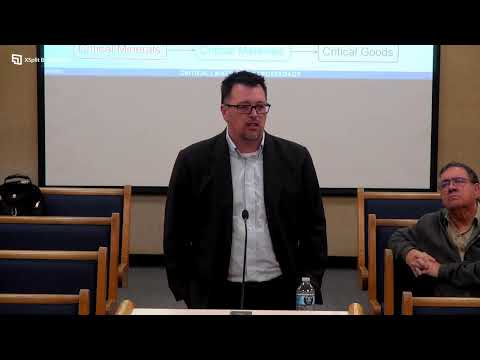
UMKC outlines Critical Materials Crossroads plan for Lake City site; council presses environmental, workforce and timeline questions
Summary
University of Missouri–Kansas City representatives presented a plan on Jan. 27, 2025, to develop a Critical Materials Crossroads manufacturing and research campus at the Lake City Army Ammunition Plant and answered council questions about jobs, environmental controls and timelines.
University of Missouri–Kansas City (UMKC) representatives presented the Critical Materials Crossroads (CMC) proposal at the City Council study session and described plans to develop a manufacturing and innovation campus on the Lake City Army Ammunition Plant site.
Jamie Andes, who said he works for UMKC and is leading the project team, told the council the campus would focus on midstream battery-material processing — refining concentrates into battery-grade powders and producing cathode active material (CAM) for battery manufacturers. Andes said the plan would include research and pilot-scale manufacturing areas, private development for full-scale manufacturing and workforce and wraparound services coordinated with area school districts and community partners.
Andes described projected economic impacts the team has cited from third-party analysis: roughly 10,000 jobs tied to the project (about 2,500 direct jobs on campus and the remainder induced or indirect), and a multi‑billion‑dollar regional economic gain (UMKC presented figures of about $17 billion in one projection and a linked $40 billion figure in longer-range forecasts). He said the campus could produce on the order of 100 kilotons per year of cathode active material at full buildout and emphasized the importance of barge and rail access for incoming raw materials.
Council members raised environmental and public-safety concerns repeatedly. Andes said UMKC has received a $1,000,000 grant from the National Science Foundation Engines Program to develop the proposal and that the project team will submit the full NSF proposal on Feb. 11; he said final award decisions are not promised until March 2026. He told council members the team plans to meet or exceed Missouri Department of Natural Resources and U.S. Environmental Protection Agency requirements and that the campus would include its own wastewater treatment capacity; he also said some developers and manufacturers at the site would pursue cleaner processes intended to reduce waste-stream volumes.
Several council members asked about hazardous materials, responder training and long-term storage of residuals. Andes said Lake City currently has first responders on site and that Fort Osage would provide backup; he acknowledged the city and local EMS would need additional engagement and training and said UMKC expects to coordinate with those agencies over the coming year. On storage and byproducts, Andes said some recovered materials could be marketed and some inventory could be held on site to allow the project to sell when market prices are favorable; he said regulatory oversight would apply.
Council members also pressed historical environmental issues tied to regional mining and processing — in particular, questions about Doe Run and past enforcement actions. Andes said the prior Doe Run smelter that prompted earlier litigation has been shut down and that the CMC project would not transfer that smelter activity to Independence; he said company- and university-affiliated researchers will work with regulators to study and mitigate environmental risk.
No votes or formal commitments were made at the study session. Andes said UMKC would provide materials and updates to the city as the NSF proposal is submitted and the project seeks private investment; he and council members agreed to continued engagement on environmental studies, first-responder preparedness and workforce planning.