Get Full Government Meeting Transcripts, Videos, & Alerts Forever!
Get email alerts on the Forensic Mental Health topic
No spam. Unsubscribe anytime.
Lawmakers back 25‑member task force to review criminal‑insanity and competency statutes
Summary
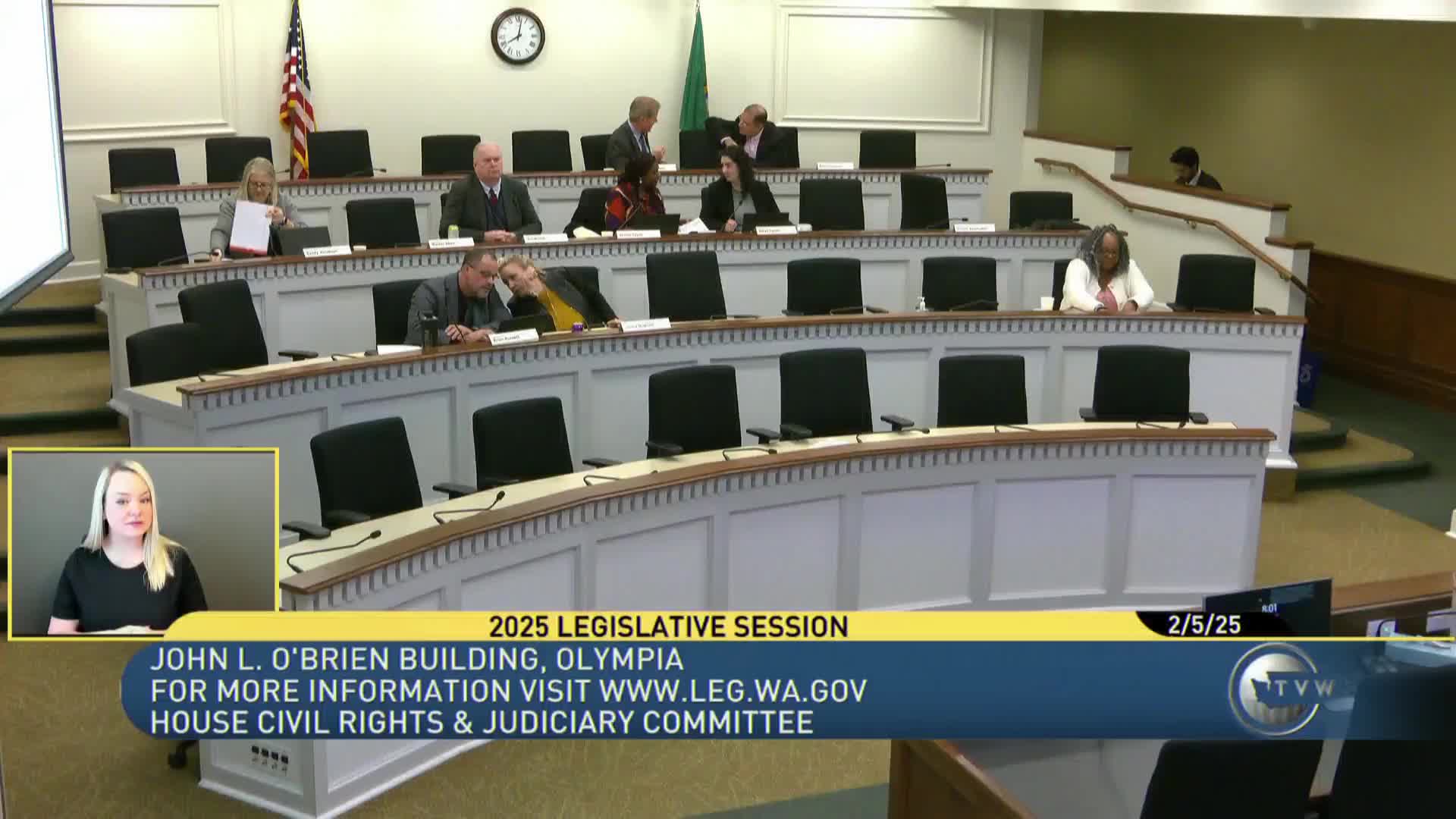
House Bill 13‑59 would create a 25‑member task force to review Washington’s laws on criminal insanity and competency to stand trial, staff told the Civil Rights & Judiciary Committee on Feb. 5.
House Bill 13‑59 would create a 25‑member task force to review Washington’s laws on criminal insanity and competency to stand trial, staff told the Civil Rights & Judiciary Committee on Feb. 5.
Eric Lopez, staff to the committee, said the bill “establishes a 25 member task force to to review laws on criminal insanity and competency to stand trial.” He told the committee the statutes at issue are codified in chapter 10.77 and are overseen in part by the Office of Forensic Mental Health Services at the Department of Social and Health Services.
The task force would be charged with recommending statute changes to “clean up and modernize” chapter 10.77, promote patient‑centered language to reduce stigma, remove barriers to diversion and effective treatment, reorganize the chapter under thematic headings and decodify obsolete sections, Lopez said.
Why it matters: Judges, prosecutors, defense lawyers and advocacy groups told the committee that chapter 10.77 — enacted in 1973 and amended piecemeal for decades — contains inconsistencies and gaps that create different mandatory processes across municipal, district and superior courts. King County District Court Judge Michael Finkel told the committee, “If you pass it, you will receive a detailed report recommending whether chapter 10.77 should be retained as is, modified or overhauled.” He said the work group would include “very subject matter experts that work with it, on a daily basis,” and that modern diagnostic and treatment advances make a review appropriate.
Supporters said the task force would produce the information the Legislature needs before making large statutory changes. Melissa Johnson, testifying for the District and Municipal Court Judges Association, said the association supports HB 13‑59 and that last session’s narrower terminology update highlighted the need for a broader review: “This bill creates a task force to examine the broader issues in 10 77 and produce solutions for legislative consideration.”
Stakeholder representation: Testimony emphasized broad representation. Carrie Reardon, representing the Washington Defender Association and the Washington Association of Criminal Defense Lawyers, urged that the work group include both district/municipal and superior court practitioners because competency practice differs by jurisdiction. Nicole Gomez of the Washington Federation of State Employees asked that the task force include a designated labor representative with expertise in forensic evaluation and state service so workforce challenges and evaluator perspectives are represented.
Public‑safety and system coordination concerns were raised by prosecutors and counties. Russell Brown of the Washington Association of Prosecuting Attorneys said prosecutors and defense counsel alike had identified multiple problems across the chapter and supported a comprehensive review. Brad Banks of the Washington State Association of Counties urged inclusion of behavioral health administrative services organizations because of their role in jail diversion and community ITA (Involuntary Treatment Act) funding.
Panelists cited court decisions and lawsuits as drivers of change. Carrie Reardon noted lawsuits (referenced in testimony as the “Trueblood” and related cases) and prior enforcement actions that affected forms and processes. Judge Jessica Genaire, who runs a municipal court mental‑health calendar in Renton, said courts of limited jurisdiction often lack the range of options superior courts have and need clearer legislative direction on prioritizing lower‑level competency cases.
Questions from legislators focused on scope and timing. Representative Walsh asked whether the task force would rationalize the interaction between not‑guilty‑by‑reason‑of‑insanity issues and the Involuntary Treatment Act; Judge Finkel replied that the report would provide a roadmap explaining “this is what it was for, this is what it needs to do, this is where it needs changing.” Representative Jacobson and others asked whether a task force was a prudent use of resources in a short session; witnesses argued it would produce information outside the compressed legislative calendar and avoid piecemeal fixes.
What the bill does not do at hearing: The task force would report recommendations to the Legislature; the bill does not itself change substantive commitment or competency timelines. Several witnesses urged amendments to the bill’s membership list to add seats representing district/municipal courts, labor/forensic evaluators, and behavioral‑health administrative organizations.
Ending note: Supporters asked the committee to approve HB 13‑59 so the Legislature would receive a consolidated, expert review of chapter 10.77 and recommendations for statutory reform before drafting specific statutory changes.