Firefighter and law‑enforcement supporters seek to remove time limits for heart‑disease presumption in workers' comp
Loading...
Summary
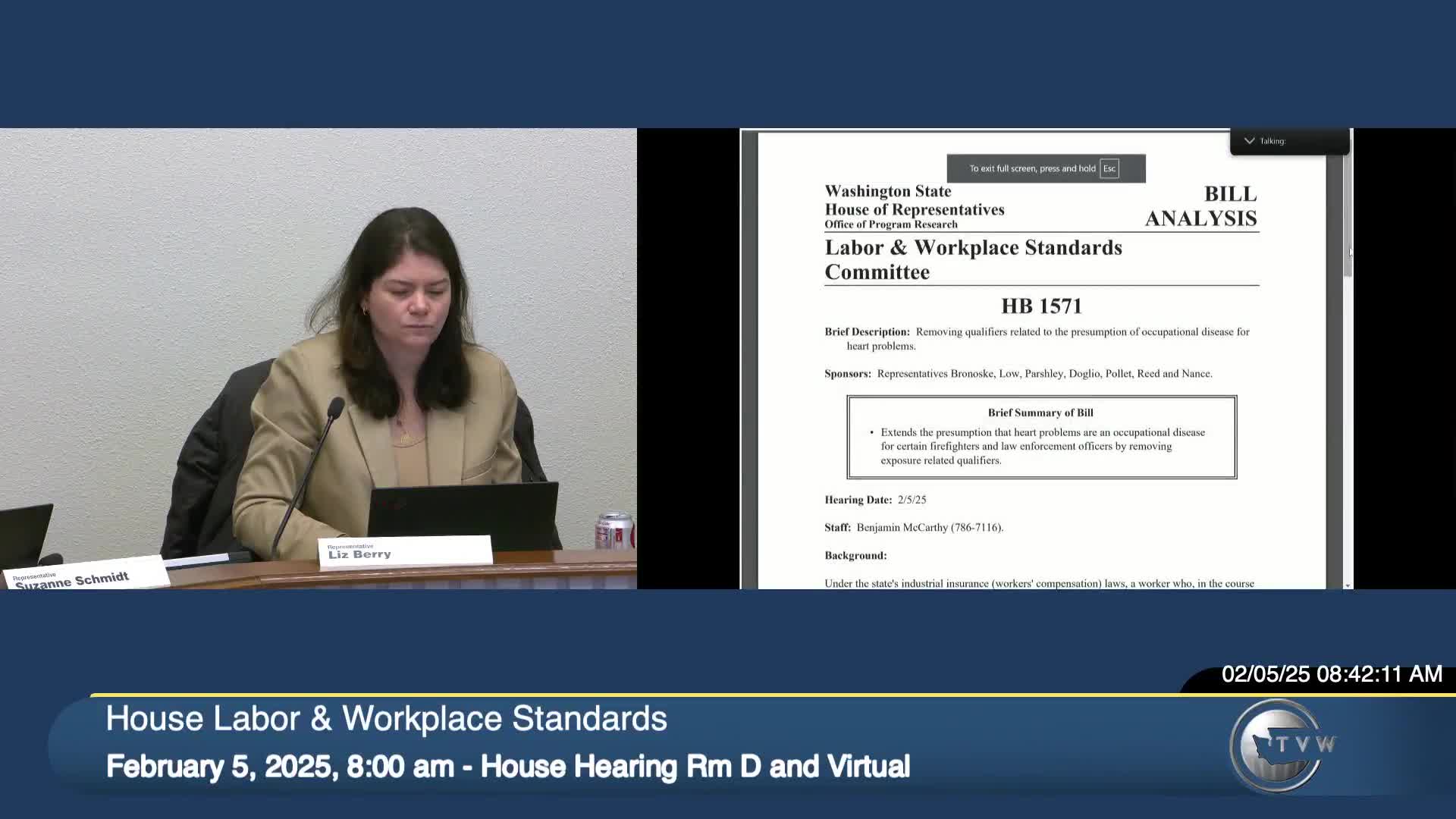
House Bill 15-71 would remove 24‑ and 72‑hour time qualifiers from the workers'‑compensation presumption that certain heart problems in firefighters and law‑enforcement officers are occupational, family members and first responders told the committee on Feb. 5.
House Bill 15-71 would remove the current time qualifiers that limit the statutory presumption that heart problems are occupational diseases for certain firefighters and law enforcement officers, witnesses told the committee on Feb. 5.
Committee staff summarized current law: the presumption applies when a heart problem arises within 72 hours of exposure to smoke, fumes or toxic substances or within 24 hours of strenuous exertion during firefighting activity. The bill would eliminate those exposure and exertion windows and extend the presumption for a period after employment equal to three months per year of service, up to a maximum of 60 months, staff said.
Family members and firefighters delivering testimony said the existing timelines can leave families without presumptive coverage when a cardiac event occurs days or even weeks after exposure or exertion. Colina Schaus, whose husband Eric Schaus died of occupational heart disease, described delays and difficulty navigating the claim process and urged lawmakers to "establish the path" that presumptive coverage provides. Several firefighters described how chronic exposures, stress, heat and disrupted sleep patterns contribute to delayed cardiac events and that a presumption without narrow time windows would better serve affected families.
The Department of Labor & Industries provided research and an advisory‑committee report. Dr. David Bonnado, L&I research director, told the committee that the advisory committee found biologic plausibility for chronic inflammatory and coagulopathy pathways linking firefighting exposures and cardiac disease, but that epidemiologic studies comparing firefighters to general populations did not uniformly show elevated ischemic heart disease rates. The committee recommended not modifying the current statewide presumption for all firefighters while recognizing that individual claims may still prove causation under existing law.
Local government associations (cities and counties) opposed the bill or urged use of the existing L&I advisory committee process, noting rising workers' compensation rates driven in part by presumptive disease claims and asking for expert review. Theresa Taylor of the Washington Council of Police and Sheriffs supported the bill, citing national line‑of‑duty fatality trends and the difficulty of proving a work nexus when events occur outside existing time windows.
L&I said injured workers may receive conditional payments while a claim is adjudicated but noted the advisory committee's recommendation against a blanket expansion. No committee vote was recorded at the hearing.