Get Full Government Meeting Transcripts, Videos, & Alerts Forever!
Get email alerts on the Historic Designation topic
No spam. Unsubscribe anytime.
Bill to require owner consent for city historic landmark designations draws mixed testimony
Summary
House Bill 1576 would bar cities from designating properties under 40 years old or from designating privately owned properties without owner written consent. The bill drew both support and opposition in testimony, with preservationists warning of unintended consequences.
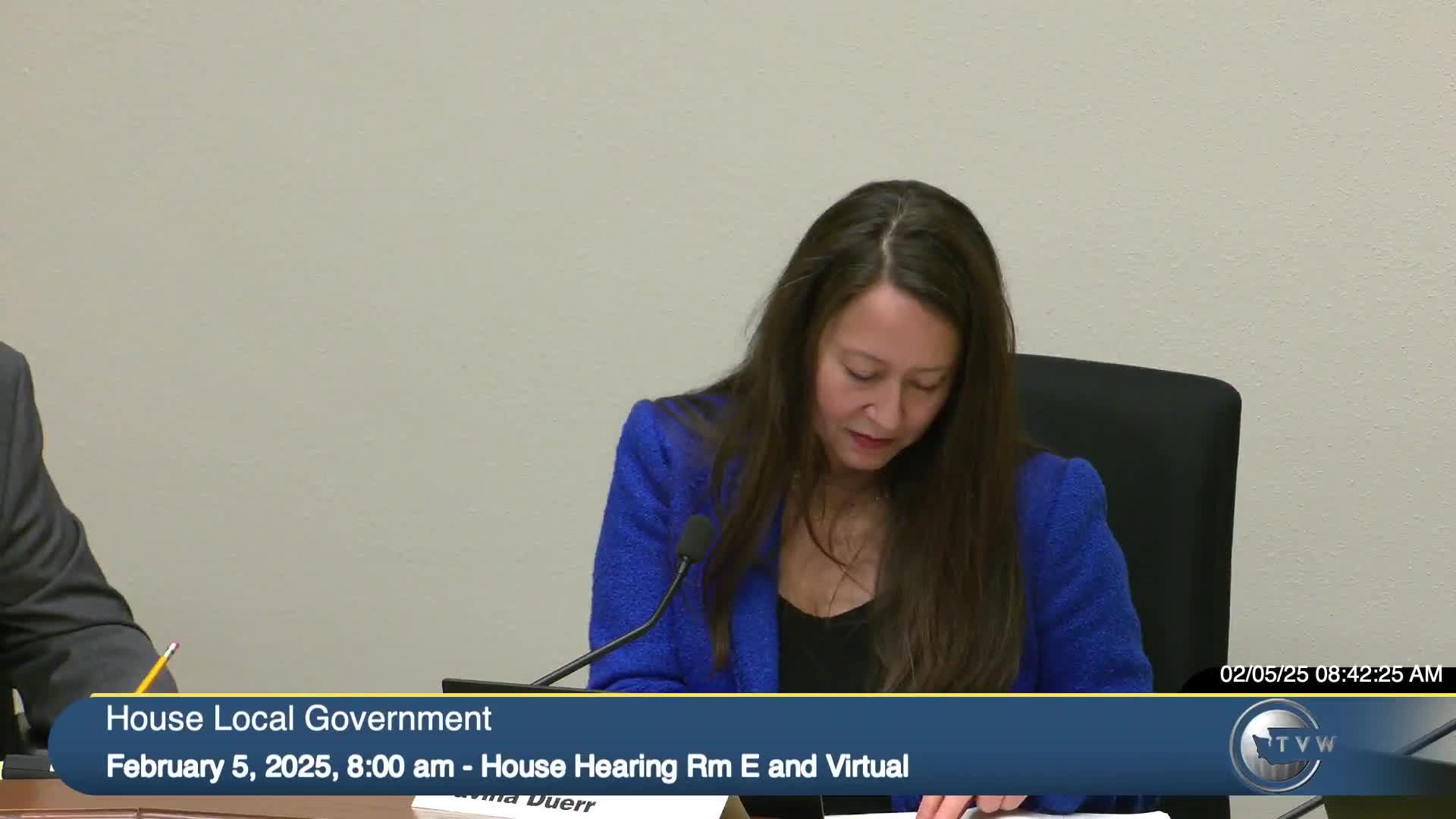
House Bill 1576, which would establish a 40-year minimum age and require owner consent for city historic landmark designations, drew a lengthy and divided public hearing in the Local Government Committee.
Committee staff described the bill’s scope: beginning July 20 next year, cities could not designate a property as a historic landmark if the property is less than 40 years old or if the designation would restrict use without the property owner’s written consent. The prohibition would not apply to properties already inside a designated historic district, and cities’ compliance actions would not be subject to appeal under the State Environmental Policy Act, staff said.
Sponsor Representative Amy Walen characterized HB 1576 as a housing-supply measure meant to prevent recent buildings from being landmarked in a way that blocks redevelopment. “When we're trying to implement missing middle and we're trying to remove barriers to the creation of housing, we don't want using a historic designation process to interfere,” Walen said. She described 40 years as the proposed baseline used in other states, and said owner consent avoids third-party nominations that can delay or stop redevelopment.
Proponents included representatives of the Washington Realtors and the Building Industry Association of Washington. Bill Clark of Washington Realtors said landmarking without owner consent is “unique only to Seattle and Tacoma” and cited cases where nominations reportedly delayed housing projects. The Building Industry Association suggested considering an even longer age threshold, such as 100 years, but supported owner consent.
Preservation groups and local preservation advocates opposed the bill as written. Chris Moore, executive director of the Washington Trust for Historic Preservation, said the state should avoid using one-size-fits-all legislation to adjust local preservation practice: “There is no data right now to support the fear that we will see a rush to nominate single family homes as landmarks across the state,” he said, and urged more local conversation. Historic Seattle’s Eugenia Wu told the committee that preservation “is not anti-development” and noted that designated parcels represent roughly 0.5% of Seattle’s parcels.
Sightline Institute and several architects testified in favor of HB 1576, arguing owner consent prevents misuse of designation to block housing. Sightline’s Dan Berchtlet recounted examples in Seattle where landmark nominations slowed or halted new housing and said requiring owner consent would “eliminate this risk.” Opponents emphasized that landmark processes in many cities already include council oversight and noted redevelopment incentives that preserve historic structures while allowing new housing.
The committee suspended the hearing after many witnesses testified; lawmakers and stakeholders asked for follow-up discussion and possible interim work sessions to reconcile historic-preservation goals with housing objectives.
Why it matters HB 1576 would set a statewide baseline on how local landmark designations are applied, directly affecting local preservation practices, redevelopment, and housing supply. Supporters frame it as protection against external nomination strategies that can delay housing; opponents warn the bill could strip local governments of tools for stewarding irreplaceable historic resources.
Next steps The committee paused the hearing with many testifiers on the record and requested further engagement with preservation organizations, municipal preservation programs and housing advocates before advancing the bill.