Get Full Government Meeting Transcripts, Videos, & Alerts Forever!
Get email alerts on the Artificial Intelligence Bargaining topic
No spam. Unsubscribe anytime.
Bill would require public employers to bargain with unions on AI adoption that affects wages, hours or conditions
Summary
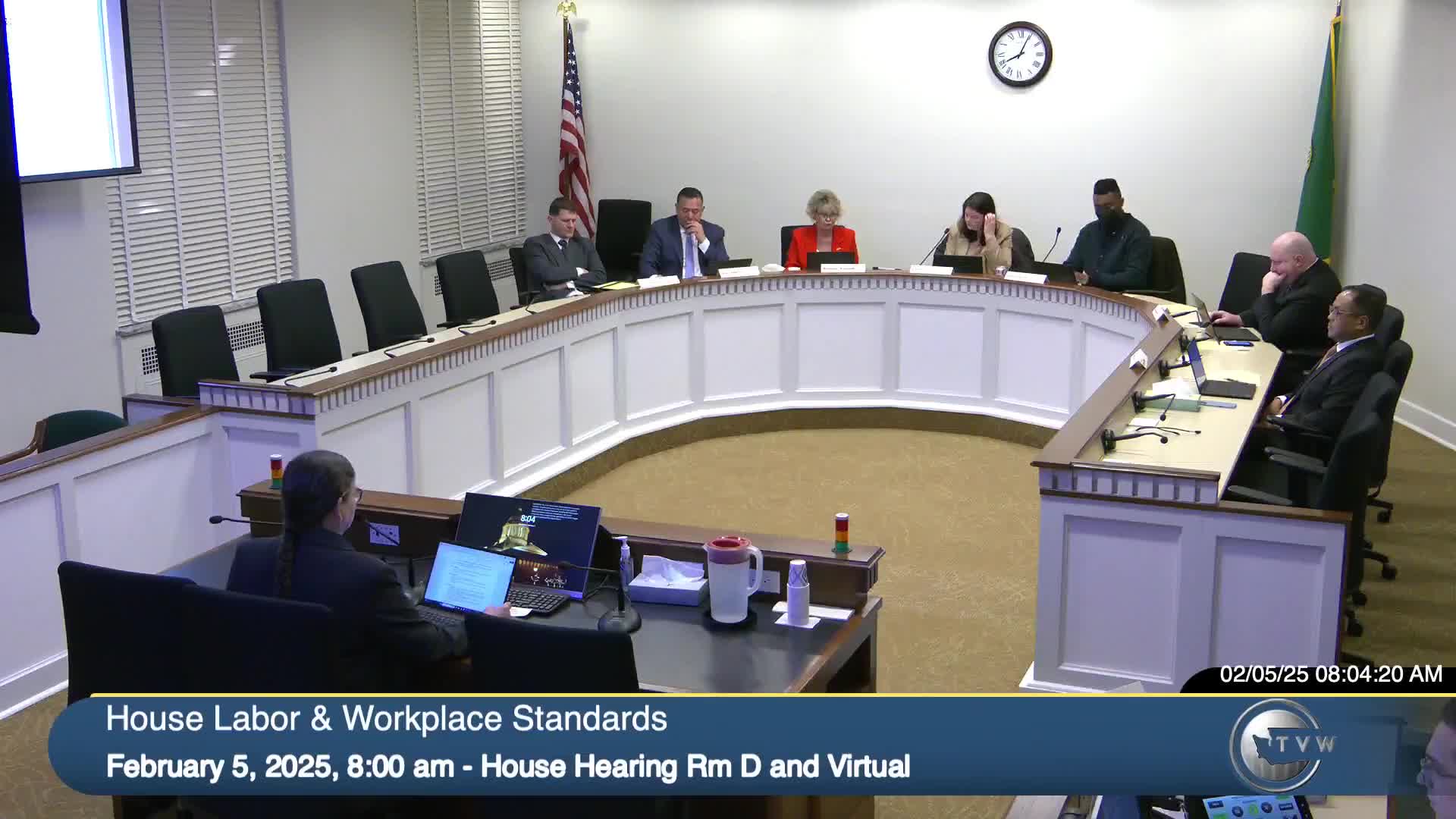
House Bill 16-22 would require public employers covered by Washington collective bargaining statutes to negotiate with employee representatives before adopting or changing the use of artificial intelligence if the change affects wages, hours or other terms and conditions of employment, committee staff and witnesses said on Feb. 5.
House Bill 16-22 would require public employers covered by Washington’s collective bargaining frameworks to negotiate with employee representatives over the adoption or change in use of artificial intelligence when that adoption would affect wages, hours, or other terms and conditions of employment, committee staff told the Labor and Workplace Standards Committee on Feb. 5.
Ben McCarthy, committee staff, said the bill applies to employees covered by the Personnel System Reform Act (PSRA) and the Public Employees Collective Bargaining Act (PECBA) and defines artificial intelligence to include "machine learning and related technology that use data to train statistical models for the purpose of enabling computer systems to perform tasks normally associated with human intelligence or perception." The staff briefing noted that the PSRA historically limited bargaining over the use of technology to management, and the bill would require bargaining in circumstances where AI adoption affects employment terms.
Labor unions, public‑sector employees and some elected officials who testified said the bill simply moves bargaining earlier in the decision process. "All this bill does is say you do have to talk to your workforce about these kinds of changes when you want to make them," Samantha Grad of Teamsters 117 said. Katie Durkin of the Washington Federation of State Employees said the bill would likely reduce overall costs by forcing agencies to justify technology purchases at the bargaining table before costly implementation. Sharika Carter of the Washington State Labor Council, who represents labor on the state's AI task force, testified that worker input is necessary to ensure AI augments rather than harms public services.
Local government associations and public‑sector employers testified in opposition, saying use of technology is traditionally a management right and that requiring bargaining over adoption itself could delay or block efficiency gains. Candace Bach of the Association of Washington Cities and Paul Jewell of the Washington State Association of Counties both said the bill would impair managerial authority and could increase costs to cities and counties.
Law enforcement and first‑responder unions supported the bill, saying AI is not static like earlier technology and can introduce new uses after deployment. Theresa Taylor of the Washington Council of Police and Sheriffs said the bill could reduce litigation and gray areas about post‑deployment use. Several public employees and task‑force participants told the committee they are concerned about agencies buying off‑the‑shelf AI systems that are poorly matched to real operations and data, and urged worker input before purchase and deployment.
Committee members asked about precedent and the history of bargaining over technology; sponsors and staff said prior statute and case law treated implementation and impact differently, and that this bill seeks to ensure bargaining occurs earlier when AI will affect wages, hours, or working conditions. The committee did not take a vote at the hearing.