Get Full Government Meeting Transcripts, Videos, & Alerts Forever!
Get email alerts on the Enterprise Erp topic
No spam. Unsubscribe anytime.
OFM outlines 1 Washington Workday implementation: large system inventory, phased rollout targeting 2027 go-live for phase 1a
Summary
Office of Financial Management officials said the 1 Washington ERP project will replace multiple legacy administrative systems with Workday, affect more than 100 agencies and roughly 270 systems, and target an early 2027 implementation for phase 1a while later phases will include HR/payroll and budget.
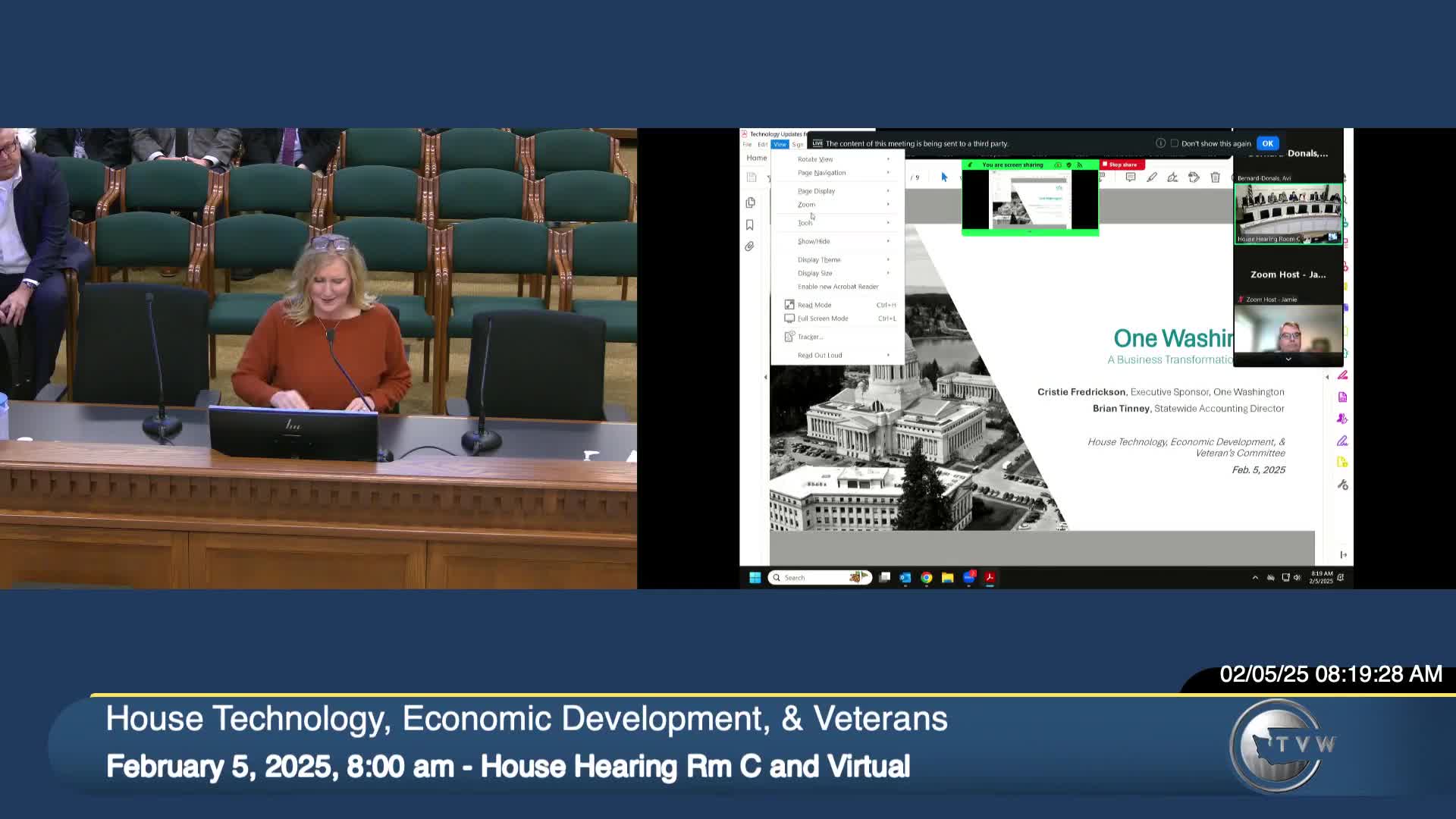
Christie Frederickson, executive sponsor for the 1 Washington enterprise program at the Office of Financial Management (OFM), and Brian Tinney, statewide accounting director and business owner for phase one, briefed the committee on Feb. 5 on the state’s enterprise resource planning (ERP) implementation using Workday.
Frederickson said early planning established a business case for replacing disparate administrative systems that perform shared enterprise functions such as accounting, payroll, human resources and budgeting. OFM selected Workday as the ERP platform and Deloitte as the system integrator, she said.
Why it matters: OFM described the project as a multiyear, multi-agency transformation intended to standardize core administrative business processes across the enterprise and reduce the number of unique systems.
Frederickson told the committee the first implementation will focus on core financials. OFM estimates the project impacts more than 100 agencies and about 270 systems: the presenters said 25 systems have been retired, roughly 250 are being modified, about 150 will connect directly to Workday and roughly 100 will connect through intermediary systems. The presenters noted some numbers on slides had typographical errors and that corrected statistics have been submitted to the committee record.
Tinney described user benefits from a modern Workday interface, saying it will be more intuitive, reduce training time and let staff move between agencies more easily. He said Workday allows expansion of data fields and standardized tagging that will help track items such as emergency or grant spending across agencies.
On schedule, OFM said the target for phase 1a is early calendar year 2027. Frederickson cautioned that later phases — HR and payroll, procurement and grants, and budget functions — depend on the complexity of inventory and cross-agency dependencies and that firm dates for those phases are not yet set.
OFM said the first phase will provide a foundation for future phases and will require agency subject-matter engagement: more than 60 agencies have designated project work and 40 agencies have the most interaction because their systems require technical changes.
Committee members asked about connectivity and why some systems talk to Workday indirectly; OFM said the architecture of legacy systems and intermediary integrations account for that complexity. Members asked whether budget functions might someday support dynamic fiscal notes; OFM said budget functionality would come in later phases and did not set a firm date.
OFM and Tinney emphasized the scale of transactions the current system handles, noting that last state fiscal year roughly $3.5 billion per month flowed through existing accounting transactions and that the project’s iterative approach will test thousands of transaction types before go-live.