Get Full Government Meeting Transcripts, Videos, & Alerts Forever!
Get email alerts on the Infrastructure Reimbursement topic
No spam. Unsubscribe anytime.
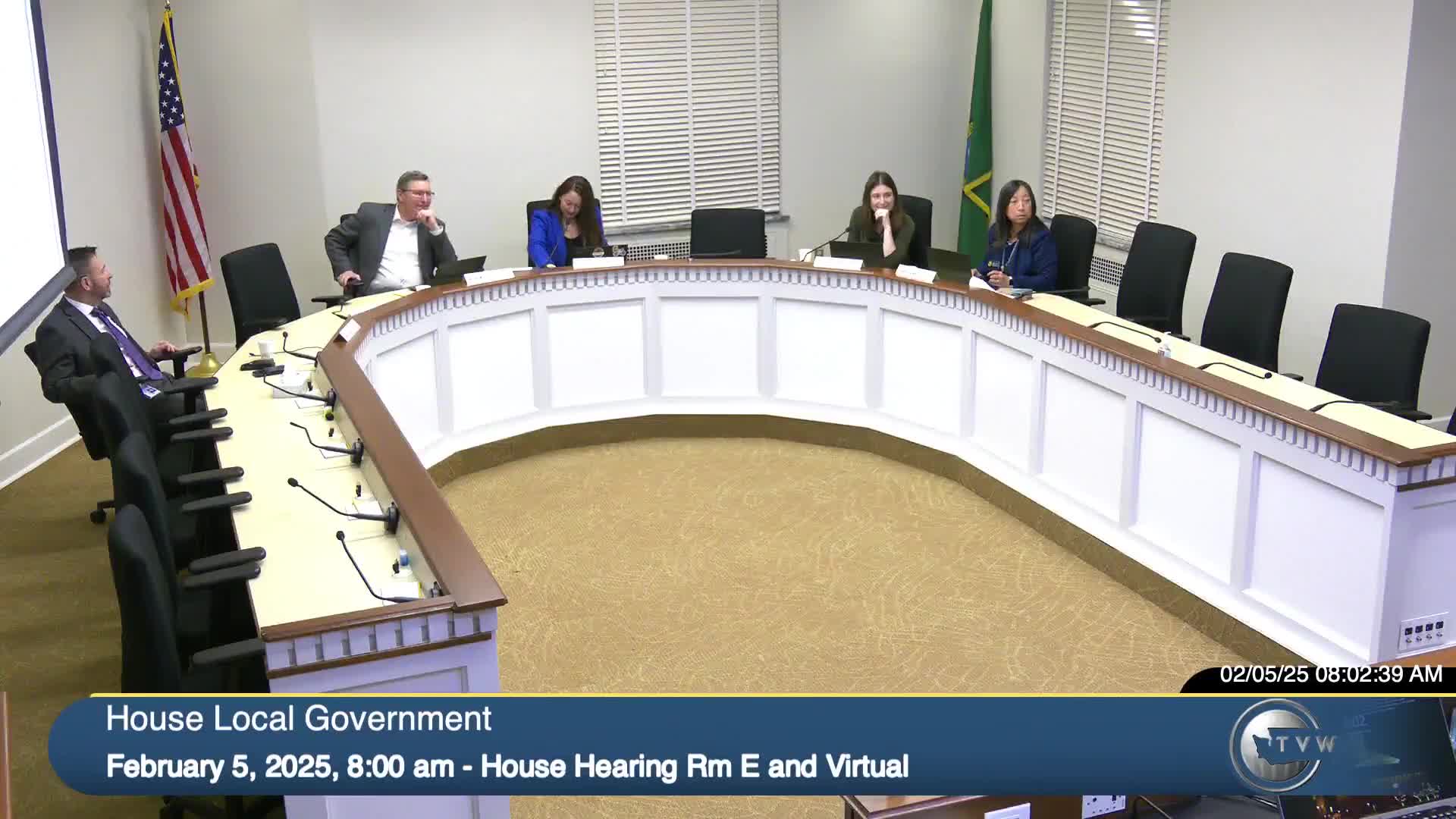
Committee backs 20-year limit for latecomer reimbursement contracts but rejects retroactive COVID extension
Summary
A legislative committee reported House Bill 1305 out with a due-pass recommendation after adopting an amendment that fixes a 20-year maximum for reimbursement contracts and rejecting an amendment that would have removed a COVID-era extension grandfathering provision. The vote was 4-3.
The Local Government Committee voted to report out House Bill 1305 on a due-pass recommendation after adopting an amendment that sets a 20-year maximum for reimbursement contracts used to recover costs for street, water and sewer extensions.
The bill would permit reimbursement contracts for water, sewer and street projects to run for up to 20 years and had included language allowing those contracts to be extended for the duration of a national economic recession and for the duration of the COVID-19 state of emergency. Committee members debated two Representative Griffey amendments and one Representative Hunt amendment before voting.
Committee chair Duda opened discussion by summarizing the bill’s purpose: to allow “reimbursement contracts for water sewer extensions, and street projects [that] may last for up to 20 years” and to permit extensions tied to recession or emergency periods. Representative Griffey attempted to streamline the package by withdrawing one amendment (3-62) and pressing amendment 3-63, which would limit 20-year extensions to contracts entered after the bill’s effective date. Representative Griffey told the committee he “like[s] the idea of a 20 year payback” so initial investors can recover more of their costs.
Representative Hunt opposed amendment 3-63, saying the original bill’s COVID-era extension was intended to protect property owners who signed latecomer agreements before the pandemic and then saw development slow. “The COVID-nineteen extension is part of the intent of the bill,” Hunt said, and opposed limiting the 20-year extension only to prospective contracts.
Members rejected amendment 3-63 by voice vote. They then considered amendment RIC 3-61, offered by Representative Hunt, which removed the provision allowing an extension for the duration of a future national economic recession. Hunt argued the amendment “would give the sewer districts and the folks that are administering these contracts more certainty” by removing an open-ended recession extension. Representative Griffey said he still preferred a “clean 20 year bill,” but the committee adopted amendment 3-61.
After incorporating adopted amendments into a substitute, the committee voted to report substitute HB 1305 out of committee. Staff announced the roll call: 4 ayes, 3 nays, 0 absent or excused. By that tally, substitute HB 1305 was reported out of committee with a due-pass recommendation.
The committee record shows multiple points of concern about fairness to early developers who paid for infrastructure and about administrative certainty for districts administering latecomer agreements; those concerns shaped members’ support for or opposition to the amendments.
Votes at a glance - Motion: Report substitute House Bill 1305 out of committee with a due-pass recommendation. Mover: Vice Chair Parthely. Outcome: reported out. Roll call: 4 ayes, 3 nays. - Amendment RIC 3-63 (limit 20-year extension to contracts entered after effective date; remove retroactive COVID extension): moved and seconded; failed by voice vote. - Amendment RIC 3-61 (remove recession-duration extension; fix 20-year limit): moved and seconded; adopted by voice vote.
Background and next steps House Bill 1305 addresses so-called latecomer or reimbursement agreements used to spread the cost of installing streets, water and sewer infrastructure among later users. The committee’s action advances the bill to the next legislative stage with the adopted 20-year cap and without the open-ended recession extension that had been in earlier drafts.
Implementation questions remain, including whether the revised language will fully address the committee’s stated goals of balancing developer recovery and certainty for utility providers. The bill’s fiscal and implementation impacts will be considered as it moves to the floor.