Get Full Government Meeting Transcripts, Videos, & Alerts Forever!
Get email alerts on the Guaranteed Admissions topic
No spam. Unsubscribe anytime.
Committee hears bill to make Washington Guaranteed Admissions Program statewide
Summary
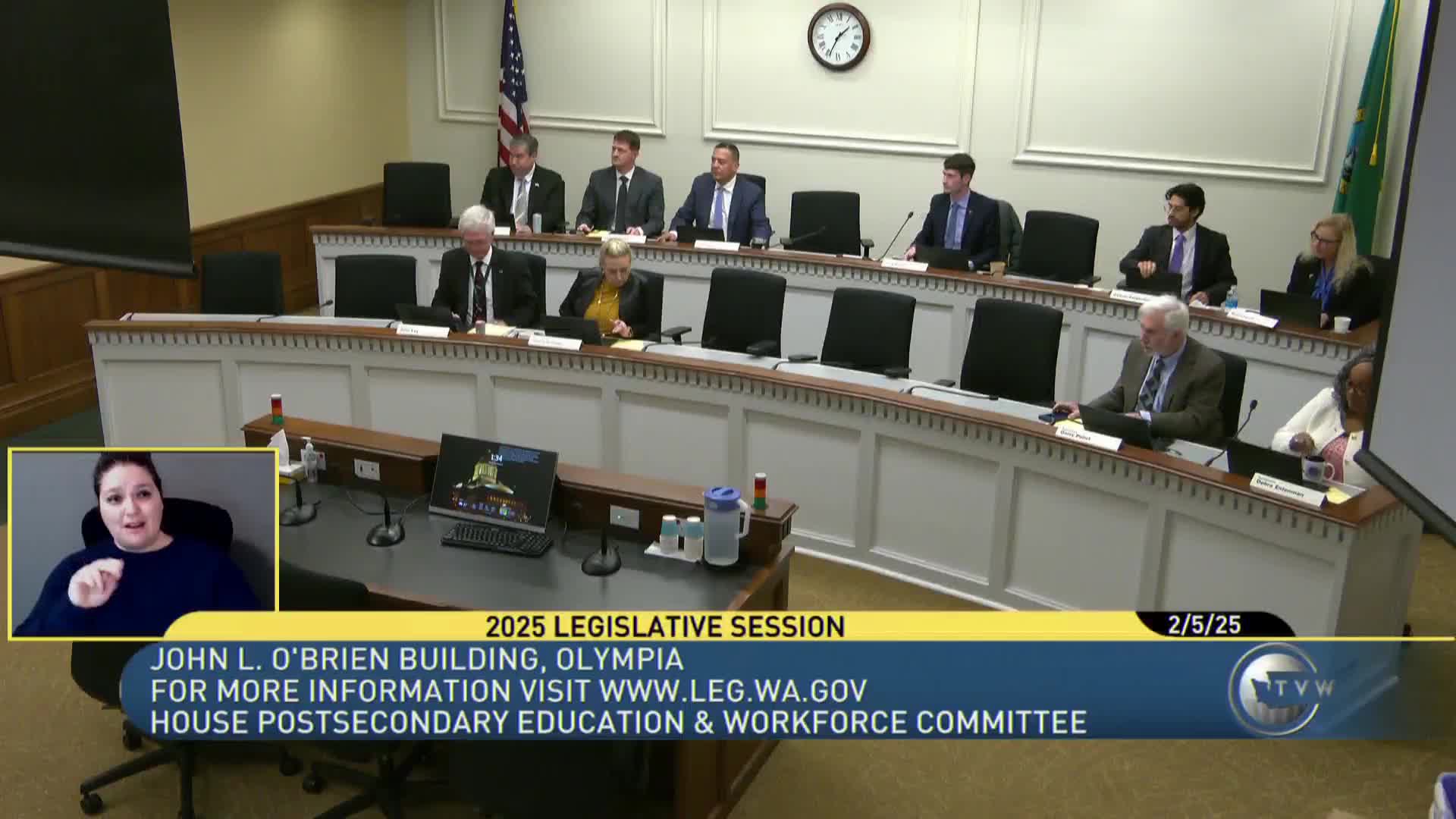
Vice Chair Greg Nance and members of the Postsecondary Education & Workforce Committee heard testimony on House Bill 15-57, which would codify the Washington Guaranteed Admissions Program (WAGAP) and require statewide notices and simplified admissions procedures.
Vice Chair Greg Nance and members of the Postsecondary Education & Workforce Committee heard testimony on House Bill 15-57, known as the Washington Guaranteed Admissions Program or WAGAP, which would codify a program offering guaranteed admission notices to eligible Washington high school students.
For the record, Shranda Ross, counsel to the committee, told members the bill would codify the Council of Presidents' existing program and require participating institutions to simplify and streamline admissions forms and to notify eligible students and families about WAGAP and related financial- and career‑pathway resources. "Guaranteed admissions does not guarantee enrollment in a specific degree program," Ross said, adding the bill sets a 3.0 GPA and completion of Washington's college academic distribution requirements as eligibility conditions.
The bill's prime sponsor, Representative Reid, said the measure "says that if you are a student in Washington state and you've done the work in high school, you got pretty good grades, you took all your courses, you graduated, you have a place at the publicly funded universities that you and your family's tax dollars support." Reid and multiple supporters told the committee the program aims to increase access, reduce undermatching, and boost enrollment among students from low-income, rural and underrepresented communities.
Representatives of higher-education groups and pilot partners testified in favor. Ruben Flores, executive director of the Council of Presidents, described the voluntary program's pilot expansion to about half the state's districts and urged the committee to make the program statewide. Troy Nichols, representing the Washington School Information Processing Cooperative (WSIPC), said his organization can securely collect and transmit student data and has run a Gates Foundation‑funded pilot of digital transcript sharing. "We can reliably gather and transmit essential student data while maintaining strict security and privacy standards," Nichols said.
Supporters cited evidence from other states. Representative Reid pointed to increases in full-time undergraduate enrollment after direct‑admissions programs in Idaho and Georgia. Jake Vigdor, faculty legislative representative for the University of Washington, said codifying the practice removes uncertainty caused by voluntary local agreements.
Asked about scope and safeguards, witnesses and the sponsor described several implementation specifics that remain in the bill: participating institutions may opt out by filing a notice and justification with the Legislature; school districts and participating institutions must provide the required notices to students in grades 9–12 and designate staff or virtual resources to support students; and the Student Achievement Council must prepare annual reports disaggregated by race, ethnicity, Title I status and economic status.
Committee members asked about incentives to encourage students to choose high-need majors, whether WSIPC is public or private (Nichols said WSIPC is a public cooperative), whether application fees would be waived (staff said the bill requires a simplified application but does not change application fees), and the opt‑in/opt‑out status of data sharing (testimony described district data agreements and said the legislation is silent on opt‑in vs. opt‑out and that WSIPC can accommodate either approach).
Speakers who raised concerns included John Axtell, a student advocate, who said a fixed GPA threshold may discourage students from taking challenging courses and questioned counselor workload and timing of data sharing. Representatives from the Office of the Superintendent of Public Instruction and the governor's office testified they support the bill's purpose but asked for clarifications on implementation and data/privacy questions.
The committee closed the public hearing on HB 15-57 after 13 registered in‑person testifiers and numerous written sign-ins. No formal committee action or vote was recorded during the hearing.
Ending: The sponsor and supporters urged the committee to move the bill forward so that eligible students statewide would "know that if they study and show an aptitude and appetite for knowledge during high school, that there's a college seat waiting for them," as Ruben Flores put it.