Get Full Government Meeting Transcripts, Videos, & Alerts Forever!
Get email alerts on the Voting Rights Restoration topic
No spam. Unsubscribe anytime.
Committee hears testimony to narrow ‘infamous crime’ definition, restore voting rights for incarcerated Washingtonians
Summary
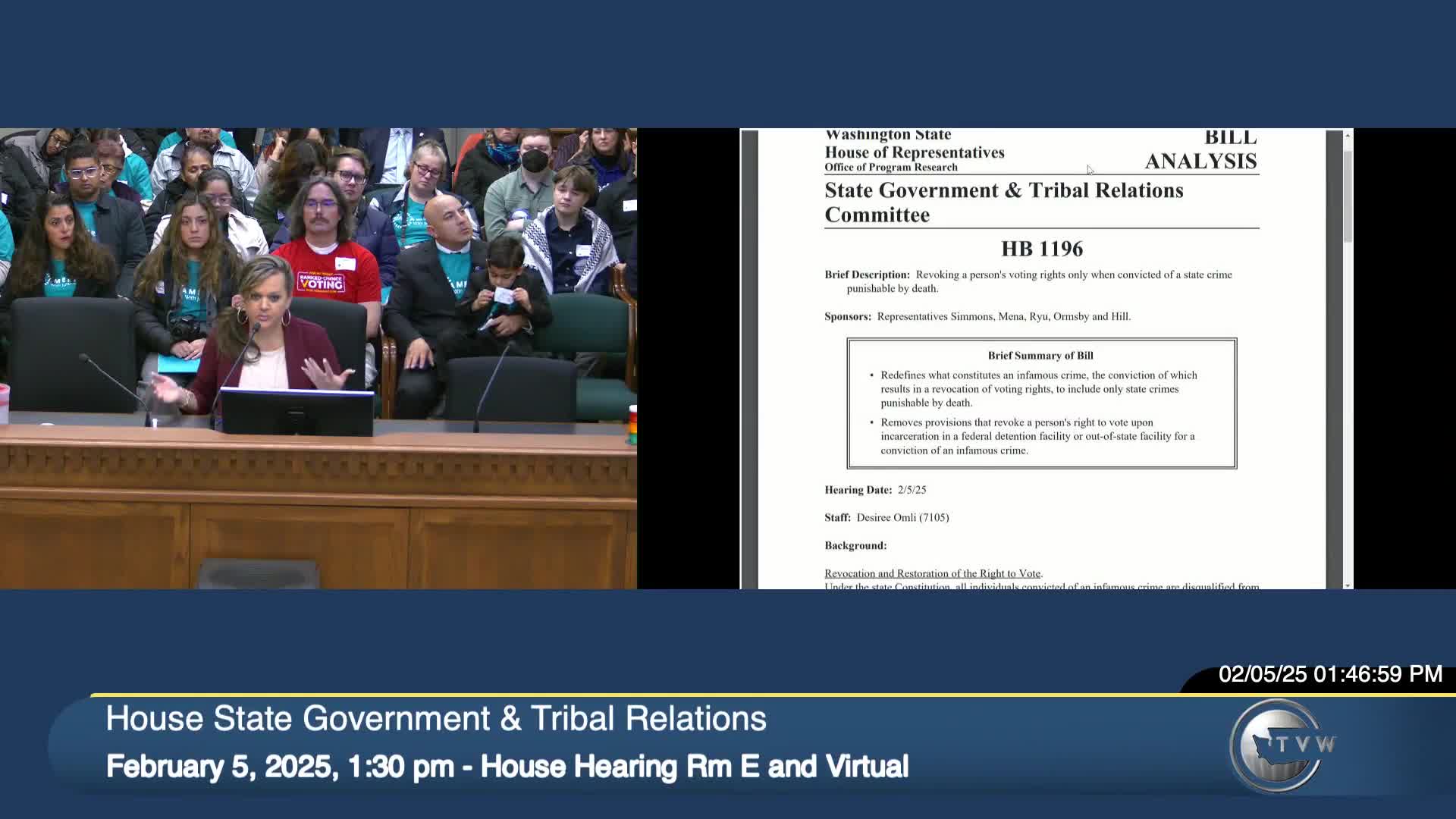
House Bill 1196 would redefine Washington’s constitutional category of “infamous crime” so only state offenses punishable by death would bar a person from voting.
House Bill 1196 would redefine the state constitutional category of “infamous crime” so that only crimes committed in Washington that are punishable by death would disqualify a person from voting, Representative Tara Simmons told the State Government & Tribal Relations Committee on Wednesday.
The change would remove most felony convictions from the constitutional basis for disenfranchisement and automatically restore voting rights for people who are not serving a sentence of total confinement under the Department of Corrections, although individuals would still need to re-register to vote. Desiree Omley, Office of Program Research staff, summarized the bill and said conforming changes are proposed throughout the elections code; a fiscal note is available in the EBB.
Supporters framed the bill as a step to repair what they called racially rooted, historical disenfranchisement and to improve reintegration. Representative Tara Simmons (20th Legislative District) said Washington’s practice of disenfranchising people convicted of an “infamous crime” outlived its rationale and noted that Maine, Vermont, Washington, D.C., and Puerto Rico allow incarcerated voting. “Voting is not a public safety issue immediately like a firearm,” Simmons said, arguing that maintaining civic ties reduces recidivism. Testimony in favor came from tribal members, formerly incarcerated residents and advocacy groups, who said restoring the franchise supports rehabilitation and community safety.
Charles Longshore, a Skokomish tribal member, said restoring the vote would ensure tribal communities in low-population districts have “a stronger voice.” Heather Kelly of the League of Women Voters called voting “a fundamental right, not a privilege.” Kelly Olsen of Civil Survival and the Free the Vote coalition urged the committee to pass the bill, citing national polling and academic research linking civic engagement to reduced recidivism. Kyle Lucas of Urban Indians Northwest highlighted disproportionate Native incarceration rates and called enfranchisement an issue of racial and economic justice.
The Secretary of State’s office, represented by Brian Hatfield, opposed the bill on logistical grounds. Hatfield said Department of Corrections rules requiring inspection of mail entering and leaving facilities could jeopardize the secret ballot if mail-ballot processes were used, and that prison population movement — he cited DOC data that roughly 20% of incarcerated people are moved across facilities in a given month — complicates ballot delivery and registration. He also noted uncertainty about which residential address incarcerated people would use for registration and expressed concern about allowing people to run for or hold office while confined. County and city officials and a representative of the Association of Washington Cities raised similar implementation and cost concerns during separate testimony on related bills.
Witnesses from advocacy organizations, formerly incarcerated people, and tribal leaders pressed the committee to prioritize restoration of voting rights as part of reentry and racial justice work. Several speakers tied the bill to broader criminal justice reform goals and to international examples they described as rehabilitative, including delegations to Norway. Supporters repeatedly emphasized that the bill, as drafted, would not reinstate disenfranchisement in Washington absent reinstatement of the death penalty, and that in practice it would remove most current disenfranchisement tied to felony convictions.
No formal vote was taken in committee during the hearing. Committee members asked technical questions about definitions, jury eligibility, and whether the bill would be effective while the state currently lacks the death penalty; sponsors and staff responded that under current law, the bill would narrow the category and that only a reinstated death penalty would again disenfranchise people under the new definition.
The committee closed the public hearing on HB 1196 after multiple panels of pro and con testimony and moved on to related bills on the agenda.