Get Full Government Meeting Transcripts, Videos, & Alerts Forever!
Get email alerts on the Human Trafficking topic
No spam. Unsubscribe anytime.
Board directs study to reimagine county approach to human trafficking, approves public‑health task force
Summary
The Board of Supervisors approved a motion to reconfigure an existing task force and study a countywide, public‑health‑centered approach to human trafficking, directing a report back and asking for coordinated data collection and survivor‑centered services.
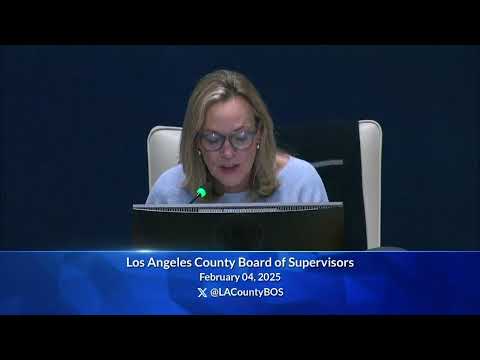
The Los Angeles County Board of Supervisors voted 5-0 on Feb. 4 to approve a motion to "reimagine" the county's approach to human trafficking, directing county agencies to propose a coordinating body, feasibility study and data‑sharing protocols to strengthen prevention and survivor services.
The board said the effort will reconfigure an existing task force toward a public‑health framework while continuing to work with law enforcement. Supervisor Solis moved the item; Supervisor Horvath joined as co‑author and the board approved the motion unanimously.
Supporters and supervisors said the motion seeks a multidisciplinary strategy that centers survivors and expands prevention. Dr. Ferrer, representing the county public health perspective, told the board a public‑health approach is "complimentary to law enforcement" and emphasized that the motion does not remove law‑enforcement authority to investigate or prosecute traffickers. "Our focus really is on making sure that we are supporting victims/survivors," Dr. Ferrer said.
Supervisor Barger, who had held the item to ask clarifying questions, said she wanted confirmation that the motion would not stop prosecution of traffickers and requested that the study include data to better profile perpetrators to inform prevention programs. Dr. Ferrer agreed to include such data collection recommendations in the report back.
Speakers from community groups endorsed a feasibility study and countywide data sharing. Paloma Bustos of the Sunita J. Anti‑Trafficking Initiative told the board that the county currently relies heavily on the criminal justice system and that a coordinated, survivor‑centered approach is needed.
The motion directs county departments to return with a proposal (structure and partners) and to consider data collection and sharing protocols among county agencies and community‑based organizations. Supervisors noted alignment with an existing child trafficking leadership team and asked staff to avoid duplicating efforts.
The board did not adopt a specific timeline in public debate for every deliverable, though supervisors and staff discussed a standard report‑back process; the motion calls for a return to the board with a proposal. The motion also asked staff to include strategies for prevention, survivor supports and partnerships with the district attorney, sheriff, probation, DCFS and community providers.
The vote was 5-0. The board's action is a directive to staff to prepare more detailed recommendations, including how the task force would operate and what data would be collected and shared.