Get Full Government Meeting Transcripts, Videos, & Alerts Forever!
Get email alerts on the Public Safety Panhandling Ordinance topic
No spam. Unsubscribe anytime.
Norwich council adopts ordinance limiting panhandling at locations traffic authority deems unsafe, 4-3
Summary
The Norwich City Council on Feb. 3 adopted an ordinance restricting panhandling and solicitation at locations the city's traffic authority deems unsafe, in a 4-3 vote.
The Norwich City Council on Feb. 3 adopted an ordinance restricting panhandling and solicitation at locations the city's traffic authority deems unsafe, in a 4-3 vote.
The ordinance allows the traffic authority (designated in the ordinance as the chief of police) to identify specific locations where solicitation and related conduct are prohibited because they create hazardous conditions for pedestrians and drivers. The measure prescribes a written warning for a first offense and a $99 fine for subsequent violations; it also envisions a publicly accessible list of restricted locations that the city will post and update.
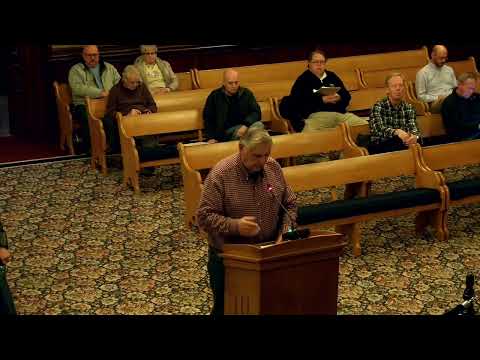
The measure followed a public hearing in which residents urged the council either to reject the ordinance or to take steps to pair enforcement with services. "The ordinance as written does not achieve its stated purpose. It does not preserve public order, protect citizens, or improve traffic flow," resident Norman Gauthier told the council. Another resident said the proposal would violate the U.S. Constitution and promised to continue standing with a sign if the law passed.
Police and council supporters framed the proposal as narrowly focused on safety rather than expression. The chief of police told the council the ordinance is intended to address hazards such as high-speed state road off-ramps, medians, intersections with reduced sight lines and railroad crossings and to steer people away from locations where traffic and pedestrian safety are compromised. The chief said the ordinance permits designation of "safe locations" for solicitation and that enforcement should prioritize warnings and referrals to human services over immediate penalties.
Alderman Betancourt, who brought the item forward for discussion, said the ordinance "doesn't ban panhandling per se" and described it as a limited, content-neutral time, place and manner regulation. He and other supporters said enforcement would be gradual and designed to connect individuals to Norwich Human Services and local nonprofit partners such as St. Vincent de Paul.
Opponents, including President Pro Tem Joseph A. DeLucia and Mayor Nystrom, said the city already has laws that address dangerous conduct by pedestrians and that the new ordinance risks criminalizing poverty. DeLucia said he was "shameful" about the presence of people in need but could not support the ordinance as the right solution.
The motion to advance the ordinance was made by Alderman Betancourt and seconded by Alderman Gold. Roll call votes recorded Yes from Aldermen Hayes, Betancourt, Gold and Singh and No from Alderman Nash, President Pro Tem DeLucia and Mayor Nystrom. The ordinance passed 4-3.
The ordinance text allows the traffic authority to maintain and update the restricted-locations list and directs the city to post that list publicly. Council members emphasized that the stated enforcement approach calls for warnings and referral information on first contact and that fines are intended as a backstop when warnings are ignored. Supporters said construction and road-maintenance activities are handled separately and may be exempt from the ordinance's restricted-location rule.
What happens next: the chief of police will identify and publish the list of locations covered by the ordinance and the city plans to make referral information available on the city website and in printed form for officers to hand to individuals when they issue warnings or citations.