Get Full Government Meeting Transcripts, Videos, & Alerts Forever!
Get email alerts on the Ag Fence Law topic
No spam. Unsubscribe anytime.
Committee hears public testimony on bill to allow limited neighbor access to repair livestock fences
Summary
Representative Ken Hayden sponsored House Bill 1116 to let livestock owners enter up to 10 feet onto adjoining property to repair or maintain division fences; the committee heard testimony from agricultural groups and an attorney and did not take a vote.
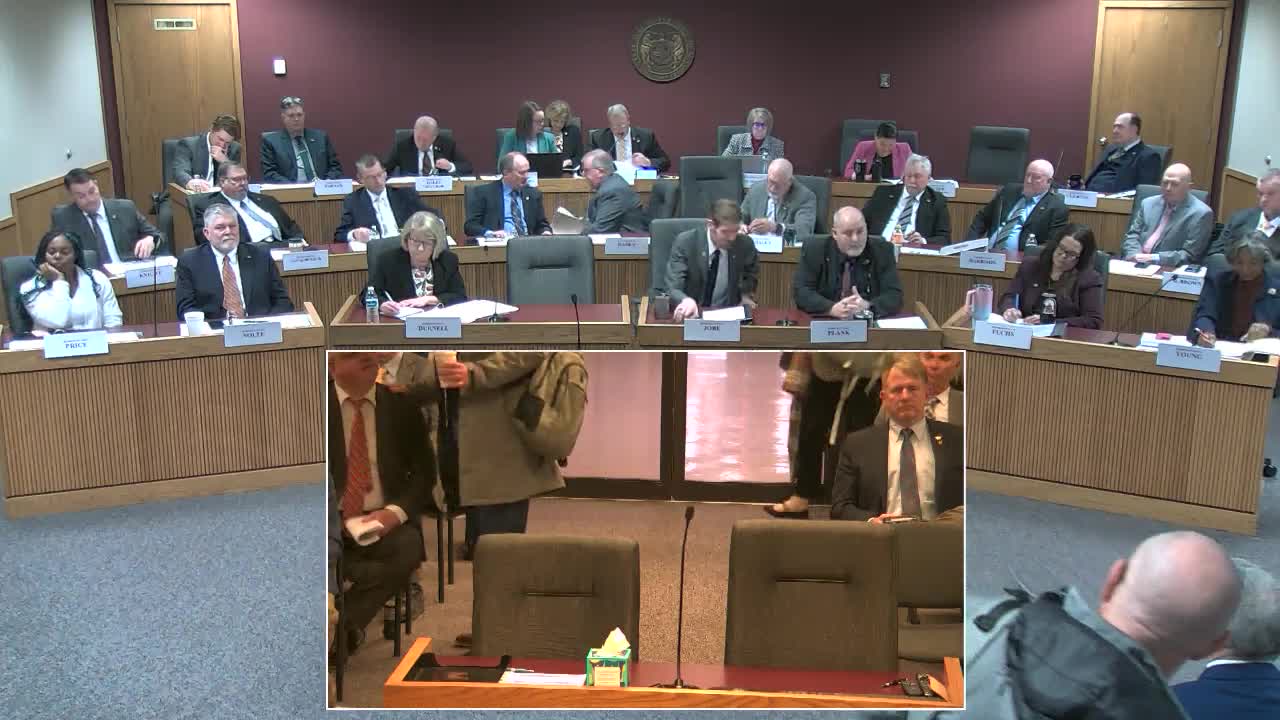
Representative Ken Hayden introduced House Bill 1116 and the Missouri House Agriculture Committee held a public hearing on Oct. 12 to consider changes to state fence law intended to help livestock owners repair and maintain division fences.
The bill would allow an owner with livestock to enter up to 10 feet onto an adjoining parcel to build, repair or maintain a fence, provided the entrant does not damage standing crops and limits removal of vegetation to what is necessary on the line. The sponsor and supporters said the change is aimed at practical problems created by absentee landowners and denser nonfarming ownership patterns.
“Cows out, neighbors mad, history, my fence, can't fix,” Representative Ken Hayden said in introducing the proposal, summarizing the problem the bill seeks to address. Hayden, who identified himself as representing District 43 and described his agricultural background, said the measure applies only to livestock fences and not to security or privacy fences.
Brent Hayden, an attorney who said his practice represents many farmers and ranchers, testified that Missouri’s fence law has two parallel systems: a general fence law that applies statewide and a local-option regime in about 16 counties where owners share responsibility. He said the current mix of obligations and trespass rules creates uncertainty for livestock owners who must both keep animals fenced and avoid trespass. He described the bill as clarifying that limited entry for fence work is allowed while remaining liable for any crop or vegetation damage beyond narrow limits.
Mark Faganbaum of the Missouri Farm Bureau, Shannon Cooper of the Missouri Cattlemen’s Association, Ben Travis of the Missouri Soybean Association and Jacob Kenebel of the Missouri Corn Growers Association all testified in support, saying the bill provides needed clarity for producers who must keep livestock secured and can face civil or criminal liability if animals escape.
Questions from committee members focused on specifics: whether the exception would apply in both general-option and local-option counties; how much vegetation or tree removal would be permitted; and whether the access could create adverse-possession risks if fences are set back from property lines. Brent Hayden and witnesses explained that the bill was drafted to apply in both systems, that it now explicitly limits the grant to livestock fences, and that removing trees or brush would be permitted only when necessary to place the fence on the line itself. Hayden noted that adverse-possession risks can be managed through private agreements or by sending a written permission letter to the neighbor.
David Jackson, speaking for the Saint Louis Zoo in an informational capacity, asked for a narrow exemption for properties with endangered species and federal requirements; he said zoo staff would provide sponsor language to address those sites.
The committee heard the testimony and had multiple questions but took no vote on HB 1116 during the hearing. The committee adjourned after the hearing.