Get Full Government Meeting Transcripts, Videos, & Alerts Forever!
Get email alerts on the Public Safety Fire Assessment topic
No spam. Unsubscribe anytime.
Bradford County holds workshop on proposed fire assessment; $167 residential fee under consideration
Summary
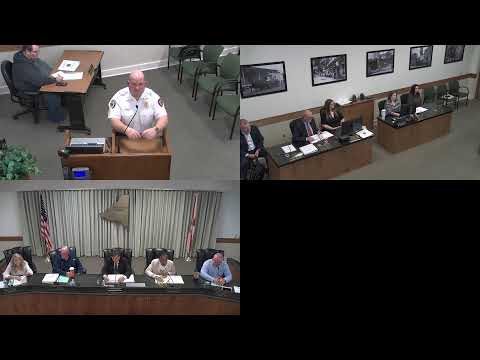
Chief Carter, chief of Bradford County Fire Rescue, presented operational data and a proposed fire-assessment model at a public workshop, including a 50% scenario that would charge $167 per residential dwelling, $0.11 per square foot for nonresidential property and $47 for vacant non-agricultural parcels.
Chief Carter, chief of Bradford County Fire Rescue, presented operational data and a proposed fire-assessment model at a county fire-assessment workshop, laying out service levels, funding history and how proposed charges would be applied.
The county consultant nd staff are proposing a 50% assessment scenario that would charge $167 per residential dwelling unit annually, $0.11 per square foot for nonresidential property, and $47 for vacant non-agricultural parcels; churches, government-owned buildings, nonprofits, 100% disabled veterans and households at or below the federal poverty guideline would be exempt. Chief Carter said the county will use the property appraiser—uilding-characteristics field to determine whether a parcel is charged for one or more dwelling units, and described a grievance process (fireassessment@BradfordCountyFL.gov) to request on-site review if a property record misstates a dwelling unit.
Why it matters: County staff framed the assessment as a way to create a reliable revenue source to fund fire and emergency services after the county absorbed volunteer departments and expanded paid operations. Officials and residents discussed tradeoffs including response coverage, insurance-class impacts and affordability.
Carter said the department—urrently averages 9 minutes, 18 seconds for response countywide and that Bradford County falls short of NFPA 1710 benchmarks that many federal grants use as a guideline. He told the board Bradford County recorded 1,223 fire-related calls in 2024 and 7,536 total incidents (about 21 calls per day), including 32 structure fires (one civilian fatality), 22 vehicle fires, 63 brush fires (422 acres) and 259 motor vehicle collisions with 595 patients. Carter reported 74 cardiac arrests in the period with return-of-spontaneous-circulation (ROSC) on 29 of those; he said the county ROSC rate was 39% compared with a 24% state average.
Carter reviewed staffing and equipment: since the department reorganization in 2020 the full-time workforce fell from 59 to 53 employees; one ambulance (the fifth) was taken out of service after a county-wide hiring freeze on March 17, 2022. He said the department recommends hiring three full-time employees to reduce overtime costs caused when shifts are short-staffed. Carter also listed vehicle purchase sources (state EMS matching grant, CARES Act funding, opioid-abatement settlement funds and unit transfers from other county offices) and provided per-vehicle county costs and grant-match amounts.
Officials discussed Insurance Services Office (ISO) classifications and how station placement affects homeowner premiums. Carter showed five-mile station-radius maps and cited a local insurance quote indicating a $400,000 wood-frame dwelling moving from ISO class 5 to class 10 would see an annual premium jump from $6,798.06 to $8,745.38 (a $1,947.32 increase, or 28.6%). He said opening the planned Brooker station would move nearby residents from class 10 to class 5 and therefore lower premiums for those households.
Residents and commissioners pressed on affordability and coverage. Several residents from Brooker and other small communities said they want local stations preserved or opened; some urged keeping volunteer traditions. Kevin Motley, safety-committee chair, urged the county to consider injury and workers'comp costs when weighing staffing, noting national staffing guidance that calls for larger initial attack crews.
Legal and fiscal constraints were discussed. A county legal advisor explained that assessments must follow statutory assessment rules that differ from ad valorem taxation; those rules are designed to tie a property ssessment to the value of service received. County staffer Miss Roden said Bradford County has already maxed nondiscretionary local sales-tax capacity and that an emergency fire-surcharge tax is effectively cost-neutral (requiring millage reductions elsewhere), limiting options for replacing assessment revenue with other local taxes.
Rates, exemptions and the grievance process - Residential: charged per dwelling unit as recorded under "building characteristics" on the property-appraiser record; multi-unit parcels are charged per dwelling. - Nonresidential: assessed per square foot based on building-characteristics square footage. - Vacant land: charged unless classified as agricultural (ag-zoned parcels are exempt by statute). - Exemptions proposed: churches, nonprofit organizations, government-owned buildings, 100% disabled veterans and households at or below the federal poverty guideline (using an existing notarized indigent form reviewed annually). - Grievance: property owners can request review via fireassessment@BradfordCountyFL.gov or the phone number shown in the presentation; staff or the fire marshal will inspect and compare records to on-site conditions.
Budget context: Carter said the combined fire-rescue budget approved in FY2021 was approximately $5.975 million; the current departmental budget is roughly $10 million and includes grant funding and the 2022 state-mandated Medicaid minimum-wage increase that raised base pay to $15 per hour, which Carter said materially increased personnel costs.
Next steps: County staff and the consultant Stantec will return to a public workshop on March 18 at 5:30 p.m.; Carter and staff asked the board and public to submit written questions to the operational email address before the next meeting. Staff also said they will provide example calculations (quarterly billing examples, commercial building examples, and how different assessment-rate scenarios would change general-fund support) at the next workshop.
No formal vote or board action took place at the workshop; the session was for public presentation, questions and direction to staff.