Get Full Government Meeting Transcripts, Videos, & Alerts Forever!
Get email alerts on the Board Governance topic
No spam. Unsubscribe anytime.
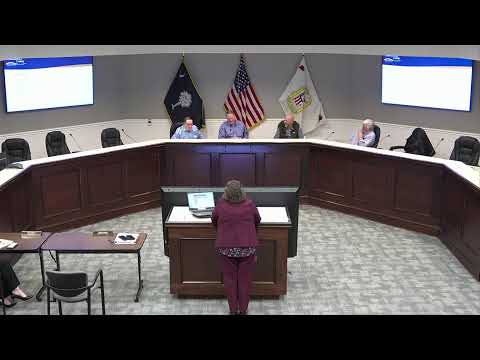
Lancaster County Board of Zoning Appeals elects chair, reviews variance standards and UDO timeline
Summary
At an organizational meeting after the board’s reconstitution, the Lancaster County Board of Zoning Appeals elected Charles Deese as chair, chose Mr. Falconberry as vice chair, approved routine agenda items, and received staff training on variance standards, ex parte communications, recusal rules and the Unified Development Ordinance rewrite.
Charles Deese was chosen as chair of the Lancaster County Board of Zoning Appeals during the board’s organizational meeting, and Mr. Falconberry was named vice chair, after members voted and one nominee withdrew. The board also approved its agenda and minutes and received a staff-led training on variance standards, impartiality, evidence requirements and the ongoing Unified Development Ordinance (UDO) rewrite.
Development services director Allison Harden opened the meeting and corrected a terminology point for the record, saying “these are board members rather than commissioners.” Harden told the reconstituted panel that an ordinance passed in December 2024 reduced the board from seven members to five, that the county council appointed the four members present in January and that one seat remains open. Harden said the board handles special exceptions, appeals of administrative decisions and variances and reviewed where to find those standards in the UDO (chapter 9, including sections 9-2-12 through 9-2-14).
The board handled routine organizational business early in the meeting. A motion to approve the meeting agenda was moved and seconded and carried 4-0. After a discussion and a proposed amendment to the draft minutes of Dec. 3, 2024, the minutes were approved by motion and second. During the chair election, Mr. Alden nominated Mr. Falconberry; that nomination drew a second. Mr. Deese and Mr. Falconberry were later both nominated for chair; the initial vote produced a tie and Mr. Falconberry withdrew his nomination and changed his vote, after which Mr. Deese was declared chair. For vice chair, Mr. Falconberry accepted a nomination that was seconded by Mr. Deese and the floor was closed; he was named vice chair.
Harden led a detailed training for the board on quasi‑judicial procedure and the standards for granting variances. She summarized the statutory framework and the board’s burden to find each of the four required variance criteria: (1) extraordinary and exceptional conditions pertaining to the property, (2) that the conditions are not generally applicable to other property in the vicinity, (3) that strict application of the ordinance would effectively prohibit or unreasonably restrict use of the property, and (4) that authorization of the variance will not substantially harm adjacent property or the public good. Harden emphasized that the applicant bears the burden of providing proof tailored to the specific relief sought and that “when you miss one of the four you don't get the variance.”
The staff presentation covered permissible conditions the board may attach to approvals, prohibitions on use variances and expansions of nonconforming uses, and the difference between popular opinion and admissible, material evidence. Harden told members they must decide on “material, substantial and competent evidence” and gave examples of quantifiable testimony (traffic counts, qualified appraisals, police call statistics) versus unqualified opinions. She also advised that evidence and witnesses must be sworn and that the chair may limit repetitive or immaterial testimony.
Board members also received guidance on ethics and ex parte communications. Harden explained that ex parte contacts are communications about a pending case outside the public hearing and said such contacts should be avoided; personal knowledge may be used if disclosed on the record. Board members were told to consult county counsel or the state ethics commission if they have questions about recusal or conflicts; staff said the county’s Tort Claims Act covers the board generally but that details on individual indemnification would be provided to members.
Harden reviewed the UDO rewrite schedule and staff support: the UDO update began with an assessment in 2021, modules addressing uses and dimensional standards and then signs/parking/landscaping were negotiated, and the administration chapter is next. She told the panel a draft is expected this fall and that staff can produce targeted research or memos when the board identifies recurring issues that warrant code amendments. Harden offered to provide digital copies of materials and to develop a formal process for the board to request staff research if members want one.
The meeting closed after a short period for questions and administrative matters. Staff recorded that the board will continue to receive staff reports and that the council still has one appointment to fill the vacant seat.