Get Full Government Meeting Transcripts, Videos, & Alerts Forever!
Get email alerts on the School Safety topic
No spam. Unsubscribe anytime.
Senate education panel hears teachers, law enforcement on school safety; three bills laid over
Summary
Teachers, sheriffs, SRO leaders and parents testifed before the Minnesota Senate Education Committee on multiple bills on school safety, parental notification and reporting; committee laid all three bills over for possible inclusion.
The Minnesota Senate Education Committee heard more than three hours of testimony on school safety Tuesday, with teachers, sheriff’s deputies, school-resource-officer leaders and parent advocates urging action on parental notice, incident reporting and employee protections.
Allison Gans, a second-grade teacher in Hibbing, told the committee, “Our schools are in trouble, and I’m here to talk to you and just ask you for your help in a listening ear.” Gans described repeated physically violent behaviors in preschool-through-third-grade settings, damaged classroom property, staff injuries requiring medical attention and limits on schools’ ability to respond under current statutes.
Why it matters: committee members said they wanted to balance transparency for families with students’ privacy and the practical burdens on school staff. Law enforcement speakers described dangers they encounter in schools and urged clearer reporting and support; civil-justice and student-advocacy witnesses warned that mandating police reports for many student fights would risk criminalizing children already overrepresented in the juvenile justice system.
The hearing focused on three related Senate bills that were presented and laid over for possible inclusion: Senate File 557 (parental notification requirements in bullying/harassment incidents), Senate File 676 (school incident notices to parents and protections for employees who report), and Senate File 371 (expanded reporting of fights and a requirement to file police reports in cases of intentionally inflicted bodily harm). Each bill was discussed at length and will be revised in consultation with stakeholders before further action.
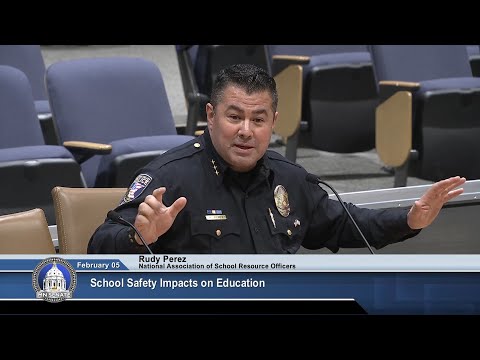
Law enforcement testimony emphasized the role some districts’ school resource officers play in preventing and investigating threats. Wright County Sheriff Sean Deringer said his office assigns 14 SROs covering 59 buildings across 10 districts and that SROs had handled 483 cases so far this school year; over the last three years his office reported more than 4,500 calls for service related to schools. Deringer recounted cases in which SRO investigation located unsecured firearms and identified students who had posted explicit threats online.
Representatives of national and statewide education and restorative-justice groups urged caution about automatic police involvement. Erin Sandsmark of Solutions Not Suspensions and Kulia Pringle, an advocate for families of students of color, said mandatory police reports for fights would escalate criminalization and disproportionately affect Black, Indigenous and disabled students. "This bill would force schools to file a police report based on that incident," Sandsmark said, noting that a preschool or elementary shove that causes a scrape could meet the bill’s threshold without context.
Several teachers and a former Minneapolis high-school teacher who said she lost her job for speaking publicly described a culture in which staff sometimes feel unable to share safety concerns. Becca Thompson, who identified herself as a teacher with 25 years’ experience, said administrators sometimes use student-privacy claims to restrict teacher reporting and that teachers who speak publicly can face retaliation.
School administrators’ associations urged clearer definitions and practical flexibility. Bob Driver, executive director of the Minnesota Association of Secondary School Principals, said the proposed 24-hour notification window in one bill could be difficult to meet in complex investigations, and he asked that principals retain discretion to complete investigations without sacrificing accuracy or due process.
Senators from both parties pressed for working-group solutions. Senator Mary K. Coleman (author of Senate File 676) said she sought sunlight and protections for employees reporting safety concerns. Senator David Limmer (author of Senate File 557) said his bill would require schools to notify parents rather than rely solely on administrator discretion while preserving the existing privacy exception in Minnesota’s data practices law (chapter 13) that allows withholding information if disclosure would not be in a minor’s best interest.
The committee concluded by laying all three files over for possible inclusion and requesting further technical fixes: tighter definitions of “violent activity” or “demonstrable bodily harm,” clarifications on who files police reports and whether one police report can satisfy multiple reporters, and discussion of the 24-hour notification timeline and any associated costs or staffing requirements.
The panel scheduled follow-up work with principals, school districts and law-enforcement representatives to narrow definitions and operational details before the bills return to the committee.