Get Full Government Meeting Transcripts, Videos, & Alerts Forever!
Get email alerts on the Fiscal Notes Paid Leave topic
No spam. Unsubscribe anytime.
Senate Finance panel probes fiscal-note process after DEED actuarial changes to paid-leave estimates
Summary
Senate Finance Committee members pressed the Legislative Budget Office, Department of Employment and Economic Development and Minnesota Management and Budget about communication, baselines and assumptions after actuarial adjustments to the paid family medical leave fiscal note altered first-year premium assumptions used in 2024 estimates.
Chair Marty opened a Senate Finance Committee hearing Feb. 5 on the state fiscal-note process, focusing on fiscal notes produced for proposed changes to the paid family medical leave law enacted in 2023 (chapter 59).
The committee spent most of the hearing questioning the Legislative Budget Office, the Department of Employment and Economic Development and Minnesota Management and Budget about how baseline assumptions were chosen and how significant changes were communicated to legislators. The discussion followed concern raised during a May 10, 2024, Senate Finance hearing about fiscal notes tied to paid leave proposals.
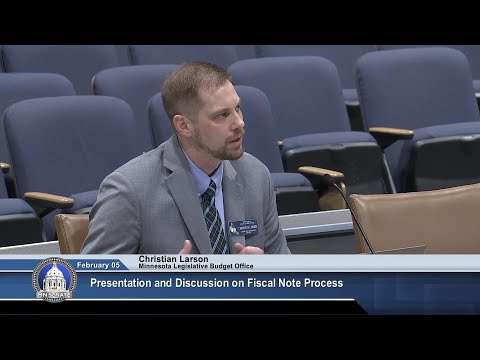
The Legislative Budget Office’s director, Christian Larsen, told the committee that the office and agencies faced three central challenges in preparing fiscal notes for proposed paid-leave changes: establishing an appropriate baseline for comparison, refinements to agency interpretations of the statute (particularly whether the seven-day “qualifying event” generated retroactive pay for those days), and exercise of permissive authority by the agency to adjust the program’s first-year premium rate. “The challenge of the paid leave law, really there’s three things, and it all comes down to really defining baseline,” Larsen said. He noted the program was enacted in 2023 but benefits do not begin until Jan. 1, 2026, which complicated baseline selection.
Larsen described two candidate baselines that created tension: the 2023 enacted budget and an October 2023 actuarial analysis produced under the 2023 law. The actuarial analysis provided two first-year rate scenarios (0.70% as in statute and an alternative 0.78% in the first year), and the LBO and agency discussions ultimately used the actuary’s October 2023 estimates as a working baseline for 2024 fiscal notes. Larsen warned that using the actuarial baseline “doesn’t provide a measure from the 2023 enacted budget,” and that resetting the base can omit the fiscal difference between the prior statutory assumption and the new actuarial assumption from the fiscal-note delta.
Committee members seized on that point. Senator Pratt said legislators must maintain confidence in the LBO’s work and asked whether a working group or other changes were needed to preserve credibility. Larsen proposed several interventions, including earlier and clearer LBO communications about the information required in a fiscal note, more-detailed analysis accompanying complex fiscal notes, and use of existing LBO authority to release an “unapproved” fiscal note when assumptions cannot be agreed. He also suggested the Legislative Budget Office Oversight Commission consider new standards for three cases: when agencies substantially update assumptions used in prior estimates, when substantially complex new programs are proposed and when third-party (actuarial) work is required.
Deputy Commissioner Evan Roe of the Department of Employment and Economic Development (DEED) told senators the agency sought to follow the uniform standards and procedures and appreciated the LBO’s recap. Roe said DEED interpreted statute language governing the first-year premium and permissive adjustment authority in a way that led it to favor the alternative actuarial scenario in its internal application of the law. “My understanding is that the fiscal note is not a tool that...is meant as...announcing policy changes,” Roe said, adding that DEED would work to improve communications with legislators and the LBO.
Anna Mingi, state budget director at Minnesota Management and Budget (MMB), said that because the paid-leave program operates in an enterprise fund rather than the general fund, it was not included in the state’s usual budget-and-economic forecast prior to November 2024. That lack of a published forecast baseline increased the weight placed on the fiscal note to explain assumptions. MMB has begun publishing a twice-yearly statement for the paid-leave fund to clarify the starting point for future discussions.
Senators repeatedly pressed whether the agency had communicated the change in the effective first-year premium assumption—an increase from the statutory 0.70% to an actuarially preferred 0.78%—to committee chairs or authors before the fiscal note was released. DEED and MMB witnesses acknowledged the timing and level of communication were inadequate and said they would seek to improve it. Larsen said that while LBO staff had signed off on the 2024 fiscal note as meeting standards, the office could have provided more analysis or more prominent explanations about how the new baseline differed from the enacted 2023 budget.
Throughout the hearing senators emphasized that fiscal notes should not be the vehicle to disclose substantial assumption changes without prior notice to authors and committee leads. Several senators asked the LBO Oversight Commission to convene a working group to examine whether the uniform standards should be updated to require earlier agency engagement, clearer explanations of baseline selection and additional documentation when actuarial or third-party work informs estimates.
No formal votes or committee actions were taken at the hearing. Committee members concluded by urging better, earlier interagency communication, clearer display of baseline comparisons in fiscal notes (for example, a chart that shows the enacted baseline and the fiscal-note baseline side-by-side), and possible updates to uniform standards to address the kinds of difficulties highlighted by the paid-leave estimates.
Ending: The committee recorded no formal actions; members said they will ask the Legislative Budget Office Oversight Commission to consider next steps, including a potential working group to examine changes to the fiscal-note process.