Get Full Government Meeting Transcripts, Videos, & Alerts Forever!
Get email alerts on the Tax Administration Private Letter Rulings topic
No spam. Unsubscribe anytime.
Committee hears bill to authorize binding private letter rulings from Department of Revenue; department flags timing, cost and staffing concerns
Summary
Senate File 783 would authorize the Minnesota Department of Revenue to issue binding private letter rulings to taxpayers, giving binding guidance on how state tax law applies to particular facts; supporters said it would increase certainty while tax agency witnesses cautioned about timing, staffing and funding.
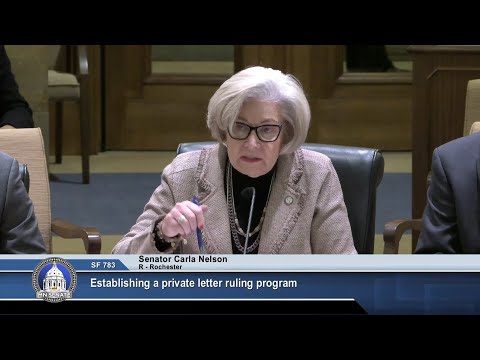
Senate File 783 (A1 amendment adopted) would authorize the Minnesota Department of Revenue to establish and issue private letter rulings (PLRs) — written determinations applying Minnesota tax law to a specific taxpayer’s facts and binding on the department for that taxpayer. Senator Nelson, sponsor of the bill, said the proposal would provide clarity and reduce disputes for taxpayers who seek definitive guidance.
Supporters’ case: Gino Fagnito (Minnesota Society of CPAs) testified in support, saying PLRs would increase certainty and voluntary compliance and align Minnesota with the federal government and most other states. He told the committee private letter rulings, when published in redacted form, can also assist other taxpayers with similar issues. Chris Martin (accounting firm Eide Bailly) gave concrete examples where a PLR could prevent costly audits or litigation involving sales tax on new product-service bundles or structure of a business sale.
Department of Revenue concerns: Melissa Tape (Department of Revenue, Appeals Legal Services and Disclosure) testified that the department would have significant administrative tasks to create a PLR program, warned the Jan. 1, 2026, start date in the draft was likely impracticable, and noted the program would require experienced tax attorneys and sustained funding. Tape said the department already issues guidance (revenue notices, fact/industry guides, classes and extensive phone/email support) and that PLRs tend to benefit more-complex taxpayers able to pay for a professional request; she warned the bill contained no appropriation for the start-up and ongoing staff costs and that fee revenue likely would not cover required staffing at experienced-attorney salary levels. She testified, “The date by which the proposal requires the program to be established, which is 01/01/2026, is not practicable.”
Committee discussion and differing perspectives: Sponsor and supporters emphasized Minnesota is one of very few states without a PLR-style program and argued the bill would increase transparency and reduce litigation. Department witnesses and staff described a spectrum of PLR programs across states: some states maintain robust published PLR systems; others have limited or discretionary programs; some neighboring states give full discretion to the tax commissioner on whether to respond. Committee members asked about precedential effect, appealability, data redaction and how other states fund and staff such programs; department staff agreed to provide additional detail on neighboring-state programs and to assist with drafting realistic timelines and fee schedules.
Outcome and next steps: The A1 author’s amendment was adopted by voice vote; the bill was laid over for further consideration and staff follow-up on fiscal, timing and data-practice issues.