Get Full Government Meeting Transcripts, Videos, & Alerts Forever!
Get email alerts on the Energy Assistance Summer Liheap topic
No spam. Unsubscribe anytime.
Committee hears bill to extend energy-assistance year‑round; author’s amendment adopted
Summary
The Senate Energy, Utilities, Environment and Climate Committee heard testimony on a proposal to create a supplemental energy assistance program that would extend LIHEAP‑style grants into the summer months, aiming to prevent utility shutoffs and provide cooling assistance for vulnerable Minnesotans.
The Senate Energy, Utilities, Environment and Climate Committee heard testimony on a proposal to create a supplemental energy assistance program that would extend Low Income Home Energy Assistance Program (LIHEAP)‑style grants into the summer months, aiming to prevent utility shutoffs and provide cooling assistance for vulnerable Minnesotans.
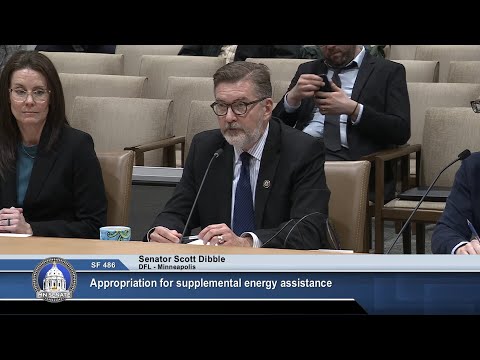
Senator Scott Dibble, the bill’s chief author, told the committee that Senate File 486 would “create [a] energy assistance program administered by the department of commerce as an adjunct or a complimentary energy assistance effort, to what we know as LIHEAP, the Low Income Home Energy Assistance Program.” He said the bill would provide both crisis grants for households facing imminent shutoff and ongoing monthly grants for households with persistent need.
The bill uses LIHEAP’s current infrastructure, eligibility and procedures as a model, according to Dibble. He described the program’s priority as expanding the number of households served rather than increasing individual grant sizes and said the proposal would allow funds to be accepted throughout the year and used until exhausted.
Advocates and utility representatives told the committee the need is large and growing. Annie Levinson Falk, executive director of the Citizens Utility Board of Minnesota, said many Minnesotans face high energy burden and that “in 2024, more than 91,000 Minnesota households were disconnected for nonpayment.” She and other witnesses said shutoffs peak in summer months after cold‑weather protections expire and that cooling is a serious health need.
Amanda Mackey, executive director of Minnesota Valley Action Council (a Community Action Program agency), described operational strain on local service providers and said year‑round funding would allow agencies to retain staff through the summer rather than lay off temporary workers after the winter LIHEAP season. She recounted a client whose life improved after receiving crisis assistance and additional referrals provided through CAP services.
Minnesota Department of Commerce staff described the existing delivery network and oversight. Michael Schmitz, director of the Energy Assistance Program at the Department of Commerce, said the state currently works with 28 local service providers (primarily community action agencies), five tribal governments, one county government and one other nonprofit to administer energy assistance through a centralized system that pays utilities directly and supports annual audits and desk monitoring.
The A2 “delete‑everything” author’s amendment was offered and adopted by voice vote during the hearing. The amendment, as discussed in committee, reorganizes the bill’s provisions and includes program details and appropriation‑style language in the amendment text. Committee discussion focused on several administrative provisions in the A2 language, including an allowance in the amendment for administrative/reimbursement percentages: a 10 percent administrative allocation to local service providers, a 2.5 percent management allowance for the Department of Commerce, and a 5 percent allotment for outreach contracts, each of which drew questions from committee members about scale and oversight.
Committee members raised oversight and fraud‑prevention questions and asked for more detail on administration and fiscal scale. Senator Andrew Matthews and others pressed CAP agencies and Commerce staff on verification, monitoring and the rationale for the administrative percentages. Ms. Mackey described a two‑person front‑end verification process at her agency and said Commerce monitors providers annually. Mr. Schmitz described the centralized EHEAP database, baked‑in eligibility controls, annual audits of service providers and ongoing desk monitoring and data analysis for anomalies.
Testimony emphasized the policy goal: provide year‑round, LIHEAP‑style support to reduce summer disconnections, protect health during heat events and relieve high energy burden in rural Minnesota. Witnesses from cooperatives, municipal utilities and large energy companies expressed support for the supplemental funding as a way to reduce disconnects and uncollectibles and to smooth demand for assistance throughout the year.
Committee action: the A2 amendment was adopted by voice vote; the bill was laid over for possible inclusion in future work. Senator Dibble and testifiers said they expect to continue work with the committee on appropriation levels, oversight language and definitions of outreach and administration before further action.