Get Full Government Meeting Transcripts, Videos, & Alerts Forever!
Get email alerts on the Immigration Funding topic
No spam. Unsubscribe anytime.
House Republican lawmakers introduce bills to bar taxpayer funding for undocumented immigrants and to require local cooperation with federal immigration agents
Summary
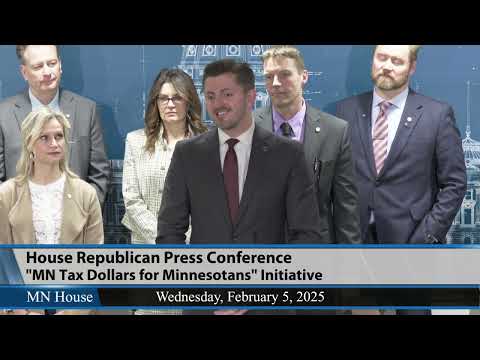
Minnesota House Republicans on Thursday announced two priority bills: one to block state taxpayer dollars for undocumented immigrants and another to require local officials to report suspected violent offenders who are undocumented to federal immigration authorities.
ST. PAUL — Minnesota House Republicans on Thursday introduced and previewed two priority bills aimed at restricting state support for undocumented immigrants and increasing cooperation between local authorities and federal immigration enforcement.
Representative Isaac Schultz, who represents House District 10B, said the first bill he plans to reintroduce (earlier filed this session as House File 10) would “preclude any taxpayer dollars from going to support illegal immigrants in Minnesota.” Schultz framed the proposal around family budgets, saying the state must “prioritize the finite amount of resources that we have in our state and to focus on the true needs of taxpayers.”
Representative Max Reimer, who represents District 28B, described a second bill he introduced as House File 16. Reimer said it would require suspected violent offenders who are undocumented to be reported to ICE or another federal immigration authority “as defined by code 624.172 subdivision 5,” and would bar local governments from withholding information from federal immigration authorities. “In essence, this ends the practice of sanctuary cities,” Reimer said.
Why it matters: Republicans framed the bills as fiscal and public-safety measures. Schultz and other Republican lawmakers at the event said the state previously ran a large budget surplus and that recent tax and spending increases have left Minnesota taxpayers strained. Schultz cited a projection—discussed during prior legislative debate—that extending medical-assistance eligibility to undocumented immigrants could cost “around $200,000,000,” and said the broader set of state services provided to undocumented immigrants could total “hundreds of millions of dollars.” He said the bill’s “umbrella approach language” would cover multiple programs, not only the North Star Promise or MinnesotaCare/medical assistance.
Scope and limits described by sponsors: Reimer said the bill targets undocumented immigrants who are suspected of committing violent crimes and seeks cooperation with federal authorities. When asked about penalties for local officials who fail to share information, Reimer said the exact penalties would depend on the underlying criminal statutes and that details could be provided later. Schultz said his bill addresses state funds; other lawmakers at the event suggested companion measures could affect local decisions.
Questions and context raised at the event: A reporter asked where the $200 million estimate came from; Schultz said it was provided during earlier floor debate but that he did not have a single source document to cite at the news conference. Lawmakers said counties such as Hennepin County had used property-tax revenue and, they asserted, FEMA emergency assistance to fund housing for undocumented immigrants; representatives said those practices raised questions about local taxpayers bearing costs if federal emergency funds expire.
Related remarks: Representative Elliot Engen (District 36A) said the Minnesota attorney general had signaled resistance to cooperating with federal immigration enforcement and that lawmakers were considering legal avenues in response. Several freshman Republican members introduced themselves at the event, including Scott Van Vinsbergen (Montevideo area), Cal Warwitz (Iron Range), Jimmy Gordon (District 28A) and others who expressed support for the introduced measures.
What was not decided: Sponsors described the bills as priorities for the coming legislative session but did not present text that had passed either chamber. No formal motions, committee referrals, or votes were recorded at the event. Several details the sponsors discussed—cost estimates, penalty structures, and the bills’ precise interactions with existing state eligibility rules—were described as subject to further definition or data collection.
Ending: Sponsors said they expect to pursue the measures during the legislative session and to provide additional details and legal language as bills move through committees.