Get Full Government Meeting Transcripts, Videos, & Alerts Forever!
Get email alerts on the Municipal Transportation Funding topic
No spam. Unsubscribe anytime.
Senate committee hears bill to bar local cost shares on MnDOT projects; Senate File 285 laid on table
Summary
Lawmakers and city officials told the Senate Transportation Committee that Minnesota’s current MnDOT cost‑participation policies shift large, sometimes unexpected bills onto municipal budgets. Senators heard testimony from mayors, engineers and associations; the committee laid Senate File 285 on the table for further work.
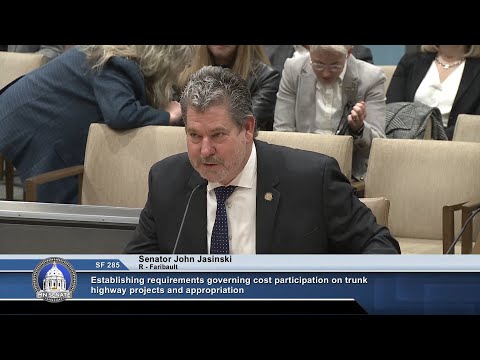
Senate Transportation Committee members on Feb. 5 heard more than two hours of testimony supporting Senate File 285, a bill that would prevent local municipalities from paying MnDOT-required cost participation on state highway projects.
The bill’s sponsor, Senator Nick Jasinski, introduced the measure and turned the hearing over to Chair Senator Dibble for questions and testimony. The committee heard from mayors, city engineers and local government associations who said current policy places disproportionate financial burdens on cities.
Mary Supple, mayor of the city of Richfield, testified on behalf of the League of Minnesota Cities and described the impact on that city’s budget. “Current state highway cost share policies as implemented result in a 1 size fits all approach, which fails to consider the financial capacities of local agencies to pay for regional projects and can consume the finances or debt capacities of communities who largely have no say in the construction timing or design of these projects,” Supple said. She told the committee that from 2003 to 2023 Richfield spent 66% ($17,900,000) of its municipal state aid (MSA) allotments on projects to rebuild or rehabilitate roads it does not own, 22% ($5,900,000) on one underpass project, and left about 12% ($3,400,000) for local MSA maintenance over that period.
Justin Femright, Public Works Director and Chief Engineer for Elk River and a member of the City Engineers Association of Minnesota executive committee, said the association has tracked the reallocation of state aid into regional projects. “Over the last 10 years, statewide, nearly 20% of the state aid dollars that are intended to go to the cities and and work on our streets have been reallocated and adjusted to state projects and county projects, through these, cost participation policies,” Femright said, urging legislators to consider the cities’ fiscal constraints when shaping policy.
Retired Faribault city administrator Tim Murray, who previously served as a city engineer, told the committee he supports the bill and called the present policy “unfair.” Murray also raised the municipal consent statute (Minn. Stat. § 161.163) as an area that merits review, saying municipalities in practice have little ability to stop projects they did not request when MnDOT deems them necessary for safety or capacity.
Small‑city advocates said the cash flow and billing practices add a further burden. Cap O’Rourke, executive director of the Minnesota Association of Small Cities, cited a Minnesota Department of Transportation letter to Baudette that revised an estimated local share from $2.3 million to $3.3 million and warned the city it would soon receive an invoice. O’Rourke said some small cities are required to place the full estimated local share into an account held by MnDOT and earn no interest while the project proceeds.
Speakers from Roseau described a separate, ongoing local example: an initial estimated local share of about $400,000 was reduced to $180,000 under a pilot program, then rose again after bids were opened to about $254,000. Todd Peterson, community development coordinator for the city of Roseau, said a future project could carry a local share in the high six figures and represent a majority of the city’s tax levy.
Support for the bill was broad among witnesses who testified: municipal officials, the City Engineers Association, the Minnesota Association of Small Cities, and representatives from Minneapolis. Testifiers urged a reexamination of MnDOT’s cost‑participation policy and better protections for municipal budgets and municipal consent processes.
After testimony and questions from senators, the committee did not adopt the bill. Committee leadership said more work was needed with stakeholders. “So, we’ll continue to work on this. I assume we wanna keep working on this, lay it on the table for now,” Chair Dibble said during the meeting. The committee then laid Senate File 285 on the table with no final vote recorded.
For now the bill remains in committee and sponsors said they will keep working with MnDOT, county engineers and cities to refine policy and consider pilot programs and statutory changes.