Get Full Government Meeting Transcripts, Videos, & Alerts Forever!
Get email alerts on the School Budget topic
No spam. Unsubscribe anytime.
Waunakee budget committee narrows deficit, discusses multi‑year plan to rebuild fund balance
Summary
District finance staff presented updated enrollment, staffing and spending data, said a 4.5% compensation assumption for 2025–26 nearly eliminates next year’s projected deficit, and asked the board to set a long‑term goal for fund balance and contingency funding.
At a February meeting of the Waunakee Community School District budget committee, district finance staff reviewed updated enrollment and staffing charts, a compensation assumption that reduced next year’s projected deficit to roughly $18,000, and options for a multi‑year plan to restore the district’s fund balance.
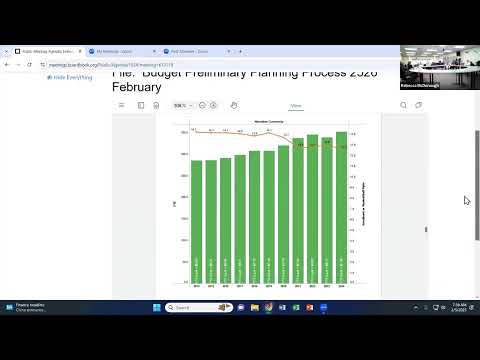
The presentation, led by Ali, district finance staff member, included student demographic trends, open‑enrollment flows, teacher counts and per‑student spending compared with peer districts in Dane County. "We're moving along the budget planning timeline," Ali said while describing the updated document and the new student data included since January. The committee was asked whether it wants administration to develop a long‑term path for contingency and fund balance targets.
Finance staff said they modeled a July 1 Consumer Price Index assumption of 2.95% and used a 4.5% compensation assumption for 2025–26 and 4% for 2026–27. "Putting the 4 and a half percent in brought our deficit to pretty much 0 for next year," Ali said. Steve, a district finance staff member, told the committee the administration now lists five priority categories that could be addressed over time: post‑employment benefits, termination benefits, increasing contingency, health insurance volatility and maintenance funding.
Why it matters: the district’s board policy target for fund balance is 15%. Finance staff said Waunakee’s fund‑balance percentage is low compared with peer districts and that meeting a 15% target would require setting aside roughly $621,000 in contingency today (staff characterized that as simple math comparing the current fund 10 budget and the 15% goal). "If fund balance was the priority, we would not have hired those 4 teachers," Steve said, explaining the tradeoffs between current investments and long‑term reserves.
Discussion and tradeoffs dominated the meeting. Dr. Brown, identified in the transcript as "Doctor Brown" and introduced by staff as leading a board workshop next week, framed the choice as one of governance and pace: "My mantra is to do nothing is is unacceptable unless you tell us not to do it," she said, urging the board to give direction if it wants administration to pursue a funded multi‑year plan. Jack, a committee member, asked for modeling that links different fund‑balance targets to potential bond rating and interest‑rate effects.
Staff noted other details the board asked to see: comparisons of staffing and enrollment with peer districts, breakdowns of teacher versus support staff growth, and clarity on health‑insurance and salary contingency assumptions. Per‑student spending in fund 10 was shown at about $13,006.79 for Waunakee compared with an average of roughly $14,467 among peer districts; staff said Waunakee is on the lower end of per‑pupil spending in the comparison group.
The committee did not take a new formal budget vote at this meeting. Staff said they will bring refined charts and fund‑balance scenarios to the board workshop next week and to the budget committee in March so the board can decide a timeframe (for example, three, five or ten years) and whether to amend the fund‑balance policy to reflect an explicit annual contribution schedule.
Ending: Finance staff will return with the enrollment comparisons and sample multi‑year scenarios; Dr. Brown will lead a related workshop with the full board next week and the administration plans to present final 2025–26 planning materials at the March meeting.