Get Full Government Meeting Transcripts, Videos, & Alerts Forever!
Get email alerts on the Public Health Vector Control topic
No spam. Unsubscribe anytime.
Marin–Sonoma Mosquito & Vector Control outlines 2024 results, warns of invasive Aedes species
Summary
District manager Peter Bonkert told the Corte Madera Town Council the district handled 6,200 service requests in 2024, reported zero West Nile virus locally, and is preparing for the possible arrival of disease‑carrying Aedes mosquitoes.
The Marin–Sonoma Mosquito and Vector Control District told the Corte Madera Town Council on Feb. 4 that it recorded no West Nile virus in Marin or Sonoma counties in 2024 but is preparing for new threats, including the invasive Aedes species that spread dengue and other viruses.
The update came during a presentation by District Manager Peter Bonkert, who described the district’s integrated approach to surveillance and control and summarized last year’s work. "In 2024, we had no West Nile virus in either Marin or Sonoma County," Bonkert said.
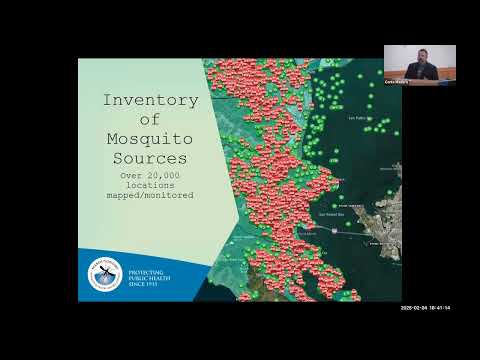
The district covers about 2,300 square miles and roughly 763,000 residents; Bonkert said staff mapped about 25,000 inspection locations and responded to about 6,200 service requests in 2024. The district reported removing roughly 2,500 in‑ground yellow‑jacket nests, carrying out about 400 rodent inspections and delivering nearly 300 classroom presentations that reached about 7,000 students.
Nut graf: The presentation emphasized ongoing surveillance, targeted biological controls and public education as the foundation of local mosquito control, while flagging the arrival of Aedes aegypti and Aedes albopictus elsewhere in California as a near‑term risk that may require expanded monitoring and new control tools.
Bonkert described the district’s toolbox of tactics under an "integrated vector management" framework: larval surveillance and targeted treatments, deployment of mosquito fish in compatible habitats, yellow‑jacket nest removal for ground nesting colonies, rodent inspections and public education. He said the chemical products the district uses are targeted and have long environmental safety records; he named BTI and methoprene as commonly used agents in certain situations.
The district also described laboratory and surveillance work: staff identified about 45,000 mosquitoes from roughly 6,000 trap nights in 2024, and perform larval and species identification to direct control efforts. The district said it tracks tick populations and tests for Borrelia burgdorferi (Lyme disease) and Borrelia miyamotoi, and reminded residents that nymphal stage ticks (very small) pose the greatest risk for human transmission.
Bonkert warned that Aedes aegypti and Aedes albopictus have been moving north in California and now occur in nearby counties. "If those mosquitoes become entrenched and you have a travel case of those diseases, they can be transmitted locally," he said, referencing recent locally acquired dengue cases in Southern California.
The district noted it is exploring new tools, including low‑cost 3D‑printed traps developed in‑house and several sterile‑insect or sterility‑based approaches being tested elsewhere in the state for Aedes control. Bonkert said these techniques may become operational in the next three to five years, though not necessarily in Marin–Sonoma immediately.
Council members asked how the town could help. Bonkert recommended involving the district early in planning and permit reviews for projects that might create standing water or other mosquito habitat, so engineering and design can reduce future mosquito breeding. Town staff also emphasized that the district’s services are funded through property taxes and are available to residents at no additional charge.
Ending: No action was required; the council thanked the district for the briefing and for its outreach to Corte Madera residents.