Get Full Government Meeting Transcripts, Videos, & Alerts Forever!
Get email alerts on the Law Enforcement Workforce topic
No spam. Unsubscribe anytime.
Police associations press Minnesota committee for recruitment, pension and discipline changes
Summary
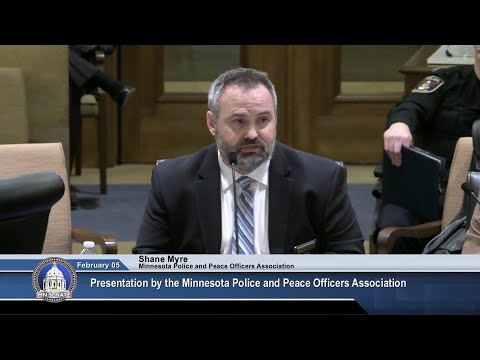
Shane Myrie, president of the Minnesota Police and Peace Officers Association and a detective with the Hennepin County Sheriff’s Office, and Jay Henthorn, chief of police in Richfield and second vice president of the Minnesota Chiefs of Police Association, told the Judiciary and Public Safety Committee on Feb. 5 that Minnesota is facing a worsening recruitment and retention crisis in policing and outlined legislative priorities to address it.
Shane Myrie, president of the Minnesota Police and Peace Officers Association and a detective with the Hennepin County Sheriff’s Office, and Jay Henthorn, chief of police in Richfield and second vice president of the Minnesota Chiefs of Police Association, told the Judiciary and Public Safety Committee on Feb. 5 that Minnesota is facing a worsening recruitment and retention crisis in policing and outlined legislative priorities to address it.
The two organizations urged lawmakers to consider a mix of funding, statutory changes and administrative fixes to stabilize staffing and improve officer retention. Myrie said MPPOA membership survey data show “80% of our membership responses indicated that members are unlikely or very unlikely to recommend the profession to a family member,” and described what he called “a structural imbalance in our law enforcement career life cycle.”
The groups framed the problem around three stages: recruiting, retention and retirement. Myrie cited recent Minnesota POST licensing totals — 706 licenses granted in 2022, 670 in 2023 and 623 in 2024 — and said there are roughly 140 agencies statewide hiring and “around a thousand peace officers short” statewide. He also told senators that Minnesota has “over 10,000 licensed peace officers” and more than 2,000 officers eligible for retirement in the next few years; he said the combined police and fire pension plan has more retirees than active members.
To address recruiting and retention, MPPOA proposed several measures that would require legislative action or appropriation: state college tuition reimbursement for dependents of active POST‑licensed peace officers modeled on Nebraska’s First Responder Pledge; expanded pathway and intensive POST training grants; retiree health‑care coverage for local officers similar to what some state law enforcement retirees receive; and increasing the police/first‑responder pension cost‑of‑living adjustment from 1% to 1.5% or to a CPI‑linked sliding scale. Myrie said PERA advised the association that the pension fund itself “cannot sustain that increase” and that MPPOA will be seeking money outside the fund to provide parity.
On discipline and grievance processes, MPPOA asked the committee to revisit a 2020 change at the Bureau of Mediation Services that created a limited roster of arbitrators who receive law‑enforcement‑specific training and are restricted to hearing police discipline matters. Myrie argued that the roster has produced limited arbitration experience and said MPPOA would like to revert to the earlier practice that allowed arbitrators wider case exposure so they develop broader arbitration skills. He added a request for a statewide standard for Brady/Giglio disclosure procedures that would spell out notice, challenge rights and limits on unilateral termination tied to a Brady designation.
Both groups asked the Legislature to increase penalties for fleeing a peace officer in a motor vehicle and to add an intermediate tier for dangerous driving that falls between a simple flee and cases that cause great bodily harm or death. MPPOA described proposed additions such as criminalizing driving onto sidewalks, through parks or the wrong way on interstates during a flight from police. Senator Carlson pressed for evidence of an increase in driveaways; Myrie and Henthorn said fleeing incidents and pursuits have risen in many jurisdictions and acknowledged legal and procedural hurdles to tracking vehicles and proving who was driving.
Jay Henthorn described the Minnesota Chiefs of Police Association’s separate but overlapping priorities. The MCPA is launching a statewide accreditation program that it says will take agencies about 12 to 18 months to complete, followed by an annual renewal. Henthorn also asked the Legislature to restore and fund the Philando Castile POST training appropriation at $6 million to support ongoing training requirements, particularly for departments in Greater Minnesota.
Henthorn cited public safety statistics in his testimony: 2,262 agency‑initiated pursuits in 2023, and 15,612 vehicles stolen in 2023 (an increase the group described as roughly 30% from 2019’s 11,410). He also told the committee that assaults on officers increased, citing MCPA figures of 1,206 police assaults in 2023 versus 467 in 2019. “We would like to see the renewal of the Philando Castile post board training money, funding to a $6,000,000 appropriation to keep the training funds ongoing,” Henthorn said.
Committee members questioned specifics and next steps. Senator Crook asked whether MPPOA’s count of arbitration awards (five posted decisions since the roster change) reflected an annual total or a cumulative posting; Myrie said those were awards posted on the Bureau of Mediation Services website since the roster change and that many discipline cases never proceed to arbitration. Senator Pappas asked whether the fund could sustain a higher COLA; Myrie said the increase would require state dollars outside the pension fund. Senator Carlson and others pressed on evidence and policy responses to fleeing and vehicle tracking. Senators and presenters repeatedly encouraged consultation with the Bureau of Mediation Services and other stakeholders before drafting statutory language.
The committee paused at the end of the panel to discuss scheduling for a separate Department of Human Rights presentation later in the week; members noted conflicts for a planned Friday noon virtual hearing and asked staff to explore alternate times.
The presenters said they would continue to refine bills and engage with the Judiciary and Public Safety Committee and other committees as the 2025 session advances.